How to Write a Radio Script: Templates for Every Part of Your Show
A radio script is the written plan for everything that happens in your show — what you say, what plays, and when — and learning how to write a radio script is the fastest way to sound prepared without sounding like you are reading.
This guide is for volunteer presenters and DJs at community radio stations, church broadcasts, school stations and diaspora shows who want their radio show to run smoothly every week. You will get a one-hour rundown you can copy, a radio script template for every talk break, and a simple way to rehearse before you go live.
What a Radio Script Is (and How Much to Write)
The first decision in how to write a radio script is how much to put on paper. Not every show needs every word written down. Most radio scripts fall into one of three levels:
| Script level | What it contains | Best for |
|---|---|---|
| Rundown | Every element of the show in order, with start times and durations | Every show, as the base layer |
| Semi-script | Key points for each talk break, plus exact wording for the open and the close | Most music and talk shows |
| Full script | Every word, read word-for-word | Sponsor reads, announcements, anything with exact facts |
For most presenters, a semi-script is the right balance. It keeps you on track while leaving room to ad-lib, improvise and let your personality come through. Write the full text only where accuracy matters, such as a sponsor’s offer or an event date. A music radio script is mostly cues and short links. A talk radio script needs more detail on topics and questions, but bullet points still work better than paragraphs.
Start With a One-Hour Rundown
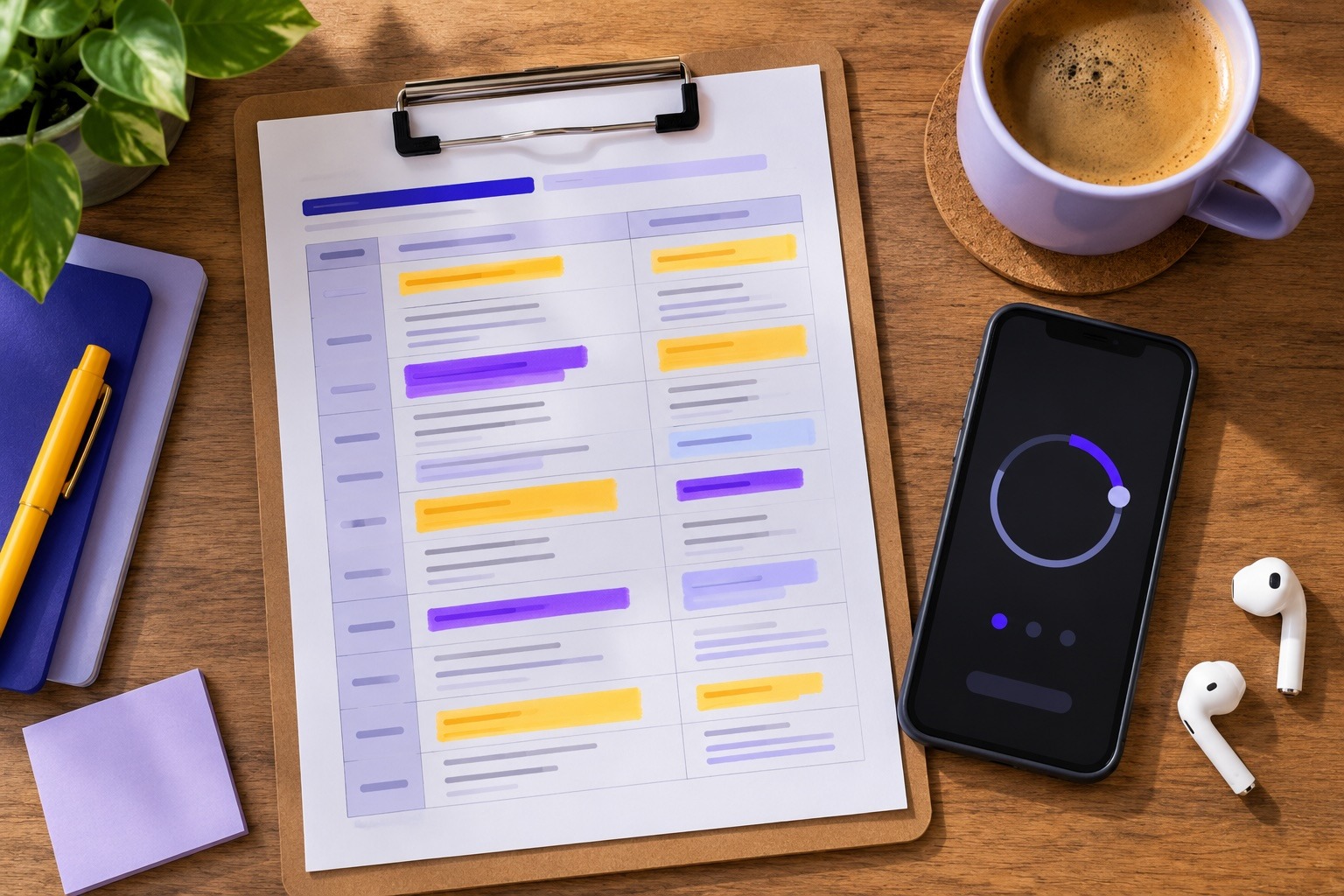
The rundown is the backbone of your radio show script and the first step of your show prep. It lists every element in order, so you always know what comes next and never face dead air while you search for the next track. If your station follows a 24/7 programming schedule, the rundown is your hour inside it.
| Minute | Segment | Duration | Notes |
|---|---|---|---|
| :00 | Top of the hour: station ID and show open | 1 min | Jingle, greeting, what’s coming up |
| :01 | Music block 1 | 12 min | Three songs from your rotation |
| :13 | Talk break 1 | 2 min | Back-announce, one story, tease the guest |
| :15 | Music block 2 | 10 min | |
| :25 | Sponsor read | 1 min | Full script, read word-for-word |
| :26 | Guest interview, part 1 | 8 min | Guest introduction plus three questions |
| :34 | Music block 3 | 10 min | |
| :44 | Guest interview, part 2 | 6 min | Listener questions, thank the guest |
| :50 | Music block 4 | 7 min | |
| :57 | Sign-off and outro | 2 min | Thanks, next show, call to action |
| :59 | Station ID or sweeper | 1 min | Hands off to the next hour |
Adjust the music blocks to fit your music rotation and write real start times in the first column. Keep the rundown printed or on a second screen, and tick off each segment as it plays.
Radio Script Templates for Every Talk Break
These templates are the practical side of how to write a radio script. Each radio script template uses [brackets] for the parts you fill in and a target duration in parentheses. Keep one idea per talk break: listeners tune in and out, and a single clear point is easier to follow than three half-finished ones.
The Show Open (about 45 seconds)
| PLAY: Intro jingle or station ID
HOST: Good [morning/evening], you’re listening to [Show Name] on [Station Name]. I’m [Your Name]. HOST: This hour we’ve got [main feature], plus [guest or segment] at [time]. HOST: Let’s start with [Artist] and [Song]. PLAY: First song |
Your open is a hook. Tell listeners what they will get this hour in one sentence, then start the music. A short music bed under your voice gives the open energy, and our guide to station IDs and jingles covers how to produce them.
Song Links: Back-Announce, Front-Announce and Tease (30 to 60 seconds)
A song link connects two songs in three parts: the back-announce (what just played), one piece of content, and the front-announce or tease (what comes next).
| HOST: That was [Song] by [Artist].
HOST: [One fact, short story, community notice or listener message.] HOST: Coming up after [Artist]: [tease the guest, the contest or the next segment]. PLAY: Next song |
Put the song title at the end of the sentence, right before the music starts. Listeners remember the last thing they hear.
The Sponsor Read (30 seconds)
The sponsor read is the one segment you should write as a full script, because a business is paying for that wording. If you are still building your list of supporters, start with our guide to help you find sponsors for your station.
| HOST: [Show Name] is brought to you by [Sponsor], [what they do] in [neighborhood or city].
HOST: [One specific offer or reason to visit.] HOST: Find them at [address, website or phone number]. |
Read contact details slowly and repeat them once if your sponsor agrees. The wording should match what you promised in your radio media kit.
The Guest Introduction (about 45 seconds)
| HOST: My guest today is [Full Name] [pronunciation note for yourself].
HOST: [One sentence on who they are and why it matters to your listeners.] HOST: [First name], welcome. [First open-ended question.] |
Check the pronunciation of your guest’s name before the show and write it phonetically in your script. Prepare five or six questions and expect to use three. Our tips on how to interview guests cover question writing in depth, and if listeners will join in, see how to take live calls.
The Sign-Off (about 45 seconds)
| HOST: That’s all for [Show Name] today. Thanks to [guest] and to [sponsor].
HOST: Join me again [day and time] for [next show’s feature]. HOST: [One call to action: follow the station, send a message or share the show.] PLAY: Outro jingle or station ID |
Give one call to action, not five. A single clear request is the one listeners act on.
How to Write for the Ear
A script is written to be heard once, at the speed you speak. Picture one listener from your target audience and write to them. Writing for the ear means:
- Write the way you talk. Use contractions such as “you’re” and “we’ll”, and keep a conversational tone.
- Use short sentences. If you run out of breath reading a line aloud, split it in two.
- Prefer active voice: “The choir recorded this last Sunday,” not “This was recorded by the choir.”
- Round numbers and simplify what is hard to say. “About three hundred people” is easier to follow than “297”.
- Read aloud every draft. Your ear catches what your eye misses, and the script will sound natural on air.
If you host a bilingual show, write both languages in the script instead of translating on air. Live translation slows your pacing and weakens both versions.
Rehearse and Time Your Script

Rehearse each talk break with a stopwatch and note its real timing next to the target duration. First drafts usually run long, so cut words rather than speaking faster. Mark every cue (music, jingle, sponsor read) in bold so you can find it at a glance.
When you work with a co-host or producer, keep everyone on the same document so the cue sheet is shared. Our guide on how to co-host remotely shows how to keep two voices in sync.
Turn Scripted Breaks Into Voice Tracks
Once your talk breaks are written, you don’t have to deliver them as a live broadcast. You can record each break as a short audio file and let AutoDJ play it between songs, a method called radio voice tracking. It lets a presenter cover a slot they can’t attend in person, and the script is what keeps each pre-recorded break sounding fresh.
Record each break separately and name the files by show and position, for example “SundayShow_break-02”, so they play in the right order.
Radio Script FAQ
How long should a radio script be?
For a music-led one-hour show, the script covers only the talk breaks: a few short lines each. A talk show needs more, but still in outline form. Time yourself reading it aloud rather than counting words.
Should I write every word?
Only for sponsor reads, announcements and anything with exact names, dates or figures. For everything else, key points work better, because reading word-for-word makes most presenters sound stiff. Rehearse until the key points are enough.
How do co-hosts share one radio show script?
Use one shared document with each host’s lines labeled by name, and agree in advance who leads each transition. Mark the hand-offs in the rundown so nobody talks over the other.
A good radio script is short, written for the ear and built on a rundown you trust. Now that you know how to write a radio script, start with the one-hour template, fill in one talk break at a time, and when you are ready to keep your station on air between live shows, explore Zeno.FM automation.
October 26, 2026