How to Start a Haitian Radio Station Online: A Practical Guide for Kreyòl Broadcasters
Maybe you grew up with konpa on the radio every Saturday night and the morning news in Kreyòl playing in the kitchen before school. Maybe you now live in Brooklyn, Miami, Boston or Montreal, where news from home and community events still travel mostly through phone calls and WhatsApp messages. Starting a Haitian radio station online is how you give those conversations a home that anyone can tune in to, wherever they live.
The challenge is that a Haitian station has to serve a community spread across several cities and countries, with listeners who switch between Kreyòl, French and English and who expect much more than a playlist. Haitian radio has always been about voices: hosts who comment on the news, callers who share their opinion, pastors, DJs and community leaders. That is why a station that only plays music on repeat rarely keeps this audience for long.
In this guide, we walk through the decisions that make a Haitian internet radio station work, in the order you will make them: defining your voice and your audience, building a music library that sounds Haitian, programming the day, setting up live talk and call-in shows, checking music licensing and growing your community. By the end, you will have a clear plan for a station your listeners will recognize as their own from the first broadcast.
Why Haitian Communities Turn to Internet Radio
Before planning shows, it helps to understand why internet radio fits the Haitian diaspora so well, because that explains what your listeners will expect from you.
In Haiti, radio is part of daily life: it is where people hear the news, follow debates and discover new music. Families abroad kept that habit, but local FM stations in their new cities rarely broadcast in Kreyòl. An online radio station removes that limit. Your stream reaches a listener in Little Haiti on a phone, a relative in Port-au-Prince over a mobile data signal and a family in Montreal on a smart speaker, all on the same live broadcast. In practice, one station can reconnect a community that distance has split apart.
Define Your Station’s Voice and Audience
Once you know why your listeners come to radio, the next step is deciding which of them you want to serve first.
“Haitian radio” can describe very different stations. A news and talk station run by a journalist in Brooklyn has little in common with a gospel station run by a church in Miami, or with a konpa station run by a DJ who plays weddings on weekends. Each one needs different hosts and a different schedule, so choosing one main focus makes every later decision easier.
Language is the second decision. Most Haitian stations broadcast mainly in Kreyòl, use French for some news or religious content and add English segments to reach the generation born abroad. A bilingual station can work very well, as long as listeners know which language to expect in each show. The table below summarizes the most common station types and what each one usually broadcasts.
| Station type | Who usually runs it | Core programming |
|---|---|---|
| News and talk | Journalists, community leaders | Morning news in Kreyòl, debates, call-in shows |
| Konpa and music | DJs, music lovers | Konpa classics, new releases, live DJ mixes |
| Gospel and church | Churches, ministries | Worship services, Kreyòl gospel, prayer and teaching |
| Youth and bilingual | Young creators born abroad | Rap kreyòl, Caribbean hits, shows in English and Kreyòl |
| Community and variety | Associations, cultural groups | News, music, culture and local announcements |
Build a Music Library That Sounds Haitian
With your focus defined, the music library is what gives your station its sound between live shows, so it deserves careful planning.
Konpa is the backbone of most Haitian music stations, but a library built only on konpa quickly sounds repetitive. Mix the generations: the classic bands that parents danced to, the konpa love songs that still fill every party and the newer artists that younger listeners follow. Around that core, add the styles that give Haitian radio its texture: mizik rasin with its traditional drums, twoubadou acoustic songs, rara during carnival season, Kreyòl gospel for Sunday mornings and rap kreyòl for the evening shows. Caribbean neighbors such as zouk also fit naturally.
Before uploading, use consistent artist and song names, keep the correct Kreyòl spelling and remove duplicates, because your radio metadata is what listeners see on the player and in apps. Then organize the library into playlists such as current hits, classics, gospel and rasin, so you can build a music rotation that repeats your best songs often enough without wearing them out. From there, AutoDJ plays those playlists and keeps the station on air 24/7 whenever no host is live.
Program a Day That Sounds Like Haitian Radio
A good library keeps the station running, but your schedule is what turns it into a daily habit for your listeners.
Start from your listeners’ routine: news and conversation in Kreyòl in the morning while people get ready for work, music and community announcements during the day, and konpa and DJ mixes in the evening. Weekends follow their own rhythm, with dancing on Saturday night and worship on Sunday morning. If your audience lives in several time zones, place your flagship live shows when most of them can listen and replay them later.
Here is a simple weekly grid you can adapt to your station:
| Time of day | Weekdays | Weekend |
|---|---|---|
| Morning | News and talk in Kreyòl | Sunday worship service and gospel |
| Midday | Music with community announcements | Konpa classics |
| Afternoon | Call-in show or cultural program | Youth show in Kreyòl and English |
| Evening | Konpa and new releases | Saturday night live DJ party |
| Overnight | AutoDJ music rotation | AutoDJ music rotation |
For a complete method to fill every hour, see our guide to building a 24/7 radio programming schedule.

Set Up Live Talk and Call-In Shows
Talk is what sets Haitian radio apart from a simple playlist, so your live shows deserve a setup that sounds clean and reliable.
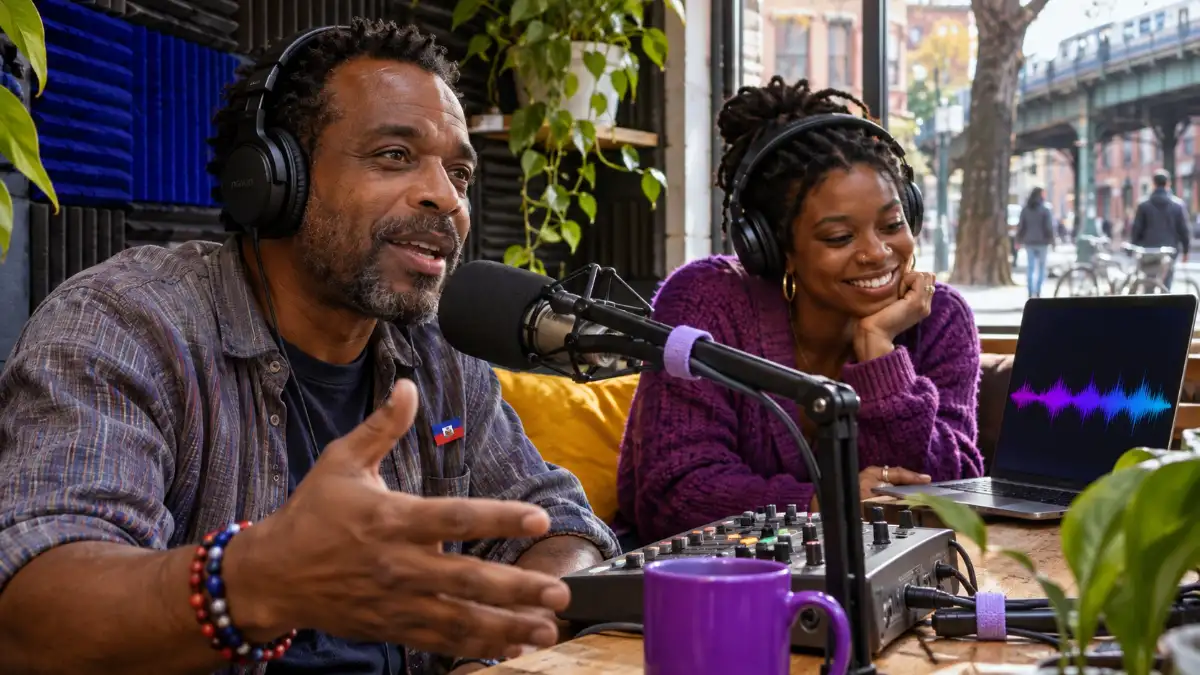
The basic signal chain is simple. Your microphone goes into a small mixer or USB audio interface, the interface connects to your computer, and a free encoder such as BUTT sends that audio signal to your station on Zeno. When the encoder connects, AutoDJ stops automatically, and it resumes when you disconnect, so the music comes back on its own after your show. Our step-by-step BUTT guide covers every setting, and a spare room or a corner of a church office is enough space for the whole studio.
A normal broadcast day might look like this: the host arrives half an hour early, checks the microphone and headphones, prepares the headlines from trusted community sources and opens the phone lines. During the show, callers react to the news, a correspondent joins remotely to report from Haiti and the host closes with announcements from local churches and associations. To bring callers on air without echo, follow our guide to taking live calls on internet radio, and if your co-host or correspondent is in another city, see how to co-host a radio show remotely.
Set clear rules for callers from day one: lively debate is part of Haitian radio culture, and respectful moderation keeps it that way.
Music Licensing: What to Check Before You Go On Air
Before your first konpa song goes out on the stream, you need to know who manages music rights in the country you broadcast from.
Music by Haitian artists is protected by copyright like any other music, and playing it on internet radio usually requires licenses. In the United States, public performance rights for songs are managed by ASCAP, BMI and SESAC, while digital performance rights for sound recordings are handled by SoundExchange. If your station operates from another country, the organizations and rules are different, so check them before launch. This article is not legal advice; for an overview of how licensing works, read our music licensing guide for internet radio.
Grow Your Haitian Community Audience
Once the station sounds right, growth comes from the same places where your community already gathers.
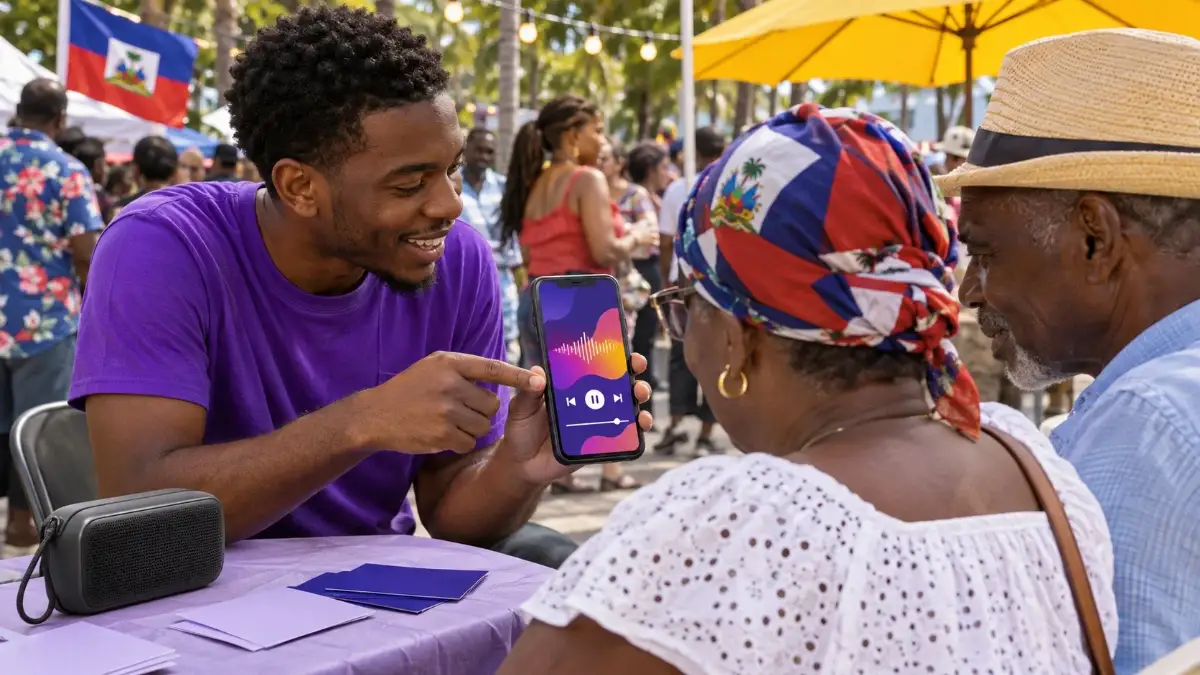
Start with the networks your listeners already trust. Share the stream link in the WhatsApp groups of families, churches and hometown associations, and announce each live show there; our WhatsApp guide for radio stations explains how to do it without spamming. Visit churches, restaurants and community events with a card that shows how to tune in, and invite local pastors, artists and business owners as guests, since each one brings their own followers.
As the audience grows, think about the second generation. Many young Haitians abroad understand Kreyòl but feel more comfortable in English, and a youth show that mixes both languages keeps them connected to the station. Our guide to building a bilingual radio station for diaspora communities covers that approach.
Frequently Asked Questions
Can I start a Haitian radio station from home?
Yes. A computer, a good microphone, headphones, a stable internet connection and a streaming platform are enough to start. You can add a mixer, a second microphone and more live shows as your audience grows.
Should my station broadcast in Kreyòl, French or English?
Kreyòl is usually the main language, since it is the one all Haitians share. Many stations add French for some news or religious content and English for younger listeners born abroad.
Can listeners in Haiti hear my station?
Yes. An internet radio station can be heard anywhere with a data connection, on a phone, a computer or a smart speaker.
Your Haitian Radio Station Starts With One Clear Voice
A Haitian radio station that lasts is built on a few clear decisions: a defined focus and language, a music library that covers every generation, a schedule that follows your listeners’ day, live talk shows with real callers, licensing checked before launch and a community that hears its own voice on air.
When you’re ready, create your station on Zeno and put your first show on air. If you’re starting from scratch, our guide to starting an online radio station walks you through every step.
November 18, 2026