Radio Interview Tips: How to Interview Guests on Your Show
A strong guest can carry an entire hour of programming. A weak one sends listeners to another station in ninety seconds. The difference is rarely talent, and it is almost always preparation. These radio interview tips cover the full cycle: choosing guests your audience wants to hear, preparing questions that produce real answers, running the conversation on air, and reusing the recording once the show is over. Everything here works for a community station, a church broadcast, a music show, or a one-person internet radio station.
Choose guests your listeners actually want to hear
Relevance beats fame. A well-known name who has nothing to do with your programming will not keep anyone listening, while a local voice with a real story will. For a small station, the best guests are usually close to home: business owners, teachers, coaches, nonprofit organizers, pastors, city officials, and musicians already in your rotation. They are easier to book, and most of them bring their own community with them.
Before you invite anyone, listen to them speak for two minutes. If they have been interviewed before, find that audio. If they have not, ask for a short voice note answering one simple question. Some people who write brilliantly are unlistenable on air, and it is better to learn that in advance than at minute three of a live segment.
Keep the invitation short and concrete. Include:
- The station name and the show they would appear on
- The topic, and one line on why you thought of them
- The date, the time, and how long the segment will run
- Whether it is live or recorded in advance
- How they will join: in studio, by phone, or online
- Anything you need from them beforehand, such as a photo or a track to play
Prepare before the guest goes on air
Give yourself twenty to thirty minutes of research per guest and look for one specific detail: a project they finished, a decision they had to make, a problem they solved. That single detail is what separates an interview from a questionnaire, because it gives you somewhere to start that your guest has not been asked about ten times already.
Write your questions as bullets, never as full sentences you plan to read aloud. Listeners can hear reading. Keep a short spine of anchor questions that must be covered, and let everything else come from the answers. Make each one open-ended: anything that can be answered with yes or no will be.
| Segment length | Anchor questions | What to prepare |
|---|---|---|
| 8 to 12 minutes | 3 | One angle and one takeaway. No background detours. |
| 20 to 25 minutes | 5 or 6 | One angle, two supporting stories, and a closing question. |
| 30 minutes or more | 8 to 10 | Split the interview into blocks separated by music or breaks. |
Then call the guest for five to ten minutes a day or two before the show. This pre-interview is not a rehearsal of the answers. You are agreeing on the format, the length, and the moment they go on air, and you are finding out what they are not willing to discuss. Guests who know exactly what is coming relax, and relaxed guests give better answers.
Run the interview on air
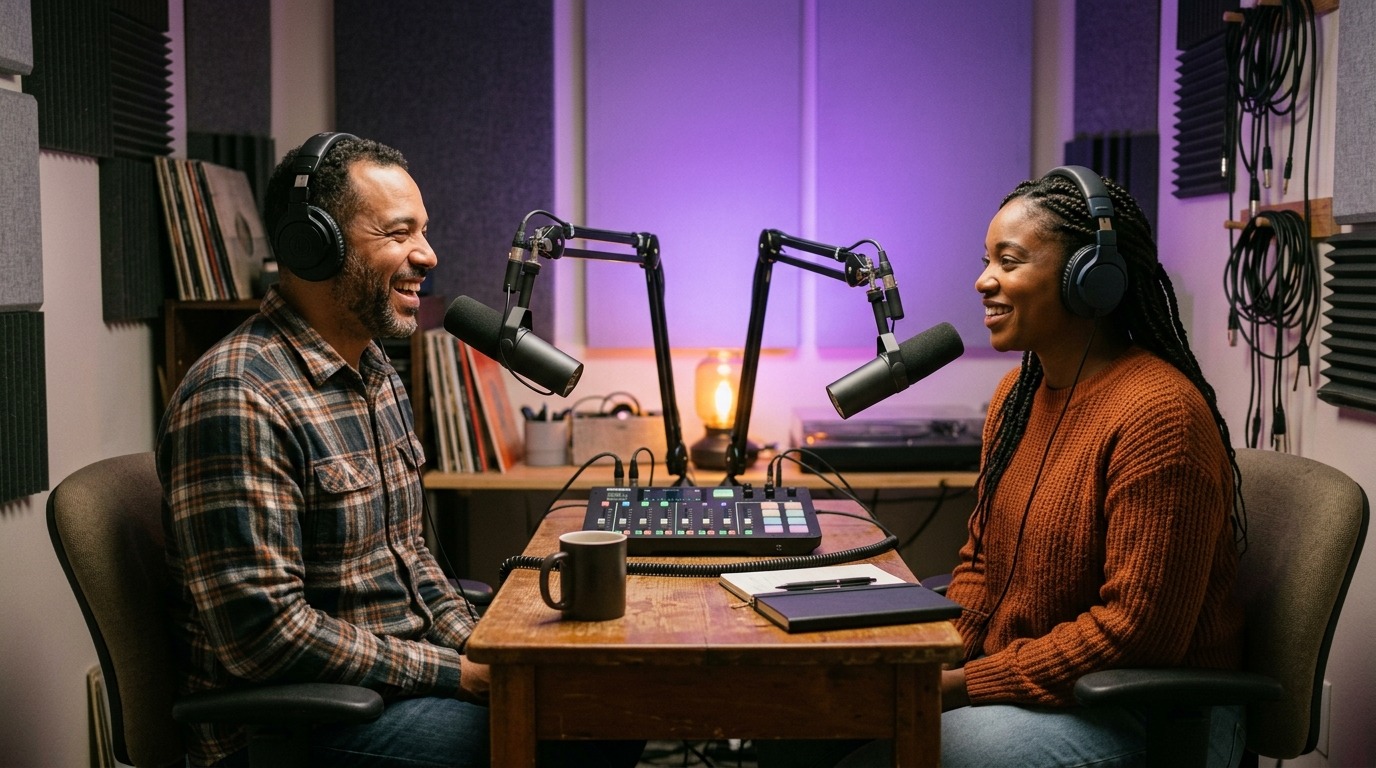
Set levels before anything else. Your guest needs their own microphone, positioned roughly a hand’s width from their mouth, and headphones if the show is remote so they do not talk over you. Skip the usual microphone test and ask them a real question instead, such as what they had for breakfast. You get a clean level at conversational volume, and they hear their own voice sounding good, which settles most nerves on the spot.
Once you are on air, put the question sheet down and listen. The best follow-up is almost never the next bullet on your list, it is the thing they just said and did not finish explaining. When an answer comes back in three words, do not repeat the question louder. Ask for the scene instead: walk me through the first time you tried that, or what did the room sound like that night. Concrete prompts get concrete answers.
Watch the clock the whole time and prepare your exit line in advance, so you can close cleanly instead of cutting your guest off mid-sentence. If they freeze, drop to an easy factual question, let them recover, and bridge back to the topic. For remote guests, ask them to sit in a carpeted room with the door closed, and keep a music bed ready in case the connection drops.
Reuse the interview after the show
A good interview is the most reusable content your station produces, and most small stations let it disappear the moment the show ends. Plan the second life of the audio before you record it:
Publish it as an on-demand episode. A single interview becomes a full podcast episode with almost no extra work. See podcast automation for how to turn a live show into a published episode.
Cut a thirty to sixty second highlight. That clip becomes a promo for the rest of the week, and it slots into your station imaging alongside your IDs and sweepers.
Schedule a replay. A strong interview deserves a second airing in a different daypart, which you can set up with voice tracking so the repeat still sounds current.
Send the audio to your guest. They will share it with their own audience, which is one of the cheapest ways to grow your station.
Finally, label the file with the guest name, the topic, and the show. An archive you cannot search is an archive you will never use again.
Frequently asked questions
How long should a radio interview be?
Eight to twelve minutes is enough for a single clear point, and twenty to twenty-five minutes suits a guest with a story to tell. Anything longer works only if you break it into blocks separated by music or a break, because attention on a live stream drops faster than in a recorded podcast.
Should I send the questions in advance?
Send the topics, not the exact wording. Guests need to know which areas you will cover so they can prepare examples, but a word-for-word list invites rehearsed answers that sound flat on air. If a guest insists on the full list, send it and plan your follow-ups to go beyond it.
What if my guest gives one-word answers?
Change the shape of the question. Ask them to describe a moment rather than give an opinion: what happened first, who else was in the room, what they decided to do next. If two or three attempts do not open them up, thank them, close the segment early, and go back to music. A short interview that works beats a long one that does not.
Ready to put your next interview on air? Start streaming with Zeno.FM and give your show the reach it deserves.
September 21, 2026