Internet Radio Blanket License: Beginner’s Guide to Broadcasting Legally
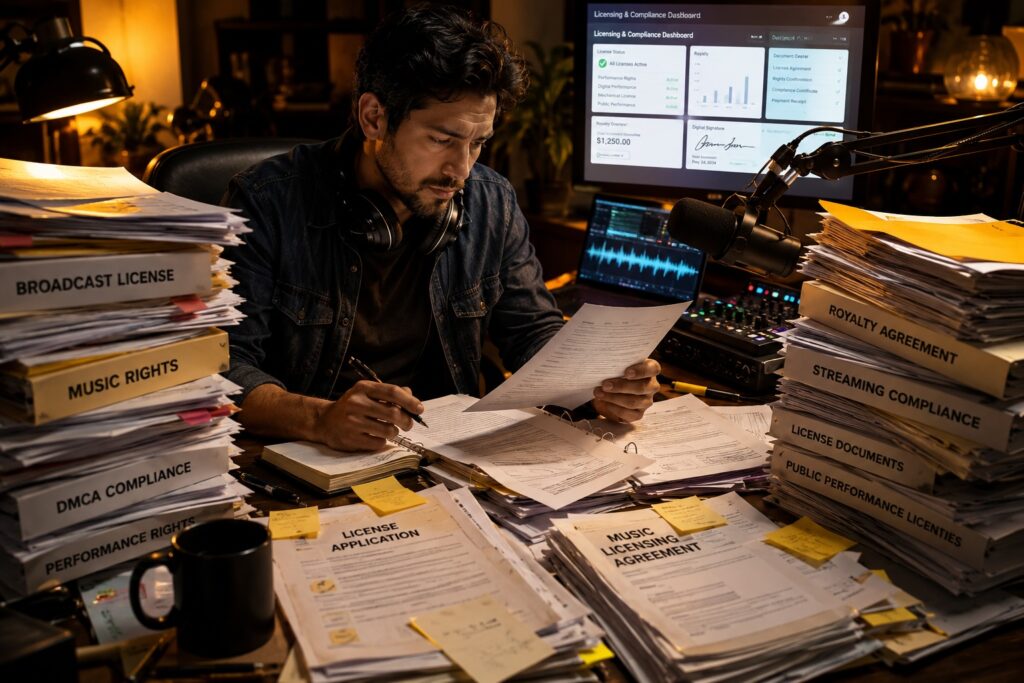
Starting an online radio station is a thrill. You’ve got the playlist, the personality, and the passion. But then comes the “L” word: Licensing
This guide is for beginners starting an internet radio station who want to understand music licensing requirements. If you’re wondering how to get an internet radio blanket license, this guide will walk you through the essentials. We cover the basics of internet radio blanket licenses, legal requirements, and practical steps to broadcast music legally online.
Many beginners freeze up here. Do you need a government permit? Will you get sued for playing a Top 40 hit? Can you just use your personal Spotify account?
The short answer: Broadcasting is different from personal listening. To stay legal, you need to understand how music rights work in the digital age. Owning a copy of a song does not grant you the right to broadcast it; internet radio stations need separate performance licenses obtained through a performance rights organization (PRO) to legally broadcast copyrighted music.
This guide breaks down everything you need to know to keep your station compliant and your focus on the music.
Why Do You Need a License for Internet Radio?
When you buy a song on iTunes or stream it on Spotify, you are getting private listening access, not a separate performance right for broadcasting. This means you can listen to it in your car, your house, or your headphones, but owning or accessing a song does not let an internet station play copyrighted music legally.
Broadcasting is a “public performance.” Because you are transmitting that audio to an audience, the songwriters, performers, and record labels are legally entitled to royalties. In the USA, PROs such as ASCAP, BMI, SESAC, and GMR license the underlying lyrics and melody for composers and publishers, while SoundExchange covers sound recordings. Without the proper licenses, you risk legal issues such as:
-
Hefty fines from copyright holders.
-
Your stream is being “blacklisted” or shut down.
-
Legal action from Performance Rights Organizations (PROs).
Internet radio stations need separate performance licenses obtained through a performance rights organization (PRO) to legally broadcast copyrighted music, as owning a copy of a song does not grant broadcasting rights.
Now that you understand why licensing is necessary, let’s explore the main types of licenses you’ll encounter.
The 3 Main Types of Licenses You’ll Encounter
Navigating the legal landscape is easier when you know which “buckets” the fees fall into.
1. Performance Rights (The “Big Three”)
These cover the “composition” (the lyrics and notes). In the US, these are managed by ASCAP, BMI, and SESAC. In the UK, it’s PRS. These organisations collect license fees on behalf of composers and publishers, track reported use, and distribute royalties as each body collects royalties for performances it covers. Most countries have their own equivalent organizations.
2. Digital Performance Royalties
This is specific to webcasting. In the US, an internet radio station pays SoundExchange for these digital performance royalties to performers and record labels, and for non-interactive services this often operates under a statutory license; ASCAP, BMI, and SESAC still handle the separate public performance rights side. Those U.S. webcasting licenses also come with strict “sound recording performance complement” rules tied to DMCA-style limits on how tracks can be programmed.
3. Blanket Licenses
A blanket license allows internet radio stations to play any type of copyrighted music without needing individual licenses for each song, simplifying the licensing process. Most internet radio stations opt for a blanket license, which allows them to play a wide range of music under a single annual fee, simplifying the licensing process. Internet radio stations typically require a blanket license to legally broadcast copyrighted music, which allows them to play a wide range of music without needing individual licenses for each song.
This is the “Golden Ticket” for beginners: a blanket license lets an internet radio station legally play a massive catalog of copyrighted music without getting individual licenses for each song, making it easier to choose the right license for the station’s format and distribution. Most licenses are paid annually, with costs varying by your home country and the countries you intend to reach within the permitted coverage area. It’s especially useful for diverse programming because it avoids licensing individual tracks one by one, unlike royalty-free music licenses, which usually require only a one-time payment. A blanket license is particularly beneficial for stations with diverse programming, as it provides comprehensive legal coverage with minimal administrative hassle.
With an understanding of the main license types, let’s move on to the practical steps for broadcasting legally.
How to Broadcast Legally: A Step-by-Step Approach
Follow these steps to ensure your internet radio station is compliant with music licensing laws:
Step 1: Identify Your Copyrighted Music Content
-
If you are running a Talk Radio station with 100% original speech, you generally don’t need a music license.
-
If you use jingles, intro music, or other station branding elements for intros and transitions, that music must be royalty-free or licensed, and original music can also work if you control the rights; music is only truly free to use when both the composition and recording are in the public domain.
-
If your station offers downloadable segments or podcasts, you may also need mechanical licenses, and using radio station automation software can help schedule compliant content around the clock.
Step 2: Choose Your Region
-
Licensing is geographic. If you are based in the US, you follow US laws (DMCA), and bodies such as the fcc sit alongside copyright rules even though music rights are handled by licensing organizations rather than the FCC alone. If you are in the UK, you look at PPL/PRS, while in Canada internet radio licensing is managed by SOCAN and Re:Sound.
-
Most internet radio licenses in your home country can cover international listeners, but check the fine print of your specific agreement to see where listener access is permitted in other countries.
-
Note: most blanket licenses are paid annually, and the cost can vary based on the country of broadcasting and the countries your station streams to; for example, Hungarian internet radio stations pay approximately 95 EUR monthly for licenses.
Step 3: Use a “Hosted” Solution vs. Going Independent
-
Independent: You contact ASCAP, BMI, and SoundExchange yourself. This is expensive, because you may need to pay music licensing fees directly, and to legally operate this way you must also manage the reporting system required by the relevant bodies, including Reports of Use, real-time song data shown to listeners, and play-history records; legal compliance is dependent on accurate metadata being submitted, so many broadcasters pair this with professional streaming plans for online radio that simplify the technical side.
-
Hosted Platform: Some platforms include licensing in their packages, making it a “plug-and-play” experience for beginners, and can also reduce the administrative burden for licensed internet radio stations that want less hands-on compliance work by using an online radio streaming platform built for broadcasters.
Once you’ve mapped out your licensing approach, it’s important to avoid common pitfalls that trip up new broadcasters.
Common Beginner Mistakes to Avoid
Common Beginner Mistakes to Avoid
-
Playing from Spotify/Apple Music: It is a violation of their Terms of Service to broadcast their stream.
-
A standard online-use license may not cover broadcast on traditional radio or tv, so stations should confirm their rights before airing music there.
-
Assuming “Fair Use” covers you: “Fair Use” rarely applies to full songs played on a radio station.
-
Licensing can still be limited even when music seems freely available online.
-
Ignoring the DMCA: In the US, the Digital Millennium Copyright Act has rules about how many songs by the same artist you can play in a row.
-
Uploading shows to youtube or repurposing them as podcasts may require separate music permissions.
Now that you know what to avoid, let’s look at how Zeno Streaming can help you navigate music licensing.
How to Navigate Music Licensing When Broadcasting with Zeno Streaming
If you’re feeling overwhelmed by the legalities, you aren’t alone. Most creators just want to play music, not sort out royalty spreadsheets or know when consulting a licensing professional makes sense.
Zeno.fm helps streamline the technical side of this process, though it’s important to understand where coverage begins and ends:
-
Zeno.fm Microsite Coverage: When you stream directly via the zeno.fm website, your broadcast is covered under Zeno’s existing agreements with ASCAP, BMI, and SESAC in the United States. This is a massive head start for new broadcasters.
-
External Platforms: If you plan to broadcast on your own independent website, your own custom mobile app, or via other aggregators and third-party platforms, you are responsible for obtaining the necessary music licenses for your specific country. For many internet-only setups, that means several licenses or agreements, including PRO coverage for songs and separate SoundExchange coverage for recordings, depending on country.
-
Global Compliance: Because licensing laws vary by territory, we always recommend checking with the licensing bodies in your specific region, since they represent the interests of different rights holders across territories, to ensure you are fully protected. This also applies to many kinds of radio stations, from internet-only streams to broader digital operations.
Check out the Zeno.fm Pricing to see how our tools for streaming podcasting can help you stay professional while you build your legal strategy.
With these tools and knowledge, you’re ready to address the most common questions about internet radio music licensing.
FAQ: Internet Radio Music Licensing
Do I need a music license if I use Zeno.fm?
If you are streaming solely through the zeno.fm portal, Zeno’s agreements with ASCAP, BMI, and SESAC cover you. However, if you embed your player on your own website or launch a standalone app, you must secure your own licenses from the relevant organizations in your country. Most internet radio stations handle this with a blanket license from the relevant PRO, and most licenses are paid as one annual fee covering all music.
How do I know which organization to contact?
Every country has its own regulatory bodies, or licensing organisations, which represent songwriters, composerspublishers; requirements also differ outside the USA (like PPL/PRS in the UK or SOCAN in Canada). We recommend researching the specific music licensing body in your jurisdiction to ensure full compliance.
Can I play music if I don’t make money from the station?
Yes, but even if you do not make money, you still need the right license and may still need to pay applicable royalties or fees for copyrighted music. Performance rights are based on the act of “public performance,” regardless of whether your station is profitable or non-commercial.
Does Zeno’s license cover my custom mobile app?
No. Zeno’s current agreements only extend to content streamed via the Zeno.fm domain. If you are using Zeno to power your own mobile apps, you will need to obtain independent licensing for that platform, even if you build a dedicated radio station mobile app to expand your reach.
How do I get an internet radio blanket license?
Most internet radio stations only need a blanket license from their country’s PRO, which covers all music in one annual fee rather than requiring a license per song, though the cost can depend on royalty rates and other factors such as territory and service scope. To obtain a blanket license, contact the relevant performance rights organization (PRO) in your country (such as ASCAP, BMI, or SESAC in the US; PRS in the UK; or SOCAN in Canada). These licenses are typically paid annually, and the cost can vary depending on your country of broadcast and the countries you intend to reach. In some formats, royalty free music can be a simpler option because it is licensed through purchasing instead of ongoing blanket arrangements. For full legal compliance, internet stations typically need several blanket licenses, including agreements with PROs for songwriters and separate licenses from SoundExchange (or the equivalent in your country) for audio recordings.
With your licensing questions answered, let’s wrap up with why legal compliance is essential for your station’s success.
Conclusion
Staying legal isn’t just about avoiding trouble; it’s about respecting the artists who make your station possible, whether your programming features classic catalog songs or trending tracks. By securing the right internet radio blanket license and understanding music licensing coverage, you build a sustainable foundation for your brand and ensure your online station thrives without legal interruptions. Whether you are just starting out or looking to expand your reach worldwide, having the correct radio licensing in place is essential to protect your broadcast and support the creative community.
Ready to get on air and join the world of internet radio? Explore how Zeno.fm’s comprehensive streaming platform simplifies the entire process—from broadcasting and automation to royalty reporting and licensing management. Our tools help you focus on what really matters: delivering great content to your listeners.
Get started today with Zeno.fm Streaming and take the hassle out of launching and managing your online radio station with professional-grade features and built-in support for music licensing compliance.
May 15, 2026