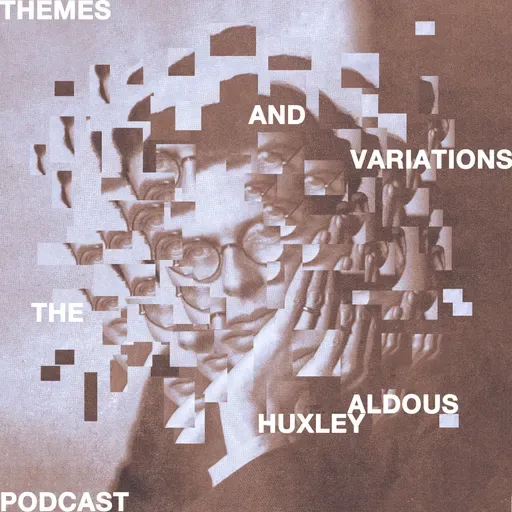
In this episode of Themes and Variations, we explore the topic of pain in Huxley’s work, bringing his literary and philosophical reflections together into dialogue with contemporary neuroscience.
Emily interviews Ryan O’Shea, a PhD researcher at Queen Mary University of London, whose work explores religion and pain in literary modernism. The conversation traces how pain shifts across Huxley’s career—from a social and psychological discomfort in his early satirical novels, to a civilizational problem in Brave New World, and ultimately to a potential site of spiritual insight in his later religious writings. Along the way, Toby and our other guest, Dr Sam Hughes, a Senior Lecturer in Pain Neuroscience, provide a striking confirmation of Huxley’s intuition that suffering cannot be understood solely as a physical sensation.
The episode opens by framing pain as a complex and unstable category: pain can be physical, emotional, psychosomatic, or even “phantom”. Modern pain theory increasingly defines it as a sensory and emotional event, which is also informed by cultural attitudes. This framework illuminates Huxley’s writing, which often blurs bodily suffering, psychological distress and spirituality. In his early satirical novels, Emily notes, pain appears mainly as wounded vanity, jealousy, embarrassment, or social awkwardness, exposing the absurdities of modern intellectual life. By Brave New World, however, pain becomes central to Huxley’s critique of civilization, as a traumatized society attempts to abolish suffering through comfort, pleasure, and technological anaesthesia.
The discussion then situates Huxley among modernists such as Virginia Woolf and E. M. Forster. Drawing on Woolf’s On Being Ill and the argument that pain “destroys language,” Ryan highlights the paradox that pain is both difficult to express and urgently needs to be shared. Huxley’s response is to make pain communicable and intellectually examinable, which we can link to Huxley’s final novel, Island, where naming pain becomes the first step toward healing.
Finally, the conversation explores pain in relation to war, psychology, and religion. In Brave New World, pleasure culture represents an overcorrection after mass trauma. Yet Huxley does not simply valorize suffering: while he becomes increasingly interested in religious mortification, he also warns of its slide into masochism. By the time of The Perennial Philosophy, he seeks to restore a sacred framework for suffering, suggesting that pain can prompt spiritual transformation.
At the heart of this discussion lies a question that feels unmistakably contemporary: what happens to a society that treats all pain as meaningless and all comfort as good? Huxley’s answer, as this episode shows, is not simple asceticism. Rather, it is a warning that a culture devoted entirely to convenience, distraction, and anaesthesia may end by dulling itself intellectually, morally, and spiritually.
Bringing Huxley into dialogue with contemporary neuroscience, Toby and Sam connect Huxley’s ideas to contemporary pain science, virtual reality, chronic pain treatment, environmental psychology, and psychedelic research. The result is one of the podcast’s richest episodes so far: a wide-ranging discussion of pain as biology, culture, theology, politics, and prophecy.
Chronic pain impacts roughly 28 million people in the UK alone, and the emerging approaches discussed in this episode suggest that the future of pain treatment may lie not only in new drugs, but in new ways of understanding consciousness, environment, and the human mind. Remarkably, many of the questions that researchers are now asking were anticipated decades ago in Huxley’s work.
These conversations reveal that, as researchers today develop new therapies for chronic pain (drawing on psychology, environmental design, and even psychedelics) Huxley’s work offers a surprisingly relevant framework for thinking about why pain matters and how it might be transformed. Reading Huxley is not simply an exercise in literary history; it is a way of engaging with ideas that are shaping the future of medicine, psychology, and our understanding of the human mind.
About our guests
Ryan O’Shea is a PhD researcher at Queen Mary University of London, funded by the London Arts and Humanities Partnership. His doctoral project, Sacred and Profane: From Mortification to Masochism in Modernist Writing, examines how early twentieth-century writers represented religious practices of mortification and how these were increasingly interpreted through psychological concepts such as masochism.His research explores the intersections of modernist literature, religion, sexuality, and the sensory experience of pain, drawing on global religious traditions and modernist experimentation in literary form. Alongside his academic work, he is also a writer, editor, and teacher. You can read more about his project here: https://www.lahp.ac.uk/student/ryan-oshea/
Dr Sam Hughes is a Senior Lecturer in Pain Neuroscience at the University of Exeter whose research focuses on how the brain modulates both experimental and clinical pain states. His work examines endogenous analgesic systems in the central nervous system and uses neurophysiological and psychophysical methods to develop new, mechanism-driven therapies for chronic pain. He also leads interdisciplinary research initiatives, including the Exeter Pain Group, which brings together experts in neuroscience, psychology, data science, and clinical medicine to improve understanding and treatment of pain. You can find out more about his work here: https://experts.exeter.ac.uk/39853-sam-hughes
Works Mentioned
By Aldous Huxley
* Brave New World (1932)
* Time Must Have a Stop (1944)
* The Perennial Philosophy (1946)
* Grey Eminence (1941)
* Island (1962)
* The Doors of Perception [and] Heaven & Hell
* Jacob’s Hands
Novels
* Mrs Dalloway by Virginia Woolf
* A Passage to India by E. M. Forster
* On Being Ill by Virginia Woolf
Scholarly works
* Christian Asceticism and Modern Man, translated by Walter Mitchell and the Carisbrooke Dominicans (Blackfriars Publications, 1955)
* Ryan O’Shea, ‘‘the Self which underlies [...] separate individuality’: pain and the transcendence of selfhood in the work of Aldous Huxley’, Postgraduate English: A Journal and Forum for Postgraduates in English, No. 42 (2021), doi: https://postgradenglishjournal.awh.durham.ac.uk/ojs/index.php/pgenglish/article/view/281
This is a public episode. If you would like to discuss this with other subscribers or get access to bonus episodes, visit themesandvariations.substack.com