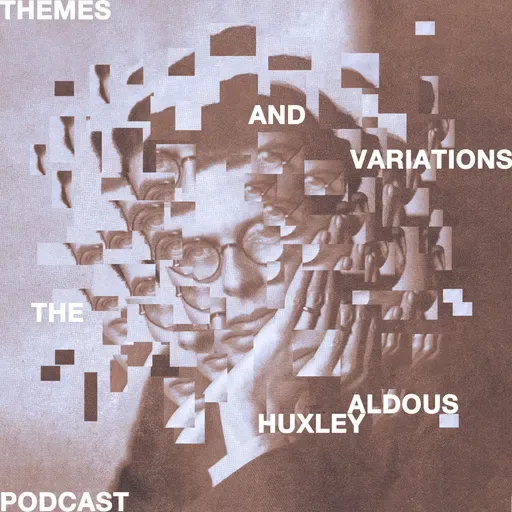
7. Huxley and the Difficulty of Being Good
Themes and Variations: The Aldous Huxley Podcast
In this episode of Themes and Variations, Toby and Robin turn to Grey Eminence, Aldous Huxley’s 1941 historical study of the monk-statesman Father Joseph and the Thirty Years’ War, and use it as a lens for Huxley’s wider philosophy: spirituality versus organised religion, distraction versus consciousness, and why political reform fails without inner transformation.
The central question discussed is one that Huxley posed throughout his career:
Why do sincere, intelligent and even spiritually serious people help produce catastrophic political outcomes?
Father Joseph attempts to bring contemplative spirituality into the centre of power. The result, for Huxley, is the opposite of redemption. Mysticism sharpens his perception and discipline, but those powers are directed toward diplomacy, manipulation, and the prolongation of war.
In their discussion, Toby and Robin explore Huxley’s distinction between two kinds of religion: institutional religion that operates through hierarchy, doctrine, and authority; and mysticism, the direct experience of reality beyond the self.
Huxley would later develop this idea fully in The Perennial Philosophy: genuine religious experience requires the suspension of ideas, identities, and even theology itself. Yet Father Joseph tries to keep both worlds: the contemplative life and the machinery of state. His failure becomes Huxley’s argument that spirituality cannot morally purify power structures. Indeed, large-scale political movements inevitably corrupt spiritual insight. Huxley contrasts this with small voluntary communities such as the Religious Society of Friends, whose relative moral consistency derives precisely from remaining outside power politics.
The discussion connects Grey Eminence to Brave New World through the topic of unconsciousness. Human beings do not become cruel primarily through hatred, but through unconsciousness. Distraction in the forms of appetites, entertainment, ideology, and emotional noise blocks awareness. A society organised around comfort and stimulation (such as the World State in Brave New World) produces obedience more efficiently than tyranny.
Political evil therefore originates in psychology before ideology.
Writing in 1941, Huxley saw the early modern religious wars as prototypes of ideological wars. Nationalism, centralised power, and crowd psychology reappear across centuries. The lesson of Grey Eminence is not historical but anthropological:civilisation collapses when consciousness does.
Political reform without inward change reproduces the same catastrophe under new banners.
In this episode’s speculative segment on ‘What would Huxley think about…?’. Emily and Toby consider Huxley’s recurring interest in bodily discipline: asceticism, self-inflicted pain, and the relationship between sensation and consciousness. In a word, BDSM.
From Father Joseph’s mortifications to John the Savage, bodily suffering can interrupt conditioning and restore autonomy. Yet ritualised suffering can also become another distraction if detached from inner transformation.
Huxley never simply condemns pleasure or sexuality; instead he asks whether experience awakens awareness or numbs it.
Emily and Toby also spend a few minutes reviewing a new piece of Huxley scholarship: Uwe Rasch’s Aldous Huxley and the Enemies of Freedom, which will be the subject of a forthcoming episode.
Works Discussed
* Uwe Rasch, Aldous Huxley and the Enemies of Freedom, available here
* Grey Eminence – https://archive.org/details/greyeminencestud00huxl
* The Perennial Philosophy – https://archive.org/details/perennialphiloso00huxl
* Ends and Means – https://archive.org/details/endsmeansinquiri00huxl
* Brave New World – https://archive.org/details/bravenewworld00huxl
This is a public episode. If you would like to discuss this with other subscribers or get access to bonus episodes, visit themesandvariations.substack.com