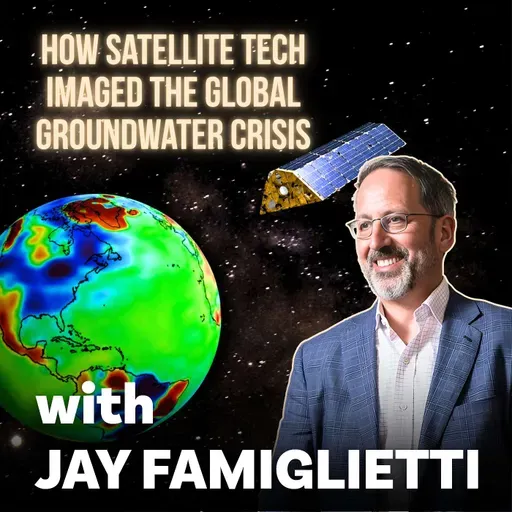
How Satellite Tech Imaged the Global Groundwater Crisis | James (Jay) Famiglietti
The Water Data Podcast
How can a satellite measure water buried deep underground? What can space-based observations tell us about groundwater depletion across the world? And how is this data shaping the future of water policy and governance?
Professor Jay Famiglietti, a leading hydrologist and former NASA scientist, joins host Veena Srinivasan on this episode of the Water Data Podcast to discuss the revolutionary GRACE satellite mission.
Jay is a Global Futures Professor at Arizona State University and is widely known for developing methods to detect groundwater depletion from space. His work has reshaped how scientists and policymakers understand global water systems.
In this episode, Jay and Veena unpack how GRACE measures tiny changes in Earth’s gravity to detect gains and losses in water mass. They explore how this technology has revealed major groundwater depletion hotspots across the world, including India, California, the Middle East, and China.
The conversation also examines the complex relationship between climate change and human water use, and why these forces are deeply intertwined. Finally, they reflect on how satellite data is influencing policy from drought monitoring systems to groundwater governance and what the future holds for global hydrology.
The Water Data Podcast is a talk show on the science, systems, and stories of water, hosted by Veena Srinivasan.
For all references and further readings related to the episode, visit here.
Subscribe to The Water Data Podcast on your favourite podcast app—and catch video episodes on the WELL Labs YouTube channel @welllabs.
Subscription links: Youtube, Apple Podcasts, Spotify, YouTube Music, Amazon Music, Audible, Castbox, and wherever you get your podcasts!
Recording by Vraj Acharya and Nabina Chakraborty. Video editing by Nabina Chakraborty. Graphics and artwork by Aparna Nambiar and Kanishka Goyal. Audio mixing and mastering by Vijay Doiphode. Podcast production and management by Nabina Chakraborty and Pavan Srinath.