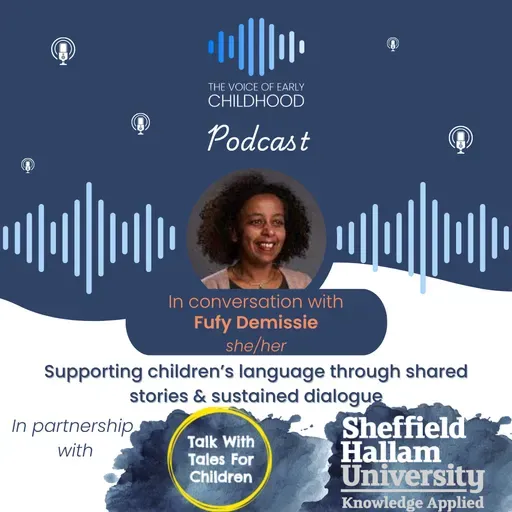
Supporting children's language through shared stories and sustained dialogue
The Voice of Early Childhood
This article explores the TWiTCH (Talk with Tales for Children) programme, outlining its pedagogical foundations and structure, alongside findings from an independent pilot evaluation. It highlights how coach-led professional development and dialogic story practices can strengthen educators' confidence and support children's language, reasoning, and engagement during shared book reading.
Read the article here:
https://thevoiceofearlychildhood.com/supporting-childrens-language-through-shared-stories-and-sustained-dialogue/
This episode is in partnership with TWiTCH and Sheffield Hallam University
To find out more about the TWiTCH programme visit: https://research.shu.ac.uk/twitchefficacytrial/
To take part in the TWiTCH programme, submit an interest form:
https://forms.office.com/e/Rq3pwJGUiT?origin=lprLink
Listen to more:
If you enjoyed this episode, you might also like:
· Helicopter stories: Bringing every child's story to life, with Trisha Lee: https://thevoiceofearlychildhood.com/helicopter-stories-bringing-every-childs-story-to-life/
· Stories that connect us: How books foster belonging in the early years with Laura Henry-Allain: https://thevoiceofearlychildhood.com/stories-that-connect-us-how-books-foster-belonging-in-the-early-years-2/
Get in touch and share your voice:
Do you have thoughts, questions or feedback? Get in touch here! – https://thevoiceofearlychildhood.com/contact/
Episode break down:
00:00 – Welcome and episode overview
00:36 – Guest introduction: Fufy Demissie
00:54 – Fufy's background and experience
01:27 – What is the TWiTCH programme?
02:37 – Origins: language gap and research context
03:11 – Funding, development, and trial expansion
03:55 – What TWiTCH stands for
04:11 – Structure: nine stories across the year
04:46 – Week one: story immersion and strategies
05:36 – Week two: RCRI and reasoning discussions
06:40 – Decontextualised talk and critical thinking
07:25 – Week three: continuous provision and play
08:11 – Embedding vocabulary through practice
08:32 – Repetition of cycle across stories
08:52 – Dialogue, dilemmas, and child engagement
09:30 – Practitioner concerns and outcomes
10:18 – Pedagogical approaches underpinning TWiTCH
10:44 – Use of puppets and modelling language
11:05 – Hanan approach and responsive interaction
12:31 – Importance of repeated reading
13:31 – Educator training and coaching model
14:33 – Coaching visits and reflective practice
15:21 – Practitioner agency and flexibility
16:48 – Programme reach and implementation scale
17:52 – Inclusion of childminders
18:40 – Pilot findings: practitioner confidence
19:36 – Impact on reading and discussion practices
20:05 – Increased confidence in reading aloud
20:46 – Outcomes for children's language development
21:41 – Next steps: large-scale trial
22:36 – Recruitment of settings
23:50 – Trial design and evaluation approach
24:40 – Measuring children's language outcomes
25:52 – Future potential and expansion
27:05 – Key takeaway: value of repetition
28:01 – Final reflections on practice
28:41 – Closing remarks and how to get involved
For more episodes and articles visit The Voice of Early Childhood website: https://www.thevoiceofearlychildhood.com