12 September 2026
CONTENTS OF THE JOHN BATCHELOR SHOW, 9-11-2026 Global Currents: From Mission History to Interstellar Visitors
The John Batchelor Show
About
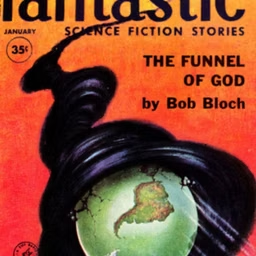
CAPTION JANUARY 1960
CONTENTS OF THE JOHN BATCHELOR SHOW, 9-11-2026
Global Currents: From Mission History to Interstellar Visitors
This broadcast overview explores a diverse range of current events and cultural history, beginning with a look at California's coastal missions and the potential impact of a super El Niño. The narrative transitions into legal and political updates, specifically addressing mail-in ballot validation and the preservation of a historic casino sign in Las Vegas. Economic and geopolitical concerns are highlighted through rising fuel prices and military tensions at Middle Easternshipping choke points. Scientific discussions follow, covering the geological formation of Italy, the growth of commercial space travel, and the study of interstellar comets. Finally, the broadcast highlights a literary biography of George Sand, celebrating her as a groundbreaking French novelist and intellectual.
California History Disasters And Ocean Swells
Jeff Bliss speaks from San Luis Obispo, describing the 1772 Spanish mission built to project military and religious control in early California. Reflecting on the 25th anniversary of 9/11, he recalls being in San Luis Obispo preparing to fly to San Francisco when the attacks occurred, noting how generational memory of the event has shifted over time. Additionally, he discusses the severe damage along the Southern California coastline caused by Hurricane Marie's high heat, humidity, and massive swells that eroded beaches and threatened Amtrak rail lines. Finally, he highlights efforts to restore the iconic Circus Circus clown sign in Las Vegas. (1)
Legal Challenges To Postal Voting Rules
Richard Epstein analyzes the appellate court decision halting the Trump administration's proposed Postal Service mail-in voting rules. Epstein argues that while the government claims postal regulatory authority to combat potential fraud, applying restrictive envelope and documentation requirements acts as a harmful monopoly power over state election procedures. He emphasizes that the Postal Service lacks the necessary equipment, programs, or execution capability to process millions of ballots neutrally before the election, risking widespread voter disqualification. Epstein also criticizes President Trump's campaign promise to distribute $5,000 checks to adult citizens if Republicans win Congress, calling it an unfeasible and populist bribe. (2)Inflation Pressures And Local Pennsylvania Elections
Jim McTague reports on economic and political developments in Lancaster County, Pennsylvania. Rising gas prices—reaching $4.26 at Costco and up to $4.60 elsewhere—alongside diesel exceeding $6 per gallon, are squeezing family budgets and slowing retail activity across the region. Dining out costs have also increased substantially. On the political front, McTague discusses a visit from a campaign canvasser for Republican state representative candidate Tom Jones, who is challenging incumbent Democrat Malone. Notably, the canvasser actively avoided discussing Donald Trump, highlighting how local candidates in this traditionally Republican county are downplaying national party affiliations. (3)
Wines And Cuisine Of Monferrato Italy
Lorenzo Fiori explores the Monferrato region in Piedmont, Italy, highlighting its picturesque landscape of rolling hills, vineyards, and historic villages. He details the region's rich viticultural offerings, including Barbera red wines, Dolcetto, white wines such as Gavi, Cortese, and Arneis, as well as Asti Spumante and Vermouth. Fiori also describes regional culinary specialties, such as agnolotti—stuffed meat pasta served with butter, sage, or roast sauce—alongside beef tartare, truffles, and amaretti biscuits paired with Moscato d'Asti. He recommends visiting during September and October to experience the vibrant autumn colors, ideal weather, and seasonal food pairings. (4)
Small Business Trends And AI Concerns
Gene Marks discusses current economic conditions, noting strong corporate profits alongside owner concerns over rising regulations and labor costs. Warning of inevitable market contractions, he advises business owners to build cash reserves and credit lines. Marks also addresses workplace artificial intelligence trends, observing that younger workers often fear AI job displacement due to economic uncertainty, driving higher enrollment in trade and technical schools. Furthermore, he notes widespread distrust among business owners toward big tech executives regarding data privacy and security, even as businesses selectively adopt AI tools to enhance productivity. (5)
Literary Legacy Of Novelist George Sand
Fiona Sampson, author of Becoming George, Part Two: Sampson discusses French author George Sand (Aurore Dupin), examining her distinct appearance, unconventional attire, and public identity in 19th-century Paris. Sand broke social taboos through her independent lifestyle, extramarital affairs, and progressive writings on women, ecology, and working-class lives. Sampson outlines Sand's complex personal relationships, including her tense dynamic with her daughter Solange, her supportive role for her son Maurice, and her nine-year relationship with composer Frédéric Chopin, whose artistic output she enabled. Additionally, Sampson highlights Sand's deep literary friendship and correspondence with Gustave Flaubert and her enduring influence on modern literature. (6)
Nuclear Proliferation And Orbital Space Warfare
Henry Sokolski examines non-proliferation concerns surrounding Saudi Arabia's pursuit of domestic nuclear power and uranium enrichment capabilities. He questions proposed inspection arrangements and "black box" proposals, highlighting technical limits in detecting clandestine material diversion and warning of security risks in active war zones. Turning to space security, Sokolski describes a war game simulating a 2039 crisis between the United States and China over space-based interceptor networks like "Golden Dome." He warns that orbital systems designed for missile defense could also be deployed offensively to conduct space launch blockades or disable satellites, urging public debate over primary orbital military missions. (7)
Commercial Space Boom And Planetary Exploration
Bob Zimmerman, author of the 2017 policy paper Capitalism in Space, outlines a commercial space boom, predicting 14 operational rockets launching by early 2027—half of them American—which will significantly lower orbital launch costs and expand private enterprise. He details corporate developments involving Firefly, Relativity, Vast's commercial space station plans, and Europe's Exploration Company. Zimmerman also highlights India's efforts to privatize its space sector under Prime Minister Modi. Moving to planetary exploration, he notes the Curiosity rover's milestone climb up Mount Sharp on Mars, past discoveries of unique interstellar comet 3I/ATLAS, and Chandra X-ray Observatoryfindings revealing low-energy X-ray objects across distant galaxies. (8)V
CONTENTS OF THE JOHN BATCHELOR SHOW, 9-11-2026
Global Currents: From Mission History to Interstellar Visitors
This broadcast overview explores a diverse range of current events and cultural history, beginning with a look at California's coastal missions and the potential impact of a super El Niño. The narrative transitions into legal and political updates, specifically addressing mail-in ballot validation and the preservation of a historic casino sign in Las Vegas. Economic and geopolitical concerns are highlighted through rising fuel prices and military tensions at Middle Easternshipping choke points. Scientific discussions follow, covering the geological formation of Italy, the growth of commercial space travel, and the study of interstellar comets. Finally, the broadcast highlights a literary biography of George Sand, celebrating her as a groundbreaking French novelist and intellectual.
California History Disasters And Ocean Swells
Jeff Bliss speaks from San Luis Obispo, describing the 1772 Spanish mission built to project military and religious control in early California. Reflecting on the 25th anniversary of 9/11, he recalls being in San Luis Obispo preparing to fly to San Francisco when the attacks occurred, noting how generational memory of the event has shifted over time. Additionally, he discusses the severe damage along the Southern California coastline caused by Hurricane Marie's high heat, humidity, and massive swells that eroded beaches and threatened Amtrak rail lines. Finally, he highlights efforts to restore the iconic Circus Circus clown sign in Las Vegas. (1)
Legal Challenges To Postal Voting Rules
Richard Epstein analyzes the appellate court decision halting the Trump administration's proposed Postal Service mail-in voting rules. Epstein argues that while the government claims postal regulatory authority to combat potential fraud, applying restrictive envelope and documentation requirements acts as a harmful monopoly power over state election procedures. He emphasizes that the Postal Service lacks the necessary equipment, programs, or execution capability to process millions of ballots neutrally before the election, risking widespread voter disqualification. Epstein also criticizes President Trump's campaign promise to distribute $5,000 checks to adult citizens if Republicans win Congress, calling it an unfeasible and populist bribe. (2)Inflation Pressures And Local Pennsylvania Elections
Jim McTague reports on economic and political developments in Lancaster County, Pennsylvania. Rising gas prices—reaching $4.26 at Costco and up to $4.60 elsewhere—alongside diesel exceeding $6 per gallon, are squeezing family budgets and slowing retail activity across the region. Dining out costs have also increased substantially. On the political front, McTague discusses a visit from a campaign canvasser for Republican state representative candidate Tom Jones, who is challenging incumbent Democrat Malone. Notably, the canvasser actively avoided discussing Donald Trump, highlighting how local candidates in this traditionally Republican county are downplaying national party affiliations. (3)
Wines And Cuisine Of Monferrato Italy
Lorenzo Fiori explores the Monferrato region in Piedmont, Italy, highlighting its picturesque landscape of rolling hills, vineyards, and historic villages. He details the region's rich viticultural offerings, including Barbera red wines, Dolcetto, white wines such as Gavi, Cortese, and Arneis, as well as Asti Spumante and Vermouth. Fiori also describes regional culinary specialties, such as agnolotti—stuffed meat pasta served with butter, sage, or roast sauce—alongside beef tartare, truffles, and amaretti biscuits paired with Moscato d'Asti. He recommends visiting during September and October to experience the vibrant autumn colors, ideal weather, and seasonal food pairings. (4)
Small Business Trends And AI Concerns
Gene Marks discusses current economic conditions, noting strong corporate profits alongside owner concerns over rising regulations and labor costs. Warning of inevitable market contractions, he advises business owners to build cash reserves and credit lines. Marks also addresses workplace artificial intelligence trends, observing that younger workers often fear AI job displacement due to economic uncertainty, driving higher enrollment in trade and technical schools. Furthermore, he notes widespread distrust among business owners toward big tech executives regarding data privacy and security, even as businesses selectively adopt AI tools to enhance productivity. (5)
Literary Legacy Of Novelist George Sand
Fiona Sampson, author of Becoming George, Part Two: Sampson discusses French author George Sand (Aurore Dupin), examining her distinct appearance, unconventional attire, and public identity in 19th-century Paris. Sand broke social taboos through her independent lifestyle, extramarital affairs, and progressive writings on women, ecology, and working-class lives. Sampson outlines Sand's complex personal relationships, including her tense dynamic with her daughter Solange, her supportive role for her son Maurice, and her nine-year relationship with composer Frédéric Chopin, whose artistic output she enabled. Additionally, Sampson highlights Sand's deep literary friendship and correspondence with Gustave Flaubert and her enduring influence on modern literature. (6)
Nuclear Proliferation And Orbital Space Warfare
Henry Sokolski examines non-proliferation concerns surrounding Saudi Arabia's pursuit of domestic nuclear power and uranium enrichment capabilities. He questions proposed inspection arrangements and "black box" proposals, highlighting technical limits in detecting clandestine material diversion and warning of security risks in active war zones. Turning to space security, Sokolski describes a war game simulating a 2039 crisis between the United States and China over space-based interceptor networks like "Golden Dome." He warns that orbital systems designed for missile defense could also be deployed offensively to conduct space launch blockades or disable satellites, urging public debate over primary orbital military missions. (7)
Commercial Space Boom And Planetary Exploration
Bob Zimmerman, author of the 2017 policy paper Capitalism in Space, outlines a commercial space boom, predicting 14 operational rockets launching by early 2027—half of them American—which will significantly lower orbital launch costs and expand private enterprise. He details corporate developments involving Firefly, Relativity, Vast's commercial space station plans, and Europe's Exploration Company. Zimmerman also highlights India's efforts to privatize its space sector under Prime Minister Modi. Moving to planetary exploration, he notes the Curiosity rover's milestone climb up Mount Sharp on Mars, past discoveries of unique interstellar comet 3I/ATLAS, and Chandra X-ray Observatoryfindings revealing low-energy X-ray objects across distant galaxies. (8)V