05 September 2026
5. The he collapse of traditional arms treaties.: PETER HUESSY 090426
The John Batchelor Show
About
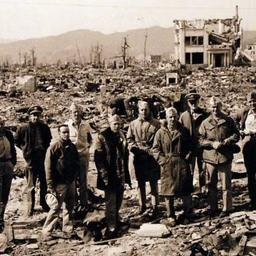
CAPTION 1945 Hiroshima inspection
The he collapse of traditional arms treaties.
Peter Huessy, fellow at the National Institute for Deterrence Studies and the Gold Institute for International Strategy, outlines several critical perspectives on the modern landscape of nuclear weapons and the collapse of traditional arms treaties. Huessy argues that a trilateral arms control agreement between the US, Russia, and China is highly unlikely: the US Senate would not approve a treaty that permits Russia and China to hold a combined 3,000 warheads while restricting the US to 1,500, and neither adversary would agree to a deal where the US matches their combined total. Instead of numerical limits, he believes any future progress would have to focus on banning specific destabilizing systems, like multiple-warhead land-based ICBMs or space-based weapons. According to Huessy, Russia's core objectives have remained unchanged since the creation of NATO: to dismantle the NATO alliance and neutralize American missile defense. He explains that Russia utilized past bilateral treaties, such as the Moscow Treaty and New START, as a tactical pause to "catch up" and build up its arsenal. A major security threat is Russia's implementation of a 1999 decree to build highly accurate, low-yield theater nuclear weapons meant to win conventional battlefield conflicts; he warns that Russia (and increasingly China) uses these weapons as tools of nuclear blackmail to coerce the West into standing down. Unlike the US, which maintains a strict separation between conventional and nuclear platforms, both Russia and China deploy dual-capable systems that can easily be converted to carry nuclear payloads, and Russia has actively developed unconstrained, exotic technologies, including hypersonic glide vehicles, nuclear-armed satellites, nuclear-powered long-range cruise missiles, and an underwater system designed to generate massive tidal waves. Ultimately, Huessy emphasizes a fundamental divergence in nuclear philosophy: while the US views its nuclear triad strictly as a defensive extended deterrent to prevent war, Russia and China view their nuclear forces as tools of coercion designed to carve out "sanctuaries" to commit conventional aggression. (5)
The he collapse of traditional arms treaties.
Peter Huessy, fellow at the National Institute for Deterrence Studies and the Gold Institute for International Strategy, outlines several critical perspectives on the modern landscape of nuclear weapons and the collapse of traditional arms treaties. Huessy argues that a trilateral arms control agreement between the US, Russia, and China is highly unlikely: the US Senate would not approve a treaty that permits Russia and China to hold a combined 3,000 warheads while restricting the US to 1,500, and neither adversary would agree to a deal where the US matches their combined total. Instead of numerical limits, he believes any future progress would have to focus on banning specific destabilizing systems, like multiple-warhead land-based ICBMs or space-based weapons. According to Huessy, Russia's core objectives have remained unchanged since the creation of NATO: to dismantle the NATO alliance and neutralize American missile defense. He explains that Russia utilized past bilateral treaties, such as the Moscow Treaty and New START, as a tactical pause to "catch up" and build up its arsenal. A major security threat is Russia's implementation of a 1999 decree to build highly accurate, low-yield theater nuclear weapons meant to win conventional battlefield conflicts; he warns that Russia (and increasingly China) uses these weapons as tools of nuclear blackmail to coerce the West into standing down. Unlike the US, which maintains a strict separation between conventional and nuclear platforms, both Russia and China deploy dual-capable systems that can easily be converted to carry nuclear payloads, and Russia has actively developed unconstrained, exotic technologies, including hypersonic glide vehicles, nuclear-armed satellites, nuclear-powered long-range cruise missiles, and an underwater system designed to generate massive tidal waves. Ultimately, Huessy emphasizes a fundamental divergence in nuclear philosophy: while the US views its nuclear triad strictly as a defensive extended deterrent to prevent war, Russia and China view their nuclear forces as tools of coercion designed to carve out "sanctuaries" to commit conventional aggression. (5)