30 September 2026
10. AMERICA - Examining Wealth Inequality And Innovation - DAVID HENDERSON 093026
The John Batchelor Show
About
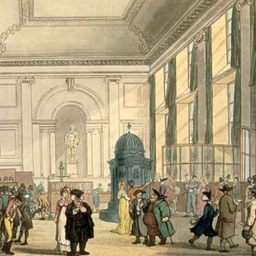
1808 GREAT HALL BANK OF ENGLAND
Examining Wealth Inequality And Innovation
David Henderson contrasts market innovation with political cronyism when evaluating wealth inequality. Rebutting Thomas Piketty's proposal for uniform wealth taxation, Henderson demonstrates that entrepreneurs like Robert McCulloch or Elon Musk created fortunes by delivering superior products that immensely benefited consumers. Citing research by William Nordhaus, he notes that innovators retain only 2.2% of the value generated by their innovations, with 97.8% flowing directly to consumers. Conversely, wealth acquired through government favor and anti-competitive restrictions harms consumers. Henderson concludes that heavy taxation on wealth discourages capital investment, productivity, and real wage growth. (10)
Examining Wealth Inequality And Innovation
David Henderson contrasts market innovation with political cronyism when evaluating wealth inequality. Rebutting Thomas Piketty's proposal for uniform wealth taxation, Henderson demonstrates that entrepreneurs like Robert McCulloch or Elon Musk created fortunes by delivering superior products that immensely benefited consumers. Citing research by William Nordhaus, he notes that innovators retain only 2.2% of the value generated by their innovations, with 97.8% flowing directly to consumers. Conversely, wealth acquired through government favor and anti-competitive restrictions harms consumers. Henderson concludes that heavy taxation on wealth discourages capital investment, productivity, and real wage growth. (10)