15 January 2026
The Untold WWII War Crimes Still Shaping Asia Today | Full Spectrum Frontiers
The Full Spectrum Frontier’s Podcast
About
World War II did not end cleanly in the Pacific.
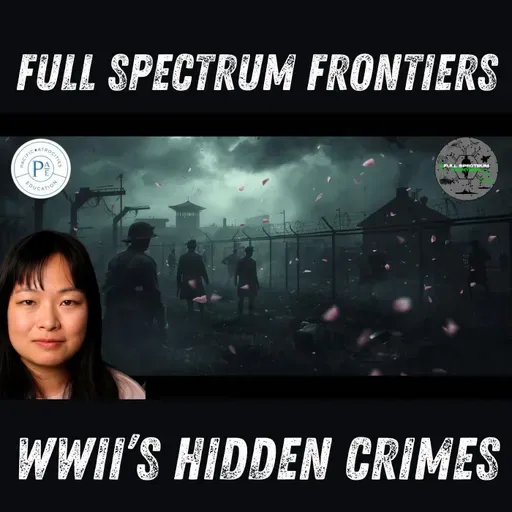
It left behind buried memories, unresolved trauma, and secrets that still shape global politics today. In this powerful conversation, Bennett Tanton sits down with Jenny Chan of the Pacific Atrocities Education Center to uncover the parts of WWII history most people were never taught. From Japanese war crimes and human experimentation to the long-term effects of generational trauma, this episode explores how history does not simply disappear when wars end. We dive into the forgotten suffering of civilians, prisoners of war, and even the soldiers who carried out horrific acts. Jenny explains how selective historical memory has distorted international relationships, fueled resentment, and quietly influenced modern geopolitics in Asia and beyond. This episode is not about blame.
It is about truth, memory, and why national security depends on understanding the full human cost of war. Topics include:
• Unit 731 and biological warfare
• Human experimentation during WWII
• Generational trauma and epigenetics
• The politics of historical memory
• How war crimes still shape Asia-Pacific relations
• Why erasing history creates future conflict Some stories are uncomfortable. But forgetting them is far more dangerous.
https://www.pacificatrocities.org/
🔍 Sources & Further Reading Unit 731 and Japanese War Crimes
National WWII Museum
https://www.nationalww2museum.org/war/articles/unit-731 Encyclopaedia Britannica
https://www.britannica.com/topic/Unit-731 Biological Warfare Programs in WWII
CDC History of Biowarfare
https://www.cdc.gov/anthrax/bioterrorism-history/index.html Generational Trauma & Epigenetics
National Institutes of Health
https://www.ncbi.nlm.nih.gov/pmc/articles/PMC5977074/ Historical Memory and Geopolitics
Brookings Institution
https://www.brookings.edu/articles/how-historical-memory-shapes-foreign-policy/
It left behind buried memories, unresolved trauma, and secrets that still shape global politics today. In this powerful conversation, Bennett Tanton sits down with Jenny Chan of the Pacific Atrocities Education Center to uncover the parts of WWII history most people were never taught. From Japanese war crimes and human experimentation to the long-term effects of generational trauma, this episode explores how history does not simply disappear when wars end. We dive into the forgotten suffering of civilians, prisoners of war, and even the soldiers who carried out horrific acts. Jenny explains how selective historical memory has distorted international relationships, fueled resentment, and quietly influenced modern geopolitics in Asia and beyond. This episode is not about blame.
It is about truth, memory, and why national security depends on understanding the full human cost of war. Topics include:
• Unit 731 and biological warfare
• Human experimentation during WWII
• Generational trauma and epigenetics
• The politics of historical memory
• How war crimes still shape Asia-Pacific relations
• Why erasing history creates future conflict Some stories are uncomfortable. But forgetting them is far more dangerous.
https://www.pacificatrocities.org/
🔍 Sources & Further Reading Unit 731 and Japanese War Crimes
National WWII Museum
https://www.nationalww2museum.org/war/articles/unit-731 Encyclopaedia Britannica
https://www.britannica.com/topic/Unit-731 Biological Warfare Programs in WWII
CDC History of Biowarfare
https://www.cdc.gov/anthrax/bioterrorism-history/index.html Generational Trauma & Epigenetics
National Institutes of Health
https://www.ncbi.nlm.nih.gov/pmc/articles/PMC5977074/ Historical Memory and Geopolitics
Brookings Institution
https://www.brookings.edu/articles/how-historical-memory-shapes-foreign-policy/