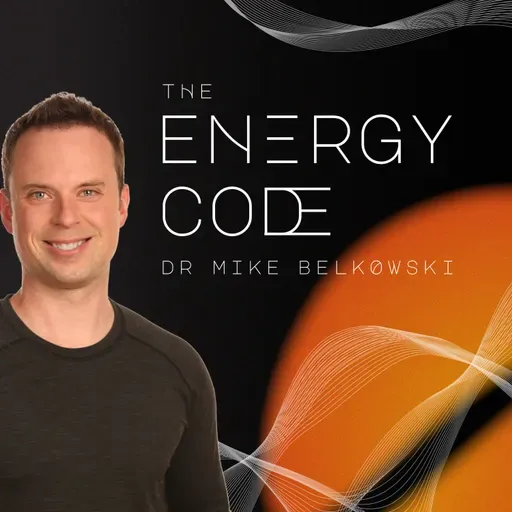
Calories Are the Surface. Mitochondria Are the Story: The Real Science of Weight Loss
The Energy Code
Most weight-loss advice stops at “calories in vs. calories out.” In this episode, Dr. Mike goes deeper: what happens to your body’s energy machinery during weight loss and why maintenance can be harder than the initial drop. Using four papers (two skeletal muscle mitochondrial studies, one PBM body-contouring study, and one chlorin e6 photodynamic obesity study in mice), you’ll learn how weight loss can lower energy expenditure, remodel mitochondrial membranes (cardiolipin), shift efficiency and coupling, and produce totally different adaptations depending on whether the weight came off via lifestyle or bariatric surgery. The headline: weight loss is an adaptive bioenergetic event, not just a subtraction problem — and mitochondria sit in the middle of the outcome.
(Educational content only, not medical advice.)
-
Articles Discussed in Episode:
Human Skeletal Muscle Mitochondria Responses to Weight Loss Induced by Bariatric Surgery or Lifestyle Intervention
Weight loss increases skeletal muscle mitochondrial energy efficiency in obese mice
Photobiomodulation Therapy for Improvement of Body Contour: A Retrospective Study on Middle Eastern Participants
Anti-Obesity Effect of Chlorin e6-Mediated Photodynamic Therapy on Mice with High-Fat-Diet-Induced Obesity
-
Key Quotes From Dr. Mike:
“Body composition is downstream of energy biology.”
“Weight loss is not just a subtraction problem, it’s an adaptive biological event.”
“After weight loss, the body isn’t just smaller — it’s more economical.”
“Maintenance is part of the weight-loss intervention, not the chapter after.”
“Don’t just ask whether something helps you lose weight—ask what it teaches your body to do with energy.”
-
Key Points
Weight loss ≠ simple subtraction: it triggers adaptive biology (hormones, fuel use, expenditure, defense mechanisms).
Mitochondria are central: not just ATP—also redox regulation, signaling, substrate use, heat generation, stress response.
Post-weight-loss “efficiency” can backfire: more efficient mitochondria can mean lower energy expenditure, making maintenance harder.
Membrane biology matters: cardiolipin remodeling (e.g., tetralinoleoyl cardiolipin) may tune oxidative phosphorylation efficiency.
Route matters: bariatric surgery vs lifestyle weight loss can produce different mitochondrial signatures despite both lowering scale weight.
Function > quantity: improvements can show up as better respiration/coupling without “more mitochondria” or big morphology changes.
Body contouring ≠ metabolic transformation: local circumference changes can occur without BMI shifts—different level of outcome.
PBM vs PDT are not the same: photodynamic therapy (chlorin e6 + light) is a more aggressive tool than classic PBM “signaling.”
Adaptive compensation is the hidden driver: hunger, expenditure, fuel partitioning, and tissue signaling shift to resist depletion.
Better question: not “did you lose weight?” but “what adaptation did your strategy create?”
-
Episode timeline
00:00 – 02:00 | The myth of “just do the math” | Why energy balance matters, but isn’t the full story. Weight loss as an adaptive event.
02:00 – 06:00 | Reframing mitochondria | Mitochondria as energy transducers + redox/signaling hubs that determine how the body handles fuel.
06:00 – 18:00 | Paper #1 (Obese mice): efficiency rises after weight loss | Lower whole-body expenditure + more efficient oxidative phosphorylation. Why “better fuel economy” can become “metabolic conservation.”
18:00 – 23:00 | Cardiolipin and TLCL: the membrane-level shift | How mitochondrial inner membrane lipids (cardiolipin remodeling) may tune efficiency and what tafazzin-related findings imply.
23:00 – 34:00 | Paper #4 (Humans): surgery vs lifestyle creates different mitochondrial outcomes | Weight loss route changes mitochondrial respiration/proteome responses; diabetes status adds individual variability.
34:00 – 41:00 | Paper #2 (Humans): PBM + contouring outcomes | Circumference changes vs BMI stability — why body contouring isn’t the same as systemic metabolic repair.
41:00 – 49:00 | Paper #3 (Mice): chlorin e6 photodynamic “anti-obesity” effects | PDT vs PBM distinction; broader obesity marker shifts in an animal model; interesting, but not a protocol permission slip.
49:00 – End | Synthesis: weight loss is energy reprogramming | The unified framework: adaptive bioenergetics, maintenance as part of the intervention, and the “optimize for what?” question.
-
Dr. Mike's #1 recommendations:
Deuterium depleted water: Litewater (code: DRMIKE)
EMF-mitigating products: Somavedic (code: BIOLIGHT)
Blue light blocking glasses: Ra Optics (code: BIOLIGHT)
Grounding products: Earthing.com
-
Stay up-to-date on social media:
Dr. Mike Belkowski:
BioLight:
Website
YouTube