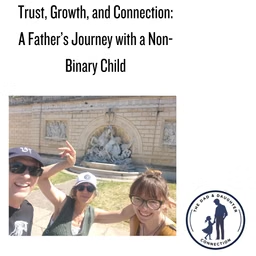
Trust, Growth, and Connection: A Father's Journey with a Non-Binary Child
The Dad & Daughter Connection
This week's episode of "The Dad and Daughter Connection" delves into the evolving journey of fatherhood, offering a heartfelt conversation with author and workplace culture expert Ed Frauenheim. Through candid storytelling and honest reflection, the episode explores what it really means to support our children—especially when their paths unfold in ways we never expected.
Dr. Christopher Lewis opens with his signature warmth, reminding listeners that the core of fatherhood isn't perfection, but presence. The conversation quickly pivots to Ed Frauenheim's personal growth as a father to Skyla, his strong-willed, non-binary child. Their story is not just about adjusting to pronouns or grappling with change, but about learning the art of persistent, trusting connection.
One major theme running through the conversation is trust. Ed Frauenheim candidly shares early struggles trying to control Skyla, only to discover the power of letting go—of giving space, listening deeply, and trusting his child's autonomy. He admits the journey wasn't always smooth, referencing honest and sometimes painful moments of conflict that led to growth. It's the small shifts—choosing to draw beside Skyla instead of insisting on homework—that became turning points, building a deeper bond rooted in respect.
The episode masterfully unpacks the challenges of moving past parental expectations when faced with a child's evolving identity. Ed Frauenheim reflects on the initial mourning and adjustments after Skyla came out as non-binary, and the courage it took to support them fully, even in spaces steeped in traditional notions of masculinity. Through his vulnerability, listeners are offered a blueprint for embracing discomfort as a catalyst for connection and understanding.
Additional highlights include practical tips for other dads: creating a home where listening is prioritized, learning together about new concepts, and bringing levity to sensitive journeys through shared experiences. Ed Frauenheim emphasizes the value of apologizing, modeling openness, and never giving up on the pursuit of genuine connection.
If you're a parent, caregiver, or anyone seeking to better support the young people in your life, this episode is a must-listen. It's a tribute to adaptability, unconditional love, and the transformative power of trust. Tune in for actionable wisdom, moving anecdotes, and inspiration to keep showing up, even when the path is uncertain.
Catch the full episode at dadanddaughterconnection.com, and remember—the journey isn't about being perfect. It's about being present, persistent, and ready to grow.
If you enjoyed this episode we ask you to take a moment to take our Dad and Daughter Connection Survey to let us know more about you as a dad. You can also sign up to get our newsletter to stay connected to our community and we will send items of interest to you to help you to be the dad that you want to be. Feel free to follow me on the following social media platforms: Facebook, Facebook Group, Instagram, LinkedIn, X.
TRANSCRIPT
Dr. Christopher Lewis [00:00:02]:
Welcome to The Dad and Daughter Connection, the podcast for dads who want to build stronger bonds and raise confident, independent daughters.
Dr. Christopher Lewis [00:00:12]:
If you're looking to build a stronger bond with your daughter and help her grow into a confident, independent woman, you're in the right place. I'm Dr. Christopher Lewis, and The Dad and Daughter Connection is the podcast where we dive into real stories, expert advice, and practical tips to help you navigate the incredible journey of fatherhood. In every episode, we'll bring you conversations that inspire, challenge, and equip you to show up as the dad your daughter needs. So let's get started. Because being a great dad isn't just about being there. It's about truly connecting. Welcome back to the Dad and Daughter Connection, where every week we have a great opportunity, we have a great opportunity to be able to come together to and grow together to be able to work on those relationships that we want to have with our daughters, to help us to be able to create those solid relationships, those solid bonds that are going to help our daughters to become the people that they are becoming in their lives.
Dr. Christopher Lewis [00:01:15]:
That's why, that's why every week I love being able to introduce you to people with different experiences, people from all different types of walks of life that have had different experiences that'll help you to be able to, I guess, in a way, reframe and to think about How are you fathering? Because not every father will father in the same ways, and that's perfectly fine. What's important is that we learn along the way. We take those bits that make sense. Maybe we adjust those things that don't work for our family, and we help ourselves to become just a little bit better every day. Because by us becoming a little bit better, our kids are going to be better, and we're going to be able to have those relationships and those— and build those connections that are going to last a lifetime. This week, we got another great guest. Ed Frauenheim is with us. And Ed is an author, a researcher, a speaker, and a workplace culture expert whose work explores how redefining masculinity can help men lead healthier, more connected, and more fulfilling lives.
Dr. Christopher Lewis [00:02:19]:
He's a co-author of Reinventing Masculinity: The Liberating Power of Compassion and Connection, a book that examines the shift from outdated restrictive ideas of manhood toward a more compassionate and emotionally healthy vision of masculinity. And in addition to his work on masculinity, he's also, also a father of 2. We're going to talk about his own journey as a father. And we're going to be able to talk a little bit further about what he's had to go through in this journey that he's been on as well. So I'm really excited to have him here. Ed, thanks so much for being here today.
Ed Frauenheim [00:02:53]:
Thanks, Christopher. It's a real pleasure to be with you here.
Dr. Christopher Lewis [00:02:56]:
It's my pleasure having you here today. And I, I'm going to be very honest with Everyone that Ed has been on a podcast with me before, he and I did a podcast on my past podcast, Dads with Daughters. And on that podcast, we talked a lot more about Reinventing Masculinity. We're not going to talk as much about the book this go around. So I encourage you that if you want to learn a lot more about Reinventing Masculinity, I talked to Ed right when that book came out. So I encourage you to go over, I'll put a link in the notes today where you can find that other podcast. And you can listen there and learn even more. And but Today what we're going to do is first we're going to start off by chatting a little bit more about being a father.
Dr. Christopher Lewis [00:03:38]:
And we're going to talk about some of the journey that you've been on. And I know you have 2 kids, you have a son, and then you have a non-binary child that at birth was a daughter and now is non-binary. And we're going to talk about that journey as well. So I always start off with a few questions that just to get a little bit of a sense about you as a dad.
Ed Frauenheim [00:03:56]:
Okay.
Dr. Christopher Lewis [00:03:56]:
And one of the things that I love being able to delve a little bit into is as fathers, one of the things that we try to do is we try to create those moments, those moments where we can really bond with our kids, really be able to share special times and special moments with our kids as well. What's one of the most meaningful moments that you've been able to share with your youngest and what made it so special?
Ed Frauenheim [00:04:20]:
Thanks for that great question, Christopher. The one that comes to mind with my child Skyla, as you mentioned, Skyla was born in a female body and now identifies as non-binary. Maybe when Skyla was 9 or so, we were butting heads a lot. We were in conflict in, in part because Skyla is quite strong-willed and I can be a little bit controlling as well, or especially back then as a dad. And I remember this moment where I was in charge of making sure the kids, and Skyla in particular, got started on their homework. And I said, Skyla, time to do your homework now. And Skyla had been doing something with like cutouts and, and making some drawings, and they said, I'm, I'm, I'm almost done. Why don't you draw with me.
Ed Frauenheim [00:05:02]:
And I did. I kind of let down my kind of controlling guard, if you will, and immersed myself a bit in Skyla's world. And they were making these interesting characters, cartoon characters. I can't remember the name right now, but I learned how Skyla was drawing them, and I drew my own, and it was a loving experience. And then after we did that for maybe 20, 30 minutes, Skyla happily went on to her homework. their homework. And I say her there, Christopher, because you and I were talking before the podcast started about how it's— I'm still struggling to get the pronouns right, even though I'm trying to honor as best I can Skyla's non-binary identity. But many years of calling Skyla by female pronouns are still hard to shake sometimes.
Ed Frauenheim [00:05:43]:
And Skyla, to their credit, gives me a lot of grace, a lot of room for growth there, and does not jump down my throat when I throw out a she or her. So anyways, to me, it was a moment of connection, a moment of realizing I could trust my child. I could trust that I didn't have to be this disciplinarian and give more space in the relationship and really kind of honor Skyla's will to chart their course and figure out what they want to do and when. And yeah, I had some boundaries to set, but being a little flexible in that moment really made a difference and I think helped us to repair a bond that wasn't so strong and has gotten stronger ever since in a lot of ways.
Dr. Christopher Lewis [00:06:20]:
All of us are having to balance. And as you talked about, Skyla tends to be strong-willed. You said that you were strong-willed at the same time. And we try to do this balancing act Because all of our kids are trying to find that independence for themselves. And especially, I have a child that's very strong-willed. And I know, especially in that time where they were first pushing that independence, it was challenging. It was challenging in many different ways because they really wanted that independence. How did you balance guiding Skyla while also giving them the independence to grow into the person that they want to be? ultimately have become?
Ed Frauenheim [00:06:58]:
I would say that a couple of things really helped me strike the balance. One of them was actually my former employer, Great Place to Work, and its mantra of trust. The research that originally began this organization, Great Place to Work, which is the company behind the Fortune 100 Best Companies to Work For list— it surveys employees and finds out which ones are having the best experience at work— it all came down to, do people feel like they can trust their leaders? Do they trust each other? Do they have good bonds at work? And so this mantra of trust was big for me back in that day. I've been out of Great Place to Work for about 6 years now, but I was reminded of it by my wife a lot. She would say, Ed, you're not necessarily practicing what you preach with respect to Skyla. You say trust your employees and build trust with them, but are you really trusting your own child? And she was right that I often— oftentimes I wasn't. And I worried that Skyla's resistance, her acting out occasionally, was a sign that she could be a sociopath. You know, I was like, I was worried that she was just not going to be a civil, polite person.
Ed Frauenheim [00:07:59]:
And, but I was wrong in that. What I found, and I heard this from other parents, Skylar was really wonderfully behaved with almost all of her friends' parents. And we had school, her teachers, they considered her a model student in a lot of ways and a model friend. They saved a lot of their resistance from Rowena and me, which I gather can happen a lot when, when parents are trying to have a more, a parenting style that's not governed by fear. Such that we didn't like try to scare or physically hit Skyla in punishment. It was about consequences. It was about conversations, mostly, these consequences of acting out. So we did set these boundaries.
Ed Frauenheim [00:08:35]:
And as I said with that opening story, eventually I, I kind of came to see it. I could trust Skyla. In fact, I needed to trust Skyla more. And I came to see that strong-willedness as a positive, Christopher. And I saw one of the places I got to see it more was that I think helped me was in on the soccer field. Skyla was a a standout soccer player for many years and ultimately was on the team that won the city championship in San Francisco in high school. And so I think that mantra from work applied by my wife and then seeing how, you know, being assertive, being aggressive is a positive thing in the sports realm, all those helped me to soften and make more space for Skyla in our relationship and I think build a stronger bond with them.
Dr. Christopher Lewis [00:09:17]:
You know, not every time, as you were just talking about, as you're raising a child is It's going to be many times where it's going to be fraught with challenge. What are some intentional ways that you worked to strengthen your bond with Skyla, especially during those challenging times?
Ed Frauenheim [00:09:35]:
I would say that I really tried to be there for Skyla on the school front and the sports front. I coached Skyla's soccer team up until the end of 5th grade and then was a fan throughout their high school years. And as Skyla got into middle school and then most, a very academically rigorous public high school here in San Francisco, Lowell High School. I really tried to make sure I was there to support them as they studied for AP History, AP US History, read the text with them and watched the kind of notes they were taking, helped with papers. As a trained writer, journalist, could be an editor for them as they, as they wrote papers and they became a pretty good strong writer even in the high school level. So those are some ways I did that. And I think it was a way of demonstrating my love, my deep trust, my care for Skyla. And to this day, they ask me to edit papers and edit memos.
Ed Frauenheim [00:10:29]:
We have that relationship of support, and it's been, it's been one of those intentional ways I've tried to be a good dad.
Dr. Christopher Lewis [00:10:35]:
As I said, none of us are infallible. We're all humans. We're all people that are going to make mistakes as we go through our own experiences as fathers. What's a mistake that you've made as a father, and what did you learn from it about fostering Better or more positive connections with Skyla?
Ed Frauenheim [00:10:53]:
Why do you have to ask that kind of a question, Christopher? The thing that pops up to my mind as maybe one of the worst moments and choices I made was treating Skyla like someone I could control in that early childhood phase into their late elementary years, you might say. Because I remember this moment where we were having a conflict and Skyla was having a tantrum of sorts, wasn't doing what I, or I think my wife, wanted them to do. And I remember carrying Skylar like a football down the street to the car. I think we had to go somewhere and it was humiliating all around. Like they were too big. I mean, they might've been in 2nd or 3rd grade when I did this. And the whole time I'm carrying Skylar literally like kicking and screaming as I'm walking like a block and a half to my car parked in this San Francisco neighborhood. And I knew that they were embarrassed and shamed by this.
Ed Frauenheim [00:11:41]:
And, and I was feeling ashamed of like what kind of an— and especially cuz I was in public. During this time. And I think in some ways that public embarrassment helped me to— that was the last time I tried to physically control their body, you know, when raising them. We shifted toward these longer and more, in some ways, trying boundaries that were a lot about conversation. You do something that breaks a rule or breaks a boundary, we're gonna talk about it. And Skylar hated that, you know, at times, you know, but they, they couldn't do what they wanted to do until we talked through it. And that meant Both my wife and I and Skylar were stuck with each other, if you will. But I think that paid off over time.
Ed Frauenheim [00:12:16]:
And I tried to learn from that mistake of manhandling my child at an age that was not really appropriate for it.
Dr. Christopher Lewis [00:12:23]:
You definitely have to learn and you have to find that balance for yourself and figure out what is right at the right time and what is right that's age appropriate. Like you said, it's not always easy to determine and, and you're definitely going to make mistakes along the way. But you definitely also have to do whatever we can to be able to support them in who they're becoming, but also who we're becoming, and know that it's okay to trip, it's okay to fall, and it's okay to pick ourselves up, dust ourselves off, and keep moving forward. And I've heard it from many fathers that have been on the show in the past that you just have to own it. And you have to say, you know, if you make a mistake, you make a mistake, and you tell your kid that. And I'm sorry.
Ed Frauenheim [00:13:05]:
Can I follow up on that, Christopher? Because I think that's a great point you're making. That idea of apologizing, I have seen that as a strength, something I determined I was going to do from a pretty young age as a father, if you will. And I remember feeling really frustrated that— and with my own father, who rarely if ever apologized for his own anger outbursts, for bad choices as a parent or spouse that we witnessed as the 3 kids in our family. And I feel good about that idea of at least if I have lost my cool or made a mistake as a parent, I have really tried to apologize every time. And I think that that modeled something good for my kids, that they could see that it's okay to make a mistake. It's okay to— and in fact, it's important to acknowledge mistakes, to say you're trying to get better. I think it's over time helped them to give me grace as a father as I've continued to make mistakes along the way.
Dr. Christopher Lewis [00:13:57]:
Every one of us as dads always are trying to find ways to support our kids. And I guess as Skyla has gotten older, what do you do to support Skyla in pursuing their passions and their dreams?
Ed Frauenheim [00:14:14]:
I guess some of the things that I mentioned before, like trusting them, giving them space to do their thing, and to support them academically, that's continued and taken on some new shapes. Right now, as we talked about before, before the show, Skyla is studying in Bologna, the University of Bologna, an academy of art there in the city of Bologna. for the semester from January to about June. And that program has been wonderful for them. They're usually— they're a University of California at Santa Cruz student. And this time abroad has been wonderful. It's also been really challenging to get through the bureaucracy of studying abroad, of getting visas, of getting the coursework that they need, navigating financial questions, of travel questions. So I've really just tried to be there for them as they've tried to get through these hurdles.
Ed Frauenheim [00:14:59]:
Like recently, for example, Skylar asked me to help with a a note to one of their professors asking that a class that they took at University of Bologna count as a requirement for a Santa Cruz degree. And so we worked back and forth with this memo or email to kind of make the best case that this literature class should count as a critical thinking, critical reading class for Skyla. So it's still supporting them with time and energy, but in some newer territories of academic and institutional bureaucracy and requirements. And it's very gratifying.
Dr. Christopher Lewis [00:15:32]:
Skyla.
Ed Frauenheim [00:15:34]:
is increasingly expressive about her appreciation for the help I've given and just the way she— they have matured. But the trust I had early on is proving true. They are not anything like a sociopath. They are like an incredibly thoughtful and kind and polite and curious young person. And I get to have that relationship with this ever more mature human being.
Dr. Christopher Lewis [00:15:56]:
So we've been talking about the fact that Skyla has come out to you as non-binary. Bring me back To that point, when they first shared that part of themselves with you, what was that experience like for you as a father?
Ed Frauenheim [00:16:09]:
It was intense, Christopher. I remember that the moment that it came about was when Skylar was applying to college and put on their UC, University of California application that they were non-binary. And that was the first time I learned that that's how Skylar was identifying. And there was some mourning that I had to go through. I loved calling Skyla my little lady. That was my nickname for her. I call my wife lady. It might be a little anachronistic, but, you know, it's part of our internal language.
Ed Frauenheim [00:16:38]:
And I would call Skyla my little lady, and I couldn't do that anymore, you know. And so I actually started calling them my young person, which is very kind of stilted on some level, but it's now taken on its own life. So I say, how are you doing, young person? Adapt and adopt their identity. And I would say, even though that moment was difficult in some ways, there was a sadness to kind of quote unquote losing a daughter, I feel like I gained a better relationship over time. I think Skyla, as I see it, really does embody a lot of both the archetypical feminine and masculine. All that strong-willedness, that assertiveness, to me reflects this integration of the 2 sacred genders, if you will. And so I think they've kind of come into their own as a non-binary person more than ever before. And so it's a joy to see them thriving.
Ed Frauenheim [00:17:25]:
And I think the gender identity is a part of that.
Dr. Christopher Lewis [00:17:28]:
So many fathers have expectations. We have expectations or assumptions about who our kids will become. How did you navigate adjusting your own expectations while continuing to support and love Skyla unconditionally?
Ed Frauenheim [00:17:44]:
I would say that a lot of my expectations were turned into uncertainties with the new gender identity that came about 3 and a half years ago, maybe. And I didn't know whether Skyla would change how they presented themselves, would change their clothes, or were they going to potentially pursue a trans transition? It was a kind of a new world for me to learn more about, but I have come to really kind of— my worries have eased, if you will, and the expectations are more just Skyla as my child. I expect that they're going to continue this path, and I'm excited to see how it unfolds for them. They continue to kind of Mostly present themselves in a feminine way. I would say skirts and makeup and clothing that is more leaning toward what you might consider females would wear typically. And I feel like I've become used to who they are. And I don't think about it that often, honestly, anymore. And those expectations that were confused maybe initially, or my uncertainties around who they were going to become, have not really plagued me much or been a lot of what I've worried about.
Ed Frauenheim [00:18:51]:
I worry about stuff like, are they going to get the courses they need? Are they going to find a job after college? The kind of worries of probably any father about their kid in college.
Dr. Christopher Lewis [00:18:59]:
What are some of the most important things that Skyla needed from you during their transition? And how did you learn to support them as they were going through that?
Ed Frauenheim [00:19:11]:
I'm guessing that Skyla needed to hear that I honored their choice. And it's funny as I look back at it, Christopher, but I think that one sign of that was getting the pronouns right. And I think that Skylar was a little more sensitive to me misgendering in the earlier phases of their, their shift to being non-binary. And we both sort of relaxed. I mean, I, I wouldn't say relaxed in the sense of I am completely relaxed about, I don't care what pronouns I use. I'm trying to use the right pronouns for them. But I would say that they're less critical of me if I don't get the pronouns right now than they were initially. But I think I demonstrated to Skylar over time that, yeah, I'm going to honor this.
Ed Frauenheim [00:19:49]:
I don't totally understand. what it means that I'm going to learn and did my best to do that. I went to some educational sessions or made some connections with folks to understand this relatively new way to my experience of defining oneself on gender terms. And at this point, I think the two of us are largely in sync around the identity and the non-binary identity and treating each other more like father and child.
Dr. Christopher Lewis [00:20:13]:
I said at the very beginning that you wrote a book on reinventing masculinity. And I guess as you look at being a father of a non-binary child, how has Having a non-binary child challenged or expanded your understanding of gender and masculinity?
Ed Frauenheim [00:20:28]:
It has pushed me to be braver and walking my own talk. I speak and give workshops in some pretty hyper-masculine territories, a niche of working with folks in the ski lift profession. Kind of a strange, very specific niche that I kind of randomly stumbled into. I love it. I love the folks in there, most of whom are guys, but I still occasionally get intimidated by all these guys with beards and mirrored sunglasses on top of their caps. They're like tough dudes out there in the snow in the middle of the night grooming hills or clearing out chairlifts. And I can feel a bit of trepidation, a bit of worry when I talk about having a non-binary child, but I typically do. And it's caused me to have to be brave around not conforming to that old outdated, what I call confined masculinity, where we are intolerant, where guys are intolerant of difference, whether it's sexual orientation, Whether it's this gender identity, whether it's non-binary identities, and to sort of like be very judgmental as men.
Ed Frauenheim [00:21:27]:
So I've been called to sort of be more courageous. That's one of the six C's they talk about around reinventing masculinity, along with curiosity and compassion, connection. You mentioned in the subtitle of the book commitment. I'll start about contemplation, but but the courage piece to bravely say I am the proud father of a non-binary kid is something that I've had to live up to, and I'm glad to say I mostly have, and and most. Most of the response I've gotten is positive, or certainly not negative. No one's challenged me to fight. I'm gonna have to fight you because you're a father of a non-binary daughter. Like, not okay.
Ed Frauenheim [00:21:59]:
I think a lot of guys, when they're given permission to open up that cramped definition of masculinity that we— many of us grew up with, they're hungry for it, and they're more curious than I would have maybe thought. So that, I think, is one of the main ways I've had to live into my own, my own words, my own philosophy. Thanks to Skyla's choice.
Dr. Christopher Lewis [00:22:18]:
For fathers whose children may be questioning their identity, what are some practical ways that they can create a home environment where their child feels safe, seen, and accepted?
Ed Frauenheim [00:22:32]:
That's a good one. I think one thing is to make a lot of space for listening as a dad. Really kind of open your ears up and say, I'd love to talk about what you're reflecting on, thinking about with respect to your identity or how you're going to define yourself. So announce that you're ready to listen and actually do listen. A lot of talking and try to paraphrase, you know, do the active listening that we know helps relationships. I would say another thing is to demonstrate that you're trying to learn about this territory as well and let your kid know you're reading articles or looking at other kind of educational content that may help explain this territory. And a third thing might be to try to have some fun with it. And I'm thinking about looking at movies together that may play around with some of these questions of identity, gender identity, non-binary identity, trans identity.
Ed Frauenheim [00:23:23]:
I don't immediately have one in mind. You know, there's been a lot of interesting film and TV show content that has been cutting edge in this stuff. I'm even watching a series called La Brea. It's, I guess, some years old. It's on Netflix right now, and it doesn't have the trans piece, but it does have same-sex couple issues in there. And so I'm just thinking about how it doesn't have to be super heavy all the time. There can be some entertainment built into your joint exploration of these questions of identity.
Dr. Christopher Lewis [00:23:50]:
You know, I was just thinking that in what you were just saying, that as you've gone through this, I'm sure that there have been moments, there's been things and things that you've learned and things that you've been able to appreciate in the journey, along with the challenges as well. What's been the greatest gift or unexpected blessing that has come from walking alongside Skyla on this journey?
Ed Frauenheim [00:24:12]:
Reciprocated love. One of the biggest challenges that I had as a dad of Skyla was that for a number of years, maybe going back to that middle elementary timeframe up through maybe into high school even, like, Skyla was very reticent to say I love you to me. And it might have had something to do with going through adolescence, puberty. She also was very— didn't want to have hugs either. They didn't want to have hugs. And I just tried to be consistent about telling them I love them every night. you know, as they're going to bed. And gradually it has become a two-way street on sharing that we love each other.
Ed Frauenheim [00:24:50]:
It actually may have helped that I've had some health challenges in recent years. Like, I had a mild heart attack in 2021 during the pandemic caused by stress. That's what the diagnosis was. And I remember Skylar giving me a hug in the hospital, and that was very dear, telling me that they love me. And then over this past year, I wrestled with appendix cancer. I'm just coming out of a year's worth of treatments. I'm cancer-free. of now, and hoping to stay that way for a while, if not forever.
Ed Frauenheim [00:25:18]:
And again, during this time, Skyla has been very caring and giving out hugs and I love yous. And I don't know if I would have predicted that would have ever happened back when we were in our most butting-of-heads times, around the time that I first talked about when I'm telling her to do their homework. So it's a delight, and I'm very grateful for our mutual affections, mutual shows of affection.
Dr. Christopher Lewis [00:25:40]:
And if Skyla was sitting here today, what would you hope that they would say about how you showed up for them as a father during this transition?
Ed Frauenheim [00:25:48]:
I would hope they would say I was— they would probably say, Dad, you're so clueless sometimes. And that's true. I have been. And I think they have a wonderful relationship with my wife. And I think they see us as playing different roles at times. Like, I'm the lead editor, if you will, on Skyla's papers, even though Rowena is a great writer as well. And I would hope they would say this, and I think it's accurate, that collectively, we parents have shown up and helped them get through this time. And thankfully, I don't think Skyla has had some of the challenges in choosing this non-binary or identifying as non-binary as some young people around the country or the world have, because Skyla has grown up in San Francisco, a very liberal-minded city.
Ed Frauenheim [00:26:27]:
They go to University of Santa Cruz, one of the hippiest schools you can possibly go to. And they've been surrounded by family and friends that have been very welcoming and understanding for the most part. So it hasn't taken a big lift of emotional support from me or my wife, I don't think, maybe compared to someone who's identifying this way and in a much more conservative area of the country, middle of Missouri, say. I don't know, but that— it's my sense is that it's more been showing up for them as a, as a young adult, more so, or as much as being a non-binary person. That might be my guess.
Dr. Christopher Lewis [00:26:59]:
Now, we always finish our interviews with what I like to call our Dad Connection. 6 more questions to delve a little bit more into you as a dad. You ready?
Ed Frauenheim [00:27:06]:
I'm ready.
Dr. Christopher Lewis [00:27:06]:
What's one word that describes your relationship with Skyla?
Ed Frauenheim [00:27:11]:
I'll go with loving. Pretty simple.
Dr. Christopher Lewis [00:27:13]:
What's the best piece of dad advice you've ever received?
Ed Frauenheim [00:27:16]:
Trust your kid.
Dr. Christopher Lewis [00:27:18]:
And what's one activity that you and Skyla love doing together?
Ed Frauenheim [00:27:22]:
Hiking, or more generally, outdoor recreation.
Dr. Christopher Lewis [00:27:26]:
And if you could give Skyla one life lesson in a single sentence, what would it be?
Ed Frauenheim [00:27:30]:
To try to calm down and trust in how things are unfolding. I haven't always abided by that myself. I, I get pretty anxious, and I think unfortunately Skyla sometimes follows me in that trait.
Dr. Christopher Lewis [00:27:42]:
What's one thing that you've learned about yourself since becoming a dad?
Ed Frauenheim [00:27:46]:
That I can build trust, that I can loosen up. That is something that I'm pleasantly surprised by over the years.
Dr. Christopher Lewis [00:27:54]:
And finally, what advice would you give to other dads who want to build a lasting and meaningful relationship with their daughters?
Ed Frauenheim [00:28:01]:
I think I would say keep at it. Keep being present with your kids, with your daughters. There may be times where they're pushing you away, And I'm not saying push back to stay right next to them, but I think the key is to sort of make clear that you're there for them. You're ready to talk. You're ready to engage and try to build these activities where you can do stuff together. But the overall message is persistence.
Dr. Christopher Lewis [00:28:23]:
Well, Ed, I just want to say thank you. Thank you for sharing your story today and for sharing your journey with Skyla. If people want to find out more about you, where should they go?
Ed Frauenheim [00:28:32]:
I would suggest come to my Substack page. I have a Substack newsletter called frauentimes.substack.com. Uh, where I've been chronicling a lot of the, the lessons of this past year of cancer, including my relationship with my kids and Skyla. I can be found on LinkedIn, and I have a website, edfrownheim.com, but happy to, to connect with folks.
Dr. Christopher Lewis [00:28:51]:
Again, Ed, thank you so much for being here today. I know this journey will only continue. You'll continue to learn. Skyla will continue to learn, but I appreciate you sharing what you've learned thus far, and I wish you all the best.
Ed Frauenheim [00:29:03]:
Thank you so much, Christopher. And it's great to be here with you.
Dr. Christopher Lewis [00:29:06]:
That's a wrap for this episode of The Dad and Daughter Connection. Thanks for joining us on this journey to build stronger bonds and raise confident, independent daughters. Remember, being an engaged dad isn't about being perfect. It's about being present. If you enjoyed this episode, be sure to subscribe and share it with a fellow dad. And don't forget, you can find all our episodes at dadanddaughterconnection.com. Until next time, keep showing up, keep connecting, and keep being the dad she needs.
Speaker D [00:29:37]:
We're all in the same boat, and it's full of tiny screaming passengers. We spend the time, we give the lessons, we make the meals. We buy them presents. Bring your A-game, 'cause those kids are growing fast. The time goes by just like a dynamite blast. Calling astronauts and firemen, carpenters and muscle men, get out and be the world to them. Be the best dad you can be.
Dr. Christopher Lewis [00:30:29]:
Be the best dad you can be.
Speaker D [00:30:30]:
Be the best dad you can be.