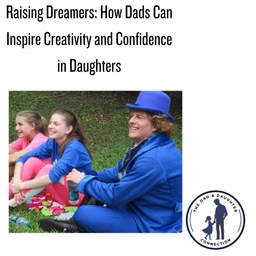
Raising Dreamers: How Dads Can Inspire Creativity and Confidence in Daughters
The Dad & Daughter Connection
One of the major themes that emerges from the conversation is the magic that comes from truly connecting with your children. Wylde Scott reflects on powerful family moments, like renewing marriage vows with his wife in front of the Eiffel Tower with both daughters by their side—a ritual that not only celebrates love but also leaves a deep, lifelong imprint on his children about commitment and family.
The episode dives into the complexities of raising uniquely different kids. Wylde Scott is refreshingly honest about the challenges of finding the right balance between guidance and independence, especially when you have one child who's fearless and adventurous and another who is more reserved. He shares how important it is to adapt your parenting—sometimes pulling back, sometimes encouraging more risk—based on your daughter's individual needs and temperament.
But perhaps the heart of this episode is the conversation about creativity. As a children's author, Wylde Scott is passionate about imagination as the foundation for success in a modern world rapidly being changed by technology and artificial intelligence. He argues that as parents, we often shut down creativity without realizing it, replacing free play and exploration with constant rules, structure, and fear of failure. Instead, he urges dads to be present—not just physically, but emotionally—and to actively nurture their daughter's curiosity and creative spirit every single day.
The episode also features real talk on mistakes, sacrifice, and the evolving nature of family life. Wylde Scott reminds listeners that no dad is perfect, but being fully engaged and willing to learn from your own shortcomings can only strengthen your relationship. Most of all, he encourages fathers to embrace the unpredictable, to make time for individual moments with each child, and to model the courage to pursue dreams at any age.
If you're a dad striving to prepare your daughter for a world full of possibilities and challenges, this episode is for you. Tune in to learn, laugh, and walk away with new ideas for nurturing both connection and creativity.
If you enjoyed this episode we ask you to take a moment to take our Dad and Daughter Connection Survey to let us know more about you as a dad. You can also sign up to get our newsletter to stay connected to our community and we will send items of interest to you to help you to be the dad that you want to be. Feel free to follow me on the following social media platforms: Facebook, Facebook Group, Instagram, LinkedIn, X.
TRANSCRIPT
Dr. Christopher Lewis [00:00:02]:
Welcome to The Dad and Daughter Connection, the podcast for dads who want to build stronger bonds and raise confident, independent daughters.
Dr. Christopher Lewis [00:00:12]:
If you're looking to build a stronger bond with your daughter and help her grow into a confident, independent woman, you're in the right place. I'm Dr. Christopher Lewis, and The Dad and Daughter Connection is the podcast where we dive into real stories, expert advice, and practical tips to help you navigate the incredible journey of fatherhood. In every episode, we'll bring you conversations that inspire, challenge, and equip you to show up as the dad your daughter needs. So let's get started, because being a great dad isn't just about being there. It's about truly connecting. Welcome back to The Dad and Daughter Connection. where every week we have a great opportunity to be able to work together to build those relationships that we want to build with our daughters.
Dr. Christopher Lewis [00:01:02]:
And it happens one day at a time. It's not always gonna be easy. There are gonna be times where you have to, you know, really just keep grinding and keep working to be able to build that relationship. Sometimes it's gonna be a high, sometimes it might be a low, but there are things that you can do every day to be able to keep creating and building that strong relationship that you want, with your daughters. And that's why this podcast exists. Every episode, I love being able to talk with you, to help you, to bring you individuals that can provide you with some tools for your own toolbox that hopefully at the end of this episode, you'll have some things that you can take out when you need them. And it might be today, it might be tomorrow, it might be a year from now. But it's important to be able to learn, to grow, and to be able to invest not only in your daughters, but in yourself.
Dr. Christopher Lewis [00:01:54]:
That's why, as I said, I love having different people on this show that can provide you with some of the experiences that they've had. And today we've got another great guest. Today we're joined by Wild Scott, who is the author of Raising Dreamers, and he's a passionate advocate for imagination, creativity, and human potential in the age of artificial intelligence. He's a father of 2 daughters, and he definitely brings a personal perspective to the question of how we can raise confident, curious, independent young women who know how to think for themselves and imagine what's possible. And today we're going to be talking to him about his own experience as a father of 2 daughters, but also about his new book, Raising Dreamers. And we'll delve into both of those today. So I'm really excited to have Wild with us today. Wild, thanks so much for being here today.
Wylde Scott [00:02:42]:
Thanks for having me on, Chris. Super excited to be here.
Dr. Christopher Lewis [00:02:44]:
So as I said, I know that you have 2 daughters and I am really excited to be able to to learn a little bit more from you on your own experiences. And all of us as dads, we are wanting to have those moments, those moments that are so important to be able to build those connections with our daughters. As you think about both of your daughters, what is one of the most meaningful moments that you've shared with your daughters and what made it so special?
Wylde Scott [00:03:08]:
So there's like, probably if you look back, there's probably 100 for each, right? If you're present, if you're always there, if you're always with them, experiencing life. I think the most recent that I would share with you was that I recently renewed my vows with my wife for the 5th time in front of the Eiffel Tower with both of my daughters as the bridesmaids. And it was a very special moment, but it's very hard for me to express how personally special that moment was for the whole family to be there doing that together. An incredible bond, an incredible just experience as a family.
Dr. Christopher Lewis [00:03:42]:
Those are great opportunities to be able to show, show your daughters so many things about not only the love that you have for your wife, but also the commitment that you have for another person. And that definitely will leave a lasting mark on who they become for themselves as well. You know, all of us, I think, as dads, I know for me, as I've done things in my life and I've worked to try to be that dad that I want to be, we are having to really think hard about how we're balancing, balancing not only life, but balancing really how we're guiding our daughters while also giving them independence. How have you done that? How have you balanced guiding your daughters while being able to give them the independence that they needed to grow into the people that they have become?
Wylde Scott [00:04:30]:
I think you have to have a philosophy, and then you— and you also evolve as you go through the process. While your brain says one thing, your heart says another. That's a very difficult challenge. I think in the early years, I have to credit my wife a lot with understanding our children. And I have one who's, you know, hot on wheels all day long, not afraid of the world from the time she was 5 years old. So our existence was a lot of trying to figure out how to pull the reins back in without killing the spirit. The other one was kind of the opposite, very timid. And my wife did an amazing job of finding ways to push and push and push a little bit for the— for her to not be afraid of the world and for her to do well.
Wylde Scott [00:05:07]:
And then it kind of takes off, you know, that's, that's the early years. And we had an experience in our house that my 14-year-old, who who's now 25. She got herself— we started driving our kids to be very independent at an early age. And she got herself into a very prominent ballet program at the University of North Carolina School of the Arts. And it meant that she was going away to boarding school at 14 years old. And that was the first time you have this— we had a personal crisis, right? My wife and I had that personal crisis. We never thought about boarding school. It's, it's not even in our normal system, right? We never thought we would do anything like that.
Wylde Scott [00:05:42]:
We're both very connected to our kids. And we're very protective and all those things. And we're like, Oh my gosh, right? We're really going to let a 14-year-old go live on her own? And by the way, the campus is a very unique small campus in Winston-Salem, and it's split with a college. So it's also the art school for the University of North Carolina system. So not only sending our kid to a high school on a campus, she's also going to be there with a bunch of college students at the same time. And that forced a tremendous, you know, gut check on this theory about how, you know, how brave are you as a parent and how much do you want them to be on their own? And, and I would say I think it kind of set the tone for us. You know, we had a very hard time the first year just mentally dealing with it, and then all of a sudden one day it's like, you know, she's doing fine, she's doing great out there on her own. And she was 14, 15, 16 years old.
Wylde Scott [00:06:26]:
And I think it led us to be a little bit more reasonable on my younger one who's 2 years behind when she was in a regular high school, right? So we experienced the regular thing with her, you know, every day, day in, day out, boys dating, wanting to stay out all hours of the night, getting in trouble, you know, doing the right thing, doing the wrong thing. We had a lot more normal experience with my younger daughter. And I think we probably were able to allow the independence a little bit more in that situation. Because we also had a daughter who was completely on her own at that age. And we would wake up every day and have that conversation. Like, as we— the natural tendency, right, is to shut down your kids for safety. Right? All you think about is safety in your brain. I'm gonna, you know, I gotta be safe, safe, safe.
Wylde Scott [00:07:12]:
And, well, we also had this kid that's living out on her own. We don't even know what she's doing for— we literally had no idea what she was doing for 2 weeks at a time. We talked to her every day, but she could do whatever she wanted to do. And that was an incredible, I guess, learning curve for us to combine those 2 mentalities of a normal kid in a normal high school, one who lives away, and find the balance. And we're a family who believes in all possibilities, and we believe in kind of the big world, and we believe in go big or go home. And but then you have to test yourself when the younger version of you is doing things that you're scared of. You're like, oh my God. But then you know what? We told them to do it.
Wylde Scott [00:07:49]:
We told them they had to dream big. We told them go out there and see the world. We told them go out and do this and that. It is a tough gut check when they start doing it to say, okay, I'm going to let this happen. And you realize you take a back seat. And we kind of believe this as a core of success as a parent. You are not successful if your kids cannot operate in the world. So if you're not, I think, introducing steps in that process that begin to allow them to think independently, operate independently, you're actually not doing a good job.
Wylde Scott [00:08:18]:
At some point, they will be out in the big bad world, and if they had no options and no opportunities to test their mettle, they're going to have a hard time.
Dr. Christopher Lewis [00:08:25]:
So what you just said made me think about fathers with multiple kids and holding kids to similar but different standards. And I guess talk to me about You have one child that's out on her own. You know, she seems like a go-getter. You know, she is, you know, like you said, completely like, I'm good. And then you got another that is completely different. I have the same in my family. I have one that is to one end, one to the other. And especially when you have one, especially at the beginning, that is such a go-getter out there in front of everything.
Dr. Christopher Lewis [00:09:02]:
And you and your wife have, have given her the keys to be able to be that and have that independence. And then you have another that is going in a different direction. How did you pause to say to yourself, or even double-check on yourself to say, are we holding our second to the same standard as our first? Should we be holding our second daughter to the same standard? Or do we completely flip the script and see them as 2 separate people and we have to parent them in some different ways?
Wylde Scott [00:09:29]:
Yeah, I think you have to parent them in 2 different ways. You have to address them as they are, all the while being cognizant, right, of the fact that they are different and the outcomes could be different. Where there's an analogy I used to use about my own childhood. I used to say I was the kid who would race straight toward the cliff with all my friends and then throw the brakes on as they all went over, right? So kind of a middle ground personality. I love the race, I love the excitement, I love going straight to the edge, but there was something internal that said, whoa, whoa, whoa, whoa, maybe this is not a great idea, this path we're on right now. And it's funny because I had 2 different kids where one would just jump the cliff with everyone else and one never even wanted to go to the edge, didn't want to look over, you know, that kind of thing. So I think that's important to understand with your children. Who are they when you're giving these, these rule sets? And if you tell one that you know is going to jump the cliff, go ahead, that's what's going to happen, right? She's going to jump that cliff.
Wylde Scott [00:10:23]:
And you know, if you tell the other one jump the cliff, she's not even going to approach the edge, right? She's not even— so you know she's safe, right? From that perspective. From that perspective, this kid's safe. But what's she missing, right? What is that child missing by not going to the edge and taking a look, right? The big, the big wide world. So yeah, we were managing it very differently. You know, we're managing one back and one forward, you know, at all times. And then it does, as, as you were asking a little bit earlier, it does become unfair sometimes. We did get the— we plenty of times when we were trying to pull the reins back on my little one got the complaint, well, you know, Samantha does whatever she wants, which is my older one. She does anything she wants, you know, and it was true.
Wylde Scott [00:11:04]:
Right? Like, I had no— there was no rope because she lived on her own. And of course, if something bad had happened, you know, my wife and I would have been in the car that day pulling her back from school, pulling her home, making sure that her life was straight. But we did operate a little bit differently. And I think with children, like so much of life, North Stars and compasses are really the answer because you have to have a, I guess, a foundational set of guiding principles on what you think you, you're doing with your children. And we all know the real world is very different. So you're basically adjusting to day-to-day-to-day-to-day circumstance, events, experiences, while somehow trying to keep the foundations of what you believe parenthood is about. So I think we did a fairly good job. But like I hear you say on your podcast all the time, it wasn't perfect.
Wylde Scott [00:11:49]:
It was messy sometimes and a lot of fights, all those good things. And it's interesting because now they're 2 young adults and there are things we notice today that is about our parenting and we kind of giggle in the corner for all the things I think they didn't hear. They suddenly opened their mouth one day and I'm like, oh my God, that's from us. That's something we talked about and it actually sunk in. But for years I didn't think it sunk in at all.
Dr. Christopher Lewis [00:12:11]:
It sounds like a lot of the things you've done has definitely worked out really well. And as fathers, we want them to work out, but they don't always work out. Things do happen. We're flawed individuals and we make mistakes along the way. What's a mistake that you made as a father and what did that do to you or help you to do to be able to foster better communication with your daughters?
Wylde Scott [00:12:32]:
First of all, I would say I'm older now, so it's way easier to think about those things and look back and have honest conversations with myself. about parenting and being a father. I think the worst thing that I would call a regret or something that I wish I had done way better— my wife is Colombian. We are both incredibly stubborn. We are not afraid to argue. We are not afraid to stand our ground. And I think about the early years when they're very small, and if you get into a yelling match with your wife and you see one of your children cry, I think that we went too far. We don't want to do that in front of our children.
Wylde Scott [00:13:04]:
And when you're in that moment, it's very hard to stop, and you want to be right, and your wife wants to be right, and all those things. And I think the reason that's so important to me now is because I think about the fact that as a father, you are constructing an image of a man, or you are constructing an image of relationships, you're constructing an image of love and parenting and all these things. And even though we're imperfect, I think we have permanent impressions we give about what they expect. So now that they're adults, and they're trying to figure out who they want to date, who they want to be in love with, develop relationships with, I honestly think a lot about the person that I created as an image. Was it a good one?
Dr. Christopher Lewis [00:13:40]:
Was it—
Wylde Scott [00:13:41]:
wasn't perfect, but was it good? And so This is the answer to your question is that would I want my daughter to stand there with her boyfriend or her husband screaming at her at full bore? And I would say no, of course not, right? Of course I wouldn't want that. But in my head, I believe that the fact that my wife and I did that, and then we're still together, we're almost 30 years together, unfortunately allows a little bit of a gap where it says, that's okay, my parents are fine. And when they were going through these screaming matches, so I think that's a regret of mine. And I would say, I wish I had been able to tone it down. I wish I had been able to have better self-control. because my 2 young daughters are in the room. Pay attention to the fact that there are 2 little bright, beautiful minds standing next to you watching these actions. And I definitely think I could have done a way better job of that.
Dr. Christopher Lewis [00:14:27]:
Now, I mentioned at the beginning that you have a new book called Raising Daughters, and your pen name, Wild Scott, as I mentioned, you write that under your pen name and your, and your persona and your personality. And I guess first and foremost, for those that don't know your persona, that they don't know Wild Scott, give me the backstory here, because when you see a picture of Wild, in full gear. It is really fun, and you can see why kids like having Wild come and talk to them. But talk to me a little bit about what made you decide to create the persona of Wild Scott and why it's still important today.
Wylde Scott [00:15:01]:
So I'm a children's author, and it's a passion of mine. It's something that I absolutely love. I started writing when I was in my early 20s, and I worked in Hollywood for most of my 20s. Very creative environments, you know, you're always around people trying to create. And, um, but I gave up that career when I had my babies because I to become a good father. I was very dedicated to the idea of a family man. And my life in my 20s was pretty much like a gypsy, going from film to film, traveling all the time, and just decided that wasn't for me. But I continued to write.
Wylde Scott [00:15:31]:
And when my children hit the ages of, say, 11, 12, 13, started getting into adolescence, I had a personal crisis, is the way I would put it. And it was that I was intensely missing the years when they are little, fun, and it's very Disney, and you're watching fantastic movies together, and you're rolling around around on the floor, and it's giggles and hugs and kisses. And then they hit the teenage years, and a lot of that goes away. Incredibly resistant. And I was kind of like many fathers who go through this. I was kind of heartbroken. And I would say probably the way I dealt with that trauma in my own head was to start writing a lot of children's stuff, right? Just something about being around that age from 3 to 7 is just magical for me. So I started writing children's books, and then I decided to start publishing.
Wylde Scott [00:16:16]:
And I had some friends who were children's authors. And the way I would describe it is I watched one of my very good friends bore a bunch of 5-year-olds to death Barnes Noble. And I said, okay, I never want to do that. I want to come into a room and I want to blow their little minds, and I want to have such a huge impact. So I created the character of Wild Scott. It wasn't intentional. It was kind of like, how am I going to do this? How am I going to tell kids about my books? And what's the interaction going to be like? And very soon, 3, 4 times in, probably the first interaction in that blue suit, I was addicted. It was the most amazing experience.
Wylde Scott [00:16:48]:
The adrenaline, the rush. The fun. It was something else. And it became almost as important as the writing to me. It was a weird thing. Like, the writing was important. Of course I want to tell beautiful stories for children. But then it became like, oh my gosh, these children, they light up with this character.
Wylde Scott [00:17:04]:
They responded amazing. And I realized the younger it got, the higher the response was. I thought of myself as writing for 5-year-olds, and then I realized 3 and 4-year-olds, man, would light up when this character came in the room. And pre-K— I killed pre-K. All right, like, so it became passion. It became an insane passion to be in that costume and interact with kids, and it's something that hasn't left me at this stage in my life. I recently— last year I left kind of the 25-year professional career that I was doing to basically start pursuing this 100% of my time. I actually mostly just consult now for money so that I can afford to continue building this character and the books and the dream full-time.
Wylde Scott [00:17:45]:
And it's funny, I was listening to one of your podcasts and you and I were talking a little bit about the impression that you make on your children. And I'm actually loving the journey I'm on right now because the lesson that became very important to me for my children was always pursue everything to the absolute end for anything that you're dreaming of. And they're watching me build a company at 56 years old in a very— it's different than everything in my real life. It's completely different than everything in my real life. And I love this journey because I love them seeing that. And they've been a part of it for 10 years. They've been to many Barnes Noble with me, many elementary schools with me as my backup crew, handing out books and wearing t-shirts that say Wild Scott. And so I'm very proud of the journey.
Wylde Scott [00:18:24]:
I'm very excited about the journey. And what I hope for my 2 daughters is that they see what's possible in life.
Dr. Christopher Lewis [00:18:30]:
I love that. And as I said, you do have the new book that's out that is definitely talking especially about the relationship that you have with your daughters and also what your daughters had in their life to help them to become who they are today. And in your book, you say that all failures of the future will be failures of the imagination. As a father, What does that statement mean to you when you think about the future your daughters are going to inherit?
Wylde Scott [00:18:58]:
The big thing for me was that I had a huge change of perspective last year. And so originally, this book was just about the imagination because there's so many ways in which I love the imagination. There are so many ways in which I believe it's teachable, and we basically have ignored it for the last 30 years of education. All these things just strictly based on creativity and imagination, I think it took a backseat to all things for children compared to, say, testing SAT scores and, you know, these linear. So when I started to do a lot of research last year, I researched education hardcore to round out the concept, and I researched child psychology, brain development, everything that was associated with how a child develops. And then the last anchor of this was AI. I did a lot of research in AI, understanding what was coming, and it changed the entire book. That's why it's not just called, hey, Imagination.
Wylde Scott [00:19:47]:
It's called Raising Dreamers. And the reason for that is I realized I realized for all of us, and this is the hardest message I'm trying to get to parents right now, their world is completely different than the world we grew up in. And we are rapidly leaving that world right now. We are leaving the world that you and I grew up in. And so for me, as any parent would who really cares, the shocking thing in my head was, man, I just had these 2 really smart, beautiful daughters that I trained for the world based on the 20th century model. I made them promise me and they both completed college educations. And then we launched them in the world based on a set of skills and circumstance and thought processes that were the last century. And I realized, wow, that's not what is coming in any way.
Wylde Scott [00:20:33]:
That's not how this is going to work. So when I say all failures of the future are failures of the imagination, it's because we are entering a world with endless possibilities, but also endlessly complex at the same time. And the major vein of change, the major crux of change is that what I would call the linear is going to evaporate. And the linear is the world we were trained for. The linear is if you really want to succeed in life, you're supposed to— elementary school is the foundation of building skill sets for middle school. Middle school is the foundation of building skill sets for high school. High school is all about the SAT score, and the SAT score is all about college. And if you go get a college degree, you are bound to do well in life.
Dr. Christopher Lewis [00:21:11]:
Well, we're—
Wylde Scott [00:21:12]:
first of all, we're watching that crumble in front of us. The generation that is graduating today with bachelor's and master's are the most unemployed or underemployed of all generations currently working. So it's already falling apart. But if you understand what's happening with artificial intelligence, it just blows up the model. So the layers of jobs that kind of evaporate are just about everything that we thought we were training for. Any job that you go to an office, you sit in an office and you sit in front of a computer for— it can be engineering, it can be accounting, it can be management— so much of what AI is built for replaces that entire layer. And if you understand the robotics and the physical world that's coming after that, that is based on artificial intelligence, very quickly a lot of the other strata begins to become a problem. problem.
Wylde Scott [00:21:57]:
And if you listen to some of the smartest people in the world, they're talking about robots building houses and robots cooking meals and robots taking over. And Chris, I'll share with you, there's a lot of people who don't believe that that's going to happen. But I will give you a very specific example if you've ever seen— I can give you 100, but I'll give you one if you've seen this. I went to a McDonald's the other day, and of course, since I wrote this book, this is always in my head. And guess what was in the lobby as I approached the ordering counter? Guess what was in that An order station? Yeah, 4 kiosks. Guess how many people were standing behind the counter?
Dr. Christopher Lewis [00:22:30]:
None.
Wylde Scott [00:22:30]:
Zero were standing behind the counter in this McDonald's. Someone would appear every 5 minutes bringing up— you know what they were bringing up mostly? Well, I mean, they were bringing— like, they brought my order up. But guess what they were mostly bringing up every 5 minutes?
Dr. Christopher Lewis [00:22:42]:
That I don't know.
Wylde Scott [00:22:43]:
An Uber order. So think about how different that is than when we were kids, or even 10 years ago. You walked into a busy McDonald's, and there were several things about this that changed my perspective. One, the biggest McDonald's had 5, 6 registers. Because they were super busy. And they had all these kids, mostly kids, all these kids at the register, behind there getting fries, behind there making burgers, evaporated. And all I was thinking is, where would— if you were a kid today and you were trying to get those classic things that we want out of first-time jobs, responsibility, showing up on time, learning how to follow instructions and listen to others, doing your job with some professionalism and some pride, taking home a paycheck, learning how to manage that paycheck, it's your own money, all these things that we thought were essential to the Americana way of growing up, right? It's gone, that evaporated. And that's one of 50 examples I can give you.
Wylde Scott [00:23:32]:
So in a world where those things start to evaporate, what's left for our children when they're 30, 40, 50? Because if you follow the AI in life sciences right now, our children are supposed to live to 120 years old. So you and I think about this, we launch them into the world at 25. It's like, for me, my kids were 23 when they both had to stand on their own two feet. And in the next 10 years, years, everything will be radically shifted into a brand new universe. So they're only 30, they're only 32, 33 years old when it's a very different circumstance. And have we prepared them for that world that is changing every 5 minutes, that robots and AI do 90% of what they used to do? We are about to see a tremendous crisis of purpose and meaning. That is the thing that is driving me right now in all of my messaging, is the world is a tremendous open oyster and full of possibilities for our children, but the linear progression is gone. So if you have endless possibilities but no guide track, what happens? What happens to your child? And if you understand what just happened in the last 10 years with social media, it frightens me because in my opinion, we all messed that up.
Wylde Scott [00:24:41]:
Not just our kids. We as parents, we as a society, we saw this thing and we were all engrossed in it and we were all Like, wow, that's incredible. Look at all these things we can do. And I believe that parents are just as guilty as these kids we complain about staring into screens all day, death scrolling, doom scrolling. I see parents do it all day long. So the crazy thing about what I learned was that AI is 10 times more powerful than what we just saw in the last 10 years. And the, the crazy thing that I really picked up was think about a child who's 5 years old today. And there's several things I love about where you're going with this podcast that matter in this conversation, which is one, One, that 5-year-old 15 years from now will be 20, and the world we know will not exist anymore.
Wylde Scott [00:25:24]:
It will be a very different world. But so much of what I learned about brain science, human development, is the same as many of the things that you're discussing on the podcast about connection. Human connection drives so much of healthy thinking and healthy brains and healthy emotional confidence, all these things. Human connection and the connection with your parents, the connection with your father, and if you're a father, the connection with your children, it is invaluable. in preparing this next generation for what's coming. And I can talk about the brain science. There's some fascinating things that happen between the ages of 5 and 10. But I'm obsessed with the ages of 5 and 10, because we do such a good job, mostly when they're 0 to 5, of— it's so easy to make that connection.
Wylde Scott [00:26:06]:
They're beautiful little hug-and-kiss dolls that they're easy to hold, easy to pick up, easy to squeeze, easy to kiss. You love sitting down and laughing because they're learning the whole time. So everything is funny, everything can be fun. And then somehow, as a society, we all kill that before they're 8. Somewhere between 5 and 8, it's— they become these little adults and we put them on a track that they have to go forward. And I would say that the world is going to be so tough and, and difficult. And with this access to this amazingly powerful technology, that if you don't build insane bonds and insane connections before they're 10 years old, we will struggle with all teenagers and all adults after that because the technology is so powerful. So as I was listening to your podcast, I was all in is the way I would I'm gonna say it, all in on the idea that we as fathers— I'm a hardcore girl dad.
Wylde Scott [00:26:54]:
I'm insane about my daughters. But that connection is so valuable. And I believe 100% that when my daughters do what all daughters do, which is at 13, they stopped talking to their dads. Now I'm just a big pain in the butt annoyance. And it took me 10 years to get back in their good graces. Like, hey, I'm still here. And I think I've heard you talk on the podcast about— they were much more naturally inclined to deal with my wife for about 100 reasons. because she's a girl mom.
Wylde Scott [00:27:18]:
But I believe 1,000%, all of my success or ability to connect with them today, and to guide them in any way through the toughest years where they don't want to listen, is based on whether or not you have built connections before they're 10, 12 years old. If you haven't built those insane connections, and love, and respect, and understanding together, good luck when they turn the corner and start not wanting to listen to you all day.
Dr. Christopher Lewis [00:27:42]:
You know, you talked about the ages between 5 and 10, and in the book, you're talking a lot about creativity. and in how that creativity shows up during those years. And one of the things that you argue in your book is that we can unintentionally kill creativity in kids, particularly between those ages, as their play gets replaced by structure, by school, by adult expectations. What are dads doing with good intentions that might actually be taking imagination away from their daughters?
Wylde Scott [00:28:17]:
There's several things I would say if you're a dad. One, of course, the idea of fear. So any good dad who has daughters has a lot of fears. Our instincts are all protective, right? So it's massively protective. So one big way, you know, you shut down creativity is conformity, just constant conformity and that type of expectation. Chris, I'll give you an example. I spent a lot of time in an afterschool program observing children, interacting with children heavily after I wrote this book, because I wanted to see and wow, how many ways it came to life. And one of the things that was such a struggle is after I did all this research and had a much deeper understanding, and I would sit there in this playground, I understood, number one, the idea of free play, how that context is incredible for them.
Wylde Scott [00:28:58]:
Because when you spend time on a playground with 40 kids— well, actually 100 kids in different classes— it is a social experiment that's happening out there. Their development is happening in 100 different ways. So one, that idea of— that's partially letting go. When your kids are with other kids, are you letting go? 2, the idea of not stepping in every 5 seconds. Conflict resolution. If you resolve every conflict for your children, they don't understand how to do it on their own. So the idea of not stepping in. 3, when it comes to creativity, creativity.
Wylde Scott [00:29:25]:
Some of your more creative kids are the wildest, the ones who do the things they're not supposed to do. They're free of some of the emotional burdens of fear, and they're naturally inquisitive, naturally curious. They naturally want to do the thing you told them not to do that. And it's amazing how, from a perspective, I stood there and started laughing about what I was watching with these children with just deeper insight. And like, if you took all the— half the kids that are supposed to be the bad kids or the most disruptive, what you're shutting down is wild open mind in many of those kids. It's not just poor behavior. It's a freedom of emotion. It's a freedom of thinking.
Wylde Scott [00:30:02]:
It's a fearlessness. And it's a very thin line. It's a very hard thing to do to figure out, wow, how do I let this thing ride without crushing spirit? And that's tough. But the other thing I would say is intention matters. Being intentional and typical forms of intention we talk about a lot with parents is be present. So we all know dads being present for your daughter is unbelievably valuable if you're present for their childhood. But I think there are levels to presence. So one of the things that I'm seeing right now constantly is parents on the phone.
Wylde Scott [00:30:31]:
So if you're in the room and your kid's over there on the phone and you're on the phone, or you're on the phone and they're on an iPad, you're not present, you're not engaged, you're not active. So the first thing I would say is, are you really present? Are you really engaged? Are you really active? And what happens with that switch at like 5 or 6 years old is the old days would be maybe coming home, hug and kiss, roll on the floor, and you stop doing that. So the big thing for me is from 5 to 10, are you still playing with Are you coming home? Because again, they're also developing as children. They're starting to be independent. So they have some natural instincts to maybe play with their sibling or watch TV or get on the phone. So it's this divide that starts to happen between 5 and 10 between the connection. So intentional— what I mean by intentional is, are you driving that connection back together? Are you cognizant of that room? Are you cognizant of every time you're in that room? Are you cognizant of what's happening when you're with your children? Are you on the phone? Are you actively engaged with them. That's the number one thing.
Wylde Scott [00:31:23]:
And that connection is the same connection that drives creativity. So the last piece of that is, are you intentional about creativity? And I write a lot about that in the book. Like, what does that actually mean, creativity and the imagination? Well, the simple thing is, for example, everyone knows literacy is the foundation of just about everything in mental development. Do we have a good program for literacy? How many different ways children slow down their development if they don't have a good literary background? But at the same time, it's more than that. It's, do you go to bed at night? I think we have about 10 years to read to our kids at night, but most of us stop somewhere around 5 or 6, and most of us stop with, say, picture books. But how many sit up there and read children's novels from beginning to end with their children? Because it's not just about time together, it's about opening up their mind to wild worlds and big dreams and all kinds of fascinating characters. So that's one for me. Number 2 is, do you understand how to prompt imagination? Do you understand how in basic conversations you can constantly think about a normal world? Get dressed, put your toys away, go eat your food.
Wylde Scott [00:32:24]:
It's all instruction sets. We spend all day giving instruction sets to children. How much time do we spend thinking about blowing up their imagination, blowing up their creativity? How much time do we spend dedicated— you know, all of us, and I'm guilty of a lot of this because my kids were raised in an era where I was very traditional in my thinking— is we're all willing to say to the kids when they're 7 and 8, and you know, 7 and 8-year-olds don't want to do math. their math homework. They really don't. But we're very good at saying you need to sit down and finish your math homework because we were told to, because school told us to, because everybody says we got to do this. Well, what happens when that's not the formula? What happens if math isn't king? Because a robot can do math 10 times faster at 10 times higher levels than you can. So is it really important to sit there and push your kid at 8 to just higher and higher levels of math? Or maybe what would it be like to push your kid to higher and higher levels of imagination and push your kids to higher and higher levels of agency or differential thinking or experimentation or curiosity? When's the last time you heard anybody talk about intentional ways of doing that with your children from the ages of 5 to 10?
Dr. Christopher Lewis [00:33:27]:
Now, we always finish our interviews with what I like to call the Dad Connection 6. 6 more questions to delve into you as a dad. Are you ready?
Wylde Scott [00:33:34]:
Yes, go ahead, man.
Dr. Christopher Lewis [00:33:35]:
What's one word that describes your relationship with your daughters?
Wylde Scott [00:33:38]:
Hopefully it's love.
Dr. Christopher Lewis [00:33:39]:
What's the best piece of dad advice you've ever received?
Wylde Scott [00:33:43]:
Definitely did not get that from my parents. My life was a mess. I will tell you what what it is. And it's so funny because it has a lot to do with this book and what I just wrote. A friend of mine was a world traveler for IBM, and he was all over the world doing amazing projects because he had invented some significant technology. And he was seeing some of the greatest things being developed around the world. And our daughters were together in middle school, and he would come home and he would tell me these stories, and he would say, this is not going to be here, this is totally going to change, forget about that, this industry is going to be gone. And It was just this frightening, overwhelming thing.
Wylde Scott [00:34:16]:
And I would sit there and remember, we were the first generation where our daughters are asking for iPhones at 13, all these things. And I would sit here and I would lament everything about the past. Oh, that's terrible. Oh, this is not going to be good. Oh my God, this is awful. Oh, we can't do that. And he would look at me and say, you're thinking about this all wrong. He said, the world your daughters will grow up in has nothing to do with the world that you grew up in.
Wylde Scott [00:34:39]:
So you have to understand the world they're going to inherit. And You have to start thinking about that and preparing them for that. And he was one of the first people to plant that seed in my head.
Dr. Christopher Lewis [00:34:50]:
What's one activity that you and your daughters love doing together?
Wylde Scott [00:34:53]:
We are a restaurant family. We love good dining together. And then I would tell you my 2 daughters are very opposite. My older one loves travel and museums and ballets. And so I do as much of that as I can with her. My little one is totally bored by 90% of that stuff. So I really focus on each one individually. And we try and put together the things that they want to spend time on.
Dr. Christopher Lewis [00:35:15]:
If you could give your daughter one life lesson in a single sentence, what would it be?
Wylde Scott [00:35:18]:
Some of them I can't say because we've had some tough conversations, right? I think it is, anything in the world is possible if you are willing to work for it.
Dr. Christopher Lewis [00:35:27]:
What's one thing you've learned about yourself since becoming a dad?
Wylde Scott [00:35:30]:
I think the art of sacrifice. I think one of the things, the hardest lessons in life to learn is when you invite children into the world, it's just not about you anymore. And if you're not willing to give up anything, you don't really want to be a dad.
Dr. Christopher Lewis [00:35:41]:
And finally, what advice would you give to other dads who want to build a lasting and meaningful relationship with their daughters?
Wylde Scott [00:35:49]:
I think obsessive engagement. Are you finding the ways to spend time with your children from day one? It will get harder and harder as they get older and life takes over. So how are you spending every minute you can along the way, every minute that life allows you? Are you spending time with your children engaging?
Dr. Christopher Lewis [00:36:06]:
Well, wow, I just want to say thank you. Thank you for being here, for sharing some of your story. And I know we just touched the surface on the book. So if people want to find out more about you, about the book, where should they go?
Wylde Scott [00:36:18]:
Just go to my website, www.wyldgot.com. And it's W-Y-L-D-E for Wyld.
Dr. Christopher Lewis [00:36:24]:
Well, again, Wyld, I really appreciate you being here today for sharing your own journey. And I wish you all the best.
Wylde Scott [00:36:31]:
Thank you, Chris. Thank you for having me on.
Dr. Christopher Lewis [00:36:33]:
That's a wrap for this episode of The Dad and Daughter Connection. Thanks for joining us on this journey to build stronger bonds and raise confident, independent daughters. Remember, being an engaged dad isn't about being perfect; it's about being present. If you enjoyed this episode, be sure to subscribe and share it with a fellow dad. And don't forget, you can find all our episodes at dadanddaughterconnection.com. Until next time, keep showing up, keep connecting, and keep being engaged.
Dr. Christopher Lewis [00:37:00]:
Bye for now.
Dr. Christopher Lewis [00:37:01]:
the dad she needs.
Musical Outro Performer [00:37:03]:
We're all in the same boat, and it's full of tiny screaming passengers. We spend the time, we give the lessons, we make the meals, we buy them presents. Bring your Hey, game, 'cause those kids are growing fast. The time goes by just like a dynamite blast. Calling astronauts and firemen, carpenters and muscle men, get out and be the one to them. Be the best dad you can be. Be the best dad you can be. Be the best dad you can be.
Dr. Christopher Lewis [00:37:59]:
Be the best dad you can be.