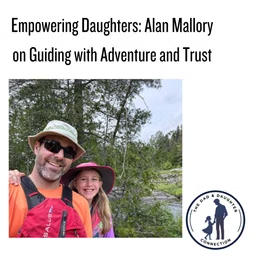
Empowering Daughters: Alan Mallory on Guiding with Adventure and Trust
The Dad & Daughter Connection
This week on The Dad and Daughter Connection, Dr. Christopher Lewis welcomed adventurer and performance coach Alan Mallory for an inspiring conversation on what it means to truly connect with your daughters. If you're a dad seeking real-world advice, heartfelt stories, and strategies to build stronger family ties, this episode is a must-listen.
One of the most impactful themes that emerged is the importance of quality time and shared adventures. Alan Mallory talked passionately about how he's embraced experiences with his two daughters, from spontaneous ski trips to months traveling across the country in a fifth wheel trailer. These journeys provided special opportunities, not just for fun, but for deep conversations and growth. "When it's just the two of us, you can connect on a deeper level," he shared, highlighting the magic of one-on-one time.
But beyond the adventures, Alan Mallory emphasized the vital balance between guidance and independence. He champions a parenting style rooted in mentorship rather than control: "You can't dictate the direction… you have to give them that latitude". This philosophy was shaped by his own experiences, like summiting Mount Everest alongside his family—and by seeing how trust and empowerment forge the strongest bonds.
Another powerful thread: fostering communication and emotional growth. Mallory admitted to struggling at times, especially when it comes to connecting on the emotional level, teaching us all that vulnerability makes for better dads: "I could probably think of a few times where I should have been more empathetic… and just listened". It's a message that resonates—sometimes the greatest gift we can offer is our presence and our ears.
For dads supporting daughters' passions or mental health journeys, this episode is rich with wisdom: encourage experimentation, be the gentle guide, and above all, show up—time is fleeting, and investing those hours pays lifelong dividends.
The Dad and Daughter Connection is a source of community and inspiration for fathers everywhere. Whether you're seeking reassurance or a nudge to start a new adventure, tune in—this conversation with Alan Mallory will remind you that being a great dad is about being present, facing the adventures together, and empowering your daughter to blaze her own trail.
Ready to strengthen your bond? Listen to the episode now and start building those lasting connections!
If you enjoyed this episode we ask you to take a moment to take our Dad and Daughter Connection Survey to let us know more about you as a dad. You can also sign up to get our newsletter to stay connected to our community and we will send items of interest to you to help you to be the dad that you want to be. Feel free to follow me on the following social media platforms: Facebook, Facebook Group, Instagram, LinkedIn, X.
TRANSCRIPT
Dr. Christopher Lewis [00:00:02]:
Welcome to the dad and Daughter Connection, the podcast for dads who want to build stronger bonds and raise confident, independent daughters. If you're looking to build a stronger bond with your daughter and help her grow into a confident, independent woman, you're in the right place. I'm Dr. Christopher Lewis, and the dad and Daughter Connection is the podcast where we dive into real stories, expert advice, and practical tips to help you navigate the incredible journey of fatherhood. In every episode, we'll bring you conversations that inspire, challenge, and equip you to show up as the dad your daughter needs. So let's get started, because being a great dad isn't just about being there. It's about truly connecting. Welcome back to the dad and Daughter Connection, where every week we have a great opportunity to be able to talk about, but also work on those relationships that we want to build with our own daughters one step at a time.
Dr. Christopher Lewis [00:01:04]:
And I'm so excited that you come back every week because we're all on a journey. We're all on a journey of trying to be the best dads that we want to be and the best dads that we can be. But to get there, we've got to put in the time. We got to put in the effort. We got to learn from other dads around us and see what they're doing, see what makes sense and what works for them. But maybe, maybe that will work for you as well, and that's why this podcast exists. This podcast exists to help you to be able to connect with other dads, but also to learn from some other dads that have different experiences. And I love being able to bring you different people with different experiences every week that can do just that.
Dr. Christopher Lewis [00:01:39]:
Today we got another great guest. Alan Mallory is with us. And Alan is a dynamic speaker. He's an author, he is a performance coach. But I saw him at a recent conference, and he was really talking about some of the things that he's done in his life to push himself beyond who he thought he was and who he thought he could be. He. In his presentations, he gives kind of a unique blend of psychology, engineering, project management, and some artistic flair to be able to make the presentations really a dynamic one. And in the conversation that he gave to the Rotary group that I was with, I loved the message that he gave because he really rooted his messages in his experiences, both as an adventurer, a mountaineer, but really talking about the things that he's done with his family, to be able to keep them, to bring them together and seeing that he is a father.
Dr. Christopher Lewis [00:02:33]:
Of two daughters. I wanted to bring him on to talk a little bit about his own experience in being a father to daughters. So, Alan, thanks so much for being here today.
Alan Mallory [00:02:41]:
My pleasure. Looking forward to it.
Dr. Christopher Lewis [00:02:42]:
Well, I'm really looking forward to talking to you today. And as I said, even before we started, I said this is kind of a topic that's a little bit different than ones that probably you talk about all the time. And I always start the interviews with an opportunity because I know that you have two daughters yourself, 12 and 8. And all of us as fathers want to create those moments, those meaningful moments, those things that we can share with our daughters that they'll remember but also will remember and that bring us closer together. What's one's, what's, what is the most meaningful moment that you've been able to share with your daughters and what made it so special?
Alan Mallory [00:03:15]:
I don't know if I could boil it down to one meaningful moment, but I mean, I've kind of emulated what my father did with me and my siblings and that spend a lot of quality time, especially out doing adventures with. With my kids. And so in many ways, I'm kind of blessed in the vocation I've chosen. I because I'm traveling all over the place, often I' bring one of my kids along and both my daughters always spent some amazing quality time. Even this past winter, different ski trips, for example, where it's just kind of a dad daughter ski trip, or when I have events in Hawaii or in kind of tropical locations, often they put their heads up to come along with those. And I found those particularly special when it's just the two of us and you can kind of connect on a deeper level and just have fun as well. It's not a chore if you're doing things that you would normally like to do anyway and that they'll like to do. And so we go kayaking or stand up paddleboarding or do some sort of adventure.
Alan Mallory [00:04:11]:
And I found those are the most special moments.
Dr. Christopher Lewis [00:04:14]:
Now your daughters are getting older and you've got that daughter that's a pre tween now and another daughter following not too far behind. And as they get older, they definitely push to get more independence. How do you balance guiding your daughters while still giving them that independence that they need to be able to grow into the people that they're bec.
Alan Mallory [00:04:34]:
Yeah, I mean, that's the balance that's hard to strike. And we, all of us, that are parents really go through that. One of my programs I share kind of A curve between. It's a parabolic relationship in that you have a mentor role that you want to kind of nudge your daughters in the right direction or what you believe is the right direction, but you can't dictate that direction. And that's what's almost makes the parenting journey such a roller coaster. They're their own people and sometimes they make. They need to learn through decisions that are made. And, you know, that's how we learn.
Alan Mallory [00:05:03]:
If we kind of prevent them from discovering and innovating and all of that, then they just end up with bigger problems down the road. And so it's through small. Allowing them the independence to make small mistakes in many ways, while providing that father mentor role that I think allows them to develop healthily. And it's a difficult balance to get. And I would say in many ways it's a balance that our society has really gone one way on. And that's this kind of, you know, over controlling, bubble wrapping our children rather than allowing them to make mistakes in life, for example. But if you want them to be strong, independent people, you have to give them that latitude. I'd say that's another thing that I learned from my father, for good or bad.
Alan Mallory [00:05:46]:
You know, he was always a very empowering person. We climbed Mount Everest in 2008, and this was with my father, brother, sister and I. And so also I was kind of learning from how he treated all of us, especially my sister in this case. There was one instance where basically we were in the death zone above 26,000ft. And he empowered her to kind of make her own decision, whether she wanted to continue on or not. And she was all by herself at that point because she had the altitude weakens your immune system. And so she had these awful sicknesses and she had actually internal bleeding, it was so bad. And.
Alan Mallory [00:06:18]:
But that was, you know, a difficult decision to make because obviously in a scenario like that, mistakes can be fatal, and often they are. But I think he's always kind of had that mentality and I've tried to do that as well. You know, you start small so that when they're young, allow them to make their own mistakes. You know, don't always be there to provide. Well, I mean, you're providing the safety rope kind of from a distance. I would say you don't want them to get badly hurt or die, but that's how they're going to learn. You learn through adversity. And when we take that adversity away, which we do out of kindness in many ways, Certainly in the Western society, we've lived pretty, what I say, good lives.
Alan Mallory [00:06:57]:
We don't have the same types of challenges that let's say our ancestors had. So we try to make life more comfortable for our kids. Well, that can be detrimental because they just don't learn. You learn through the adversity.
Dr. Christopher Lewis [00:07:11]:
Well, I'd be remiss to not push a little bit on the trip that you had on Everest. And, and I guess I'm not going to ask you to retell that story because you have some books that are specifically about that. But one of the things that I guess that I am interested in is having you talk a little bit about what you learned from that trip with your siblings and your f and how that experience has either helped you in being the father that you're becoming or has made you make some pivots in how you're fathering your kids in different ways.
Alan Mallory [00:07:45]:
Well, that was the ultimate family adventure, you might say. I mean, the stakes are very high. The need for healthy relationships is extreme because otherwise, 70 plus percent of the teens while we were there, they tore themselves apart from the inside out. And at that point it's everyone on their own and they have to just pack up and head home. And so being able to resolve conflicts effectively and quickly and say what needs to be said, even though it might inevitably result in a conflict, I think that's a big problem in a lot of families and father daughter relationships that in order to maintain the harmony in the here and now, you just don't say what needs to be said. It might cause someone to get upset. Well, the problem is these issues, they bottle up within people over time. And so every one of those said, what would you call them, items in order to preserve the relationship in the here and now, it just compounds and eventually it explodes.
Alan Mallory [00:08:44]:
And that's what tears apart family familial relationships. Now that's obviously true in spousal relationships. We see that all the time. But there's plenty of daughters that don't hardly talk to their fathers when they get married and they move off. And I see that all the time. And I want to, you know, I don't want that to be reality in my life. No, there's lots of, of factors you can't control. But again, I would say maybe I'm giving my dad too many kudos.
Alan Mallory [00:09:08]:
But when I look at his friend groups and so on and there's just lots of broken family relationships and he doesn't sugarcoat things, but more than anything, he just makes sure he creates time for doing things with his siblings. He still does. I mean, he's in his 70s now and I can kind of see in his eyes how much he really appreciates that, that his kids, they keep coming back. I mean, they kind of want to spend time with him and my mother as well. So I would love to able to create the same type of environment where your kids really want to still enjoy spending time with you. And part of the secret to that is get them involved young in things that you also are going to be interested in doing throughout your life now. So it's kind of a privilege. We all enjoy swimming and biking and mountain biking and kayaking and things like that.
Alan Mallory [00:09:56]:
And so it's not so much of chore when we're trying to get together. And I think if I can preserve that, if you aren't taking an active role when they're young, and I know some of our family friends, that this is exactly what happened. I mean, the kids kind of go a different direction. The parents are into hiking, the kids are into skateboarding, something like that. Now it's really tough. And I see in those family relationships how they can hardly get together for Christmas dinner. There's just no shared interests anymore. And certainly that tears the family apart, but certainly makes it a suboptimal situation to be in as you age.
Dr. Christopher Lewis [00:10:29]:
So how are you incorporating that mentality, that mantra into what you're doing with your daughters?
Alan Mallory [00:10:36]:
If I've maybe taken it to the extreme, you might say in terms of the different adventures, but again, it's kind of a. It dovetails well into the, the work I'm already doing because I'm traveling around. But we lived, for example, for a year on a fifth wheel trailer traveling around the. The southern United States. And every two days or so we were in some new amazing national park, state park. It was during COVID and so the kids were already doing online school. And so in the morning we would do schooling and then in the afternoon we'd be out biking and hiking and swimming and depending where we were. That was just an incredible trip.
Alan Mallory [00:11:15]:
I almost wanted to just stay on the rig and do a whole nother loop. It was so amazing. But those types of things, I mean, whether you like it or not, you're in close proximity in those in a fifth wheel trailer, for example. So yeah. And then whenever I can, especially the skiing, they've really taken to skiing. Both my daughters are just amazing, amazing skiers. And, and it happened quickly too. My eldest, I take her to Whistler and she goes Right down the double black diamonds through the trees and you know, my heart's skipping a few beats, but again, I tried it.
Alan Mallory [00:11:46]:
Well, she's got to learn her own limits here. I don't want her flying off a cliff and perishing. So I'll kind of be in watching things, but let her own. Make her own decisions. And I remember when we were there, thinking, it was only a couple years ago when I was taking her down the bunny hill at our local ski resort, going behind her to make sure she didn't kind of get out of control. But I think, did I teach them skiing? I mean, kind of the basics. But more than anything, I just gave them the latitude and the opportunity to figure out where their limits were and develop the skills themselves with a little bit of guidance here and then there when they wanted it. And so that's just wonderful going on those ski trips now.
Dr. Christopher Lewis [00:12:29]:
None of us are infallible. We're humans. We make mistakes. What's a mistake that you've made as a father and what did you learn from it about fostering better communication with your daughters?
Alan Mallory [00:12:41]:
What is a mistake? Well, I'm probably always making mistakes of some sort. I probably don't connect well on the emotional side as well as I should. I'm still a guy. I don't necessarily understand kind of the emotions and things, especially at that. The age when they're kind of going through puberty and so on. And so probably I could be better at just listening at times. I'm an engineer as well, and so I kind of like, like engineering our way out of these problems. But when there's, you know, those emotional challenges that we all go through.
Alan Mallory [00:13:14]:
Yeah, I could probably think of a few times where I thought, well, maybe I should have been a little more empathetic to that and just listened and really tried to see things from. From their perspective.
Dr. Christopher Lewis [00:13:24]:
That's definitely something that you have to do. I've heard that numerous times from numerous fathers and others about doing more listening than talking at times and. And being able to not come in trying to answer the question or to solve a problem, but let your daughter do what she can to be able to guide, whether it is either a solving conversation or a listening conversation. And that's something that I wish that I had learned earlier than not.
Alan Mallory [00:13:52]:
Yeah, no, it's interesting in some of my psychological background, you know, I remember reading this same type of thing over and over again when it comes to psychotherapy. You know, half the time the therapist is not really saying anything. You're just kind of there nodding, allowing the other individual to kind of work true in their own mind, in their own life. And surprisingly, that has just tremendous benefit. You just, you kind of need to be this sounding board that the individual can't do it on their own. They need someone there that's almost doing, you know, it's doing very little than listening, but it's tremendously beneficial. So the engineer in me says that makes no sense at all. But having just read about it again and again now, I realize as humans, you know, the human mind is not something that can be reverse engineered very well.
Dr. Christopher Lewis [00:14:41]:
And speaking about your background in psychology and now trying to raise kids and raise daughters, talk to me about that. And the juxtaposition between having the understanding of how the mind works but also being able to be the father and being able to be there for your kids in different ways and not bringing too much psychology into it at the same time.
Alan Mallory [00:15:06]:
I went the psychological direction because I had my own mental health challenges in my younger years. I had quite a severe social phobia, an anxiety disorder, generalized anxiety disorder. And so because I'm an engineer by trade, which is the polar opposite of psychology, but I started studying the human mind as I was trying to work through my own challenges. And I think what got me more and more interested in it is it started to work. I developed these different cognitive strategies that would allow me to quickly bring down elevated baseline stress levels, for example. And you know, I'd play a lot of these mental games that I would read about and, and kind of develop for my own purposes that would change my emotional responses in the here and now. And so now there's a genetic element to the predisposition to these types of mental health challenges. And I kind of see some of them in my daughters, for example.
Alan Mallory [00:15:57]:
And so I do want to be proactive in providing them the tools that are needed. Now I'm careful to even say that, that there's a genetic element because so many people just, it becomes a self fulfilling prophecy for them. You know, my father had this, my mot had this, my grandmother had this. I guess it's inevitable. I will. And I was actually told that many, many times by the different medical professionals that I thought saw my younger years throughout that journey. Basically you have this chemical imbalance that's leading to this. And almost all the time they just suggested medication.
Alan Mallory [00:16:28]:
And now I don't want to be too negative on medication because it obviously has a place, you know, when people are really at low points, sometimes anything that will help is the way to go. But I saw it as something that would kind of hide my symptoms rather than get at the root causes. So I never went down the medical pat. I developed cognitive strategies that would work. And I've tried to kind of, you know, when I've seen my daughters having, you know, who knows if they're. I think every kind of preteen has that type of thing. They have to develop their own strategies. So I.
Alan Mallory [00:16:59]:
I'm not saying necessarily are they going to be more predisposed than others to this type of thing, but I also just kind of notice when I was going through a mental health journey, you become hyper sensitized to, you know, noticing little twitches and things like that.
Dr. Christopher Lewis [00:17:14]:
Right.
Alan Mallory [00:17:15]:
Because I'm always so concerned about it in myself, or was at the time. So I've kind of tried to share those strategies that I've developed. Now. I wouldn't say I've shared them very effectively, or at least they haven't been adopted. And part of it is because I'm, I guess, the dad. You know, often they're like, oh, dad, maybe that'll work for you. But this is a different era and I can kind of relate to that because that's exactly what I said to most people who tried to share strategies with me, including the different psychologists I saw. Oh, yeah, I mean, yeah, it's easy for you to say that.
Alan Mallory [00:17:47]:
You're not living through this. And so I would mostly brush off the different things they were trying to tell me. And there was always a bit of truth in each one of them. And I really listened. I didn't really discover some of those, well, let's call them things that really helped in my life until I kept reading from people that were going through the same challenges that I'd gone through. And. And we're able to finally figure it out. And it was a combination of self education, learning how your mind works, but also kind of voluntary exposure therapy, and not getting out of your mind, stop fighting yourself, because it's a response to those symptoms, really, and the way that leads to this rumination that holds us, that perpetuates the disorder.
Alan Mallory [00:18:31]:
So when I try to share those types of strategies, I have to be careful, mindful of how I do it. And if I'm really kind of rushed in my own work, it's not effective. I think it's going to be through many years of just kind of, you know, providing little tools here and there. And this is what you should try, maybe give this a try. It worked in my life. And so hopefully I'm able to, you know, just provide what they need and maybe they won't. Sometimes this is just a natural stage of growing.
Dr. Christopher Lewis [00:19:00]:
And speaking of the mental health issues that you were dealing with yourself, how do you talk to your own daughters about that experience in relation to building that connection with them?
Alan Mallory [00:19:11]:
Well, in many ways I haven't in a lot of detail. I've tried to encourage my eldest daughter to read my second book because that's what it's all about. She finds it too boring because it's kind of psychological pace and she's into, you know, romance and adventure stories and that sort of thing. So I haven't. Wouldn't say I have been particularly effective in kind of sharing the whole journey and all the those strategies I've tried at times, but there hasn't been a lot of interest in it. It's kind of. So I don't know, maybe they're still a bit too young. Maybe they won't need those types of strategies.
Alan Mallory [00:19:44]:
I can certainly relate to how I found it frustrating to try to play the right mental movies in my mind, for example. Your mind almost fights back against it. It says, no, that's not what you need. I mean, this is futile. I mean, I should just analyze more. Well, the constant analysis of your own symptoms certainly just makes things worse and worse.
Dr. Christopher Lewis [00:20:04]:
Worse. You've had your own passions, your dreams, your things that you have tried to push yourself to do through your life, and the things that you continue to do. Talk to me about how you support your daughters in pursuing their passions and dreams.
Alan Mallory [00:20:17]:
Well, it's certainly giving them the opportunity. I guess they are still kind of discovering what their passions and dreams are. And I've seen that with my eldest. I would say, if anything, my wife and I are just trying to allow her to try different things because she doesn't seem to have. Have gravitated to particular sport or dream just yet. There certainly have been things that have captured her interest. We had her learning sign language for a while. Right.
Alan Mallory [00:20:44]:
But it let things wane and as they should. I mean, that's the whole idea. You want to just try as many things as you can and when you're young so you can kind of see what tends to excite you, I guess, and ideally align your vocation with. With whatever that is. So got them. I play the violin and so I've got them in both playing the violin. And that's just wonderful to me. And that's was a little frustrating to me in the early years because like I was when I was a kid, I just didn't want to do it.
Alan Mallory [00:21:10]:
I didn't want to practice it where you know, spending the time and energy and money in many cases to pursue that. And I had to keep reminding myself, well I gotta. This really isn't for them. Even though I'd love to be able to play with violin with my daughters, maybe they'll go a different direction now. In recent years they seem to have taken it a lot more seriously and I think it says they've gotten into the different festivals and started playing some fun songs that they recognize and enjoy and so hopefully that that passion will. Will continue to grow within them. But. And we've tried lots of different sports too.
Alan Mallory [00:21:46]:
My parents never got me involved in organized sports and we are trying that a little bit. Like my youngest is playing soccer for example and seems to really have taken to that. I guess the challenges with some of those organized sports is it consumes your life and for a lot of the adventures and travel and so on the that that certainly my wife and I like to do. It's tough if you're driving every weekend to different hockey tournaments and so on and so on. Maybe plots could argue. Well, maybe there is a bit of a selfish motivator there and I don't want to be a non stop taxi driver, but I see how it worked with my dad and he got us into running and biking and things that, you know, they were more like they're kind of individual sports versus large group sports like that and there's benefits in both. But they didn't consume our life. And that can be the challenge with.
Alan Mallory [00:22:32]:
And I don't want to sound like I'm being negative about organized sports. There's lots of benefits and you learn camaraderie and teamwork and all of that. But I look at some of my friends and they do nothing but drive around to different sports events.
Dr. Christopher Lewis [00:22:46]:
Now we always finish our interviews with what I like to call our dad connection. 66 more questions to delve deeper into you as a dad. You ready? Sure. What's one word that describes your relationship with your daughter?
Alan Mallory [00:22:58]:
Empowering.
Dr. Christopher Lewis [00:22:59]:
What's the best piece of dad advice you've ever received?
Alan Mallory [00:23:03]:
I don't know if I've received very much dad advice, but probably if I had to just choose what I've discovered, it would be, you know, spend as much quality time with your daughters as you can before it's too late, before they move on. Every, you know, every older father basically says the same thing. The time flew by.
Dr. Christopher Lewis [00:23:21]:
What's one Activity that you and your daughters love doing together.
Alan Mallory [00:23:25]:
I would say skiing.
Dr. Christopher Lewis [00:23:26]:
If you could give your daughters one life lesson in a single sentence, what would it be?
Alan Mallory [00:23:31]:
Probably to align your vocation with something that really you're passionate about.
Dr. Christopher Lewis [00:23:37]:
What's one thing you've learned about yourself since becoming a dad?
Alan Mallory [00:23:41]:
Maybe I don't have all the answers. I've still got a lot to learn.
Dr. Christopher Lewis [00:23:44]:
And what advice would you give to other dads who want to build a lasting and meaningful relationship with their daughters?
Alan Mallory [00:23:51]:
That one's easy. You've got to carve out the time. You've got to be doing adventures all the time. The father daughter relationships that fall apart. I think it's dads that are just too busy with other things. And it's a tough balance. I mean, you've got to also make a living, provide for your family in all of that. But you can't go back.
Alan Mallory [00:24:10]:
Once the time is gone and you haven't invested those important hours and days in the relationship. Then was it all worth it? I mean, there's so many people that have regrets when they get older.
Dr. Christopher Lewis [00:24:24]:
So now, Alan, I know you've got a lot of things going on. If people want to find out more about you and your books and everything else that you're doing, where should they go?
Alan Mallory [00:24:34]:
Well, my website's pretty comprehensive. It's just Alan Mallory.com a L a N and have a YouTube channel. And I put various videos on there. My electric violin and my different adventures and so on. And yeah, those are probably the. The two places to start.
Dr. Christopher Lewis [00:24:48]:
And I will tell you, check out his electric violin. He is an amazing electric violin player. And I was really impressed. I didn't even know that he was playing at the event that I was playing. And then I looked up and I'm like, oh, this is Alan playing. And it was great. So I really encourage you to check out all of that. We'll put some links in the notes today.
Dr. Christopher Lewis [00:25:08]:
And Alan, I just want to say thank you. Thank you for sharing some of your journey today. I look forward to hearing more about the adventures not only that you have, but the adventures that you're having with your kids and being able to live a little vicariously through what you're doing. And I just want to say thank you and I wish you all the best.
Alan Mallory [00:25:25]:
My pleasure. Thank you.
Dr. Christopher Lewis [00:25:26]:
That's a wrap for this episode of the dad and Daughter Connection. Thanks for joining us on this journey to be build stronger bonds and raise confident, independent daughters. Remember, being an engaged dad isn't about being perfect. It's about being present. If you enjoyed this episode, be sure to subscribe and share it with a fellow dad. And don't forget, you can find all our episodes@dadanddaughterconnection.com until next time, keep showing up, keep connecting, and keep being the dad she needs.
Alan Mallory [00:25:57]:
We're all in the same boat and it's full of tiny screaming passengers? We spend the time, we give the lessons, we make the meals, we buy them presents and bring your A game? Cause those kids are growing fast? The time goes by just like a dynamite blast? Calling astronauts and firemen, Carpenters and muscle men? Get out and be the world to them? Be the best dad you can be? Be the best dad you can.