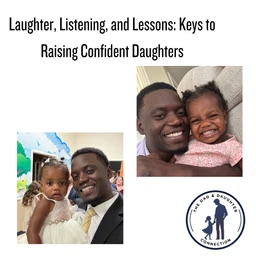
Building Unbreakable Bonds: Chris Singleton on Fatherhood and Love
The Dad & Daughter Connection
In the latest episode of The Dad and Daughter Connection, host Dr. Christopher Lewis welcomes an extraordinary guest: former professional athlete, best-selling author, and inspirational speaker Chris Singleton. This heartfelt conversation dives deep into fatherhood, resilience, and the profound ways dads can nurture strong, confident daughters, even amidst life's toughest challenges.
Chris Singleton opens up about the joy and responsibility of raising his young daughter, sharing intimate stories—like their first daddy-daughter dance—that remind us how essential it is to be present and cherish each moment. He emphasizes intentional fathering, recognizing that quality time matters more than quantity and that even simple routines, like reading together or affirming your child's beauty, play a vital role in building self-esteem and resilience. As Chris Singleton says, "Your presence, it matters. Even when you think they don't see you there… your presence, it matters" 28:18.
A powerful part of the conversation addresses difficult topics: teaching compassion, navigating conversations about differences, and helping children process a sometimes divided world. Inspired by his personal journey through tragedy and the loss of his mother, Chris Singleton shares how he uses children's books and open dialogue to foster empathy and curiosity in his children. He encourages dads to model respect for all, even when encountering different beliefs or backgrounds, and to proactively address hard questions rather than shying away from them.
Other highlights include practical advice for approaching conversations about race, mistakes Chris Singleton made early in fatherhood, and strategies for raising compassionate, curious kids in the age of social media. Vulnerability plays a central role; letting children see emotion and grief, he explains, not only builds trust but also reassures them that it's okay to feel and share openly.
Ultimately, the episode offers a hopeful message: embracing love, forgiveness, and open-mindedness at home can prepare the next generation to lead with unity and understanding.
To every dad looking to grow deeper connections with his daughter—and to anyone seeking inspiration in today's world—this episode is a must-listen. Hear the full story and practical tools by tuning in to The Dad and Daughter Connection—it may just change the way you parent, and the way you see the world.
If you enjoyed this episode we ask you to take a moment to take our Dad and Daughter Connection Survey to let us know more about you as a dad. You can also sign up to get our newsletter to stay connected to our community and we will send items of interest to you to help you to be the dad that you want to be. Feel free to follow me on the following social media platforms: Facebook, Facebook Group, Instagram, LinkedIn, X.
TRANSCRIPT
Dr. Christopher Lewis [00:00:02]:
Welcome to the dad and Daughter Connection, the podcast for dads who want to build stronger bonds and raise confident, independent daughters.
Dr. Christopher Lewis [00:00:12]:
If you're looking to build a stronger bond with your daughter and help her grow into a confident, independent woman, you're in the right place. I'm Dr. Christopher Lewis and the dad and Daughter Connection is the podcast where we dive into real stories, expert advice, and practical tips to help you navigate the incredible journey of fatherhood. In every episode, we'll bring you conversations that inspire, challenge, and equip you to show up as the dad your daughter needs. So let's get started. Because being a great dad isn't just about being there. It's about truly connecting. Welcome back to.
Dr. Christopher Lewis [00:00:53]:
Welcome back to the dad and Daughter Connection, where every week we have a great opportunity to be able to talk together, to work together to help you to be able to make those meaningful connections with your daughters one step at a time. It's not always going to be easy. It takes time, it takes effort, and you do have to work at it. But it is so important to put in that work and to know that putting in that work is you are going to be able to build those connections and build those true bonds with your daughters that you want to have every week. I love being able to bring you different people with different experiences that are offering you an opportunity, an opportunity to be able to learn, to grow and to put some, I'm going to say, tools in your toolbox that you can take with you. And you may not take everything, but my hope is that you have an opportunity to be able to take something, whether it's one thing, five things, 10 things that you're like, ah, that's something that I'm connecting to. And, and today we got another great guest. Chris Singleton is with us.
Dr. Christopher Lewis [00:01:55]:
And Chris is a former professional athlete who played for the Chicago Cubs. And following the loss of his mother in a racially motivated mass shooting, Chris has now become a nationally renowned inspirational speaker and best selling author. And he travels all over the United States and beyond to be able to spread a message of love, of compassion, and of really helping others to be able to think, think differently about the world around us and how we talk to one another, work with one another. But even beyond that, he's a father of three and he's got one daughter. So we're going to be talking about his own experience in being a father to a daughter. And we'll also talk about some of the journey that he's been on and some of the things that he has been doing with his own kids to be able to help them to live in the world that we're in today. So I'm really excited to have him here. Chris Singh, thank you so much for being here today.
Chris SIngleton [00:02:53]:
Absolutely, man. I'm grateful to be on talking about my baby girl. Girl, love it.
Dr. Christopher Lewis [00:02:57]:
Well, I'm really excited to be able to be here today and to talk to you. I know we just saw each other at a recent conference that you were speaking at, and this is a topic that you don't always get to talk a lot about. You mentioned your daughter in your speech, but I love it when we get to delve into fatherhood. And I guess first and foremost, I wanted to ask you about that relationship with your daughter. And I know she's still young, but in her life so far and in your life with her so far, what's one of the most meaningful moments that you've been able to share with your daughter thus far and what made it so special?
Chris SIngleton [00:03:28]:
Yeah, I think one of the most meaningful moments thus far is the first daddy daughter dance we did. You know, she's almost three. And so at two years old, that daddy daughter dance and she was actually dancing. I was like, oh, it's just going to be just her standing around and no, she was getting after dancing and wiggling and we had a great time. And there was a point where, you know, one of the older girls at their school started dancing with her and I just saw her. I was getting like a little emotional. Like, man, this is what a blessing it is that I get to be her dad and not only protect and provide for, but just be her friend. As she grows older and I'm looking at her, I just started getting emotional.
Chris SIngleton [00:04:06]:
So that was probably a moment where I actually stopped and just felt the moment. Because so frequently you have these experiences with your kids and you're just like, oh, it's an experience. You don't really stop and just take it all in. And that's one that I know in 20 years I'm going to remember that first daddy daughter dance that we did and how I was getting emotional. Like, man, how cool is that? I get to be her dad. So that was one so far.
Dr. Christopher Lewis [00:04:27]:
And like you said, your daughter is still young, but I'm sure that there are some ways in which some intentional things that you're trying to do to be able to strengthen your bond with your daughter. So talk to me about some of those things that you tried to do intentionally with your daughter to be able to build that Unique bond with her versus what you're doing with your sons.
Chris SIngleton [00:04:46]:
Yeah. And I think it's super important because my boys, I coach them in baseball, I coach them in sports. And so she sees me doing this. We know. Even when we do bedtime, sometimes we'll take the boys to bed first, and they'll be talking about me coaching them. They'll be talking about something baseball. And then my dad said. Then my daughter says something about, hey, Daddy, what about me with ballerina? Or what about me with this? And I'm like, you know, daddy loves that too, sweetie.
Chris SIngleton [00:05:09]:
And, you know, I can't wait for you to go to your ballerina class on Friday. And so we have those same moments where it's like, yes, I have my time with my boys, and I kind of combine the time with the boys sometimes, but I need to do a little better about splitting them up. Hey, older son get some time. Younger son gets some time. And most of the time, it's like, hey, Daddy, with the boys. And then it's like, daddy with baby girl. And whether it's just reading with her the other night, I noticed it because I didn't notice this with my boys. How.
Chris SIngleton [00:05:33]:
And I don't know if you know, the stereotype is girls learn so much quicker. They're so much smarter than boys when they're young. But my daughter was literally sitting down in her. In the rocking chair that we usually sit in before bedtime, and she was flipping through this book as if she knew exactly what she was doing at 2 years old, and she's pretending like she's reading, and I'm sitting there smiling at her, and it was a beautiful moment. I've got this nickname for my daughter, and of course, I told you guys at the conference that I call her Chocolate Chip. And so every time I'll say, hey, who's my Chocolate Chip? And she's like, I am. And I said, do you love dad? She's like, yes, I love Daddy. And so we have these little small moments.
Chris SIngleton [00:06:07]:
But I know one day when she's a little older, I might be dropping her off at school. And I'm like, who's Daddy Chocolate Chip? She's like, dad, come on. So I got to cherish these moments right now. And I surely, and I truly am
Dr. Christopher Lewis [00:06:17]:
now, no dad is infallible. We all make mistakes. We're humans. And I guess even this could be with your sons, too. But with your daughter, what's a mistake that you've made? And what did you learn about fostering positive connections? With your daughter?
Chris SIngleton [00:06:33]:
Yeah. I think the biggest mistake so far is just thinking when I'm spending time with all three of my kids, that I'm spending time with every single one of them. And I didn't do that with my daughter. I'm picking my boys up from school, we're taking them to the batting cage real quick, Then we're going back to get baby girl. Or it's like, hey, my middle child likes to play golf, and so I'll go play golf with him. I'll let the oldest stay at home. And I'm spending quality time one on one with my older boys. And I wasn't doing that with my baby girl.
Chris SIngleton [00:06:57]:
And my excuse, because we have to give ourselves excuses. I used to say, man, she's so young. Can I do with her? And I realized you can do literally everything with her, too. And so I started to try to be more intentional about saying, hey, maybe this Friday I'm picking baby girl up early, and I'm taking her with me. Whether I'm riding around to the bank or whatever it is, just having her with me, spending that quality time, not just all three kids, but just with her. And I think that was probably a mistake I made early, is just having the excuse. Well, she's so young, I don't know if I can do anything with her. And I realized once I started bringing her with me, it doesn't matter.
Chris SIngleton [00:07:28]:
You can take her just about anywhere. Even if we're on the golf course, she'd like to just sit in the golf cart drinking juice box by herself and watch Ms. Rachel. So, like, sometimes it's just bringing her with me and not using the excuse, oh, well, she's too young. I think that's a mistake that I made early on.
Dr. Christopher Lewis [00:07:43]:
Every one of us, as fathers of daughters, are doing what we can to be able to try to help our girls to feel both valued and heard. What have you done thus far to help your daughter feel that in your relationship to date?
Chris SIngleton [00:07:59]:
Yeah. I think every kid, but especially daughters, they find their confidence, they find their beauty, and they'll ask daddy or mommy, hey, do I look beautiful? And my daughter is obsessed with those words. And so every morning when we get baby girl dressed and we'll put clothes on her, she doesn't like it, she'll let us know immediately if she doesn't like the clothes. So we already know at a young age she's going to be some type of fashionista. And so she will put on her clothes. If it's not a dress, she doesn't want it. So we have to change her clothes and put on a dress and we finish and we do her hair, whatever it is, she'll always give a little twirl and say, daddy, do I look beautiful? And I think she's asking for that recognition. And I tell her every time I say, baby girl, you're beautiful before, and yes, you're beautiful right now.
Chris SIngleton [00:08:41]:
And so just hearing those words, I think is so important. Building that self esteem, knowing, hey, in my faith, I'm fearfully and wonderfully made, like God made me the way that I am, and I'm beautiful on the inside and out. And just hearing that from dad, I think it hits deep. Because yes, she asked mom, but she always runs to me and asks me to, hey, daddy, do I look beautiful? And she does a little twirl and I say, baby girl, you look so beautiful. And you see that smile, you see that confidence. And I never want that confidence to waver. And so as kids grow, there's middle school where kids use mean words for no reason, but it's just part of the gig. And there will be a time where I'm sure somebody's going to say something about my daughter that, you know, isn't the nicest thing.
Chris SIngleton [00:09:19]:
And my hope is that she's heard from her mom, from her dad, from her family, like, I am beautiful, I am amazing, I am smart, I am courageous, I am all these different things. And so if she hears otherwise, it should be in one ear and out the other, because she knows she is. And that's what I'm trying to instill at this young age. And hopefully she gets older. I'm sure there's going to be still be those parts of her where she's, you know, crying because X, Y and Z happened. But I want her to know deep down inside, hey, I've always heard who I am as a person. And so if somebody has something else to say about me, that's a problem with them and not with me.
Dr. Christopher Lewis [00:09:52]:
I mentioned at the beginning that you speak all over the world. You have been bringing a message of love, your neighbor, to the world in many different ways. And your message of love, your neighbor really came out of an incredibly personal tragedy. How has becoming a father changed the way you think about that message today?
Chris SIngleton [00:10:14]:
Yeah, well, I think initially the only reason why I started writing children's books is because I'm thinking, how do I even tell my own kids about my story? It's very traumatic. It's very glass half empty type of story. Not message but story, I mean, just losing my mom the way that I did and having to tell your kids that, you know, unfortunately there are some people that hate others because of the chemical in their skin that makes them the color that they are or telling your kids, hey, unfortunately, there's people that judge others based on their first language and all these different things that they're hard conversations to have with your kids, especially when there's tragedy involved. And so writing children's books is the way that I said I can talk about tough things in a non traumatic way. And so yes, there's going to be conflict in my children's book, but it's not conflict of losing a life. It's a conflict of maybe a kid gets picked on because the clothes that they wear or maybe their hair is a little different or maybe they wear glasses or whatever it may be and so they feel a little different. But in the end of my stories, they're always celebrated, no matter where they're from, what they look like or what makes them different. And sharing this with my kids, sharing it with kids all across the country in the world, kids start to look at each other a little different, like, oh man, okay, so we all have something that makes us different.
Chris SIngleton [00:11:17]:
Maybe my grandma does raise me, that makes me a little different. I don't have my mom and dad raising me. But you know what, that's okay. This person's a little different because maybe they're on the spectrum or maybe they wear glasses or I've even had kids would say, hey, Chris, I've got six fingers and I thought I was the weirdest kid in the world until you showed that everybody has something that makes them different. Now, you know what? I'm not ashamed of my difference. It's what makes me who I am. And so sharing this with my kids, sharing it in children's books is the easiest way for me to talk about tough things in a non traumatic way. And it's been a blessing to be able to do that.
Dr. Christopher Lewis [00:11:47]:
As I thought about that, as parents, many of us want to raise our kids who are compassionate and empathetic, but we also know that the world can be divided. What would you say are some practical ways that dads can intentionally model love and respect at home?
Chris SIngleton [00:12:01]:
Yeah, I think first and foremost, I think there needs to be. You have to teach your kids there's a certain level of respect we have for everyone. In doing so, you say, hey, this is maybe not the way that we do it in our family, but some families out there do it that Way. Now, you don't compromise on the things that you believe in and things that you hold near and dear to your heart and your morals, but you acknowledge that, hey, to your daughter, like, hey, this is the way that some people do it. Now, we don't think that way, we don't believe that way, but we still going to respect them because that's how they think, and that's how they believe. I think having that conversation early on and letting them know you don't have to compromise on who you are to just acknowledge that somebody else does something different is powerful. So doing that, I think it's been really cool to see that in the progression. And then it also, when your kids ask you questions, you got to be able to answer them, because even at a young age, it's like, hey, well, dad, what are they saying? It's like, oh, well, that's Mandarin, right? That's not what we speak, but that's a language out there.
Chris SIngleton [00:12:55]:
Or you see families that look totally different than yours. You're like, well, dad, what is that? And you're like, well, hey, that's not the way that we do it, but that is out there. And so I just want to teach you and let you know that things may be different out there, and maybe that's not what you believe or what I believe as a family, but that's out there. And I think sharing that early on helps people, especially our daughters, understand. Okay, just because it's different doesn't mean we have to hate or doesn't mean we have to do that, because that's not what we do. But we can still acknowledge that that could save some kids and our daughters from. From learning things elsewhere and not talking to us about it.
Dr. Christopher Lewis [00:13:30]:
I mentioned that you speak to organizations and schools and other groups across the country about and connection. What conversations do you think that parents are avoiding right now that they actually need to be having with their kids?
Chris SIngleton [00:13:46]:
Yeah, just the one I just shared, right? Talking to kids about how some families may look different or how, like, I'll give you a prime example. When my oldest was five years old, he went to school and he told me how one of the. One of his classmates had two moms, and he's like, well, dad, you know, where's. Where's your dad? And I was like, hey, well, this is how they do things, their family, dad. It's a little different than what mommy and daddy have, but that is out there. And so sometimes as parents, we're like, man, I don't want to talk about that, like, they're shying away from it instead of leaning in and letting their child know, hey, this is out there. But that's just not what we do in our family, in our household. And as awkward as it is, as nervous as it makes you to talk about certain things, believe it or not, the kids are seeing it, and they're putting two and two together in their own minds.
Chris SIngleton [00:14:29]:
And so they need Daddy to be there. They need parents to be there to kind of navigate that for them so that they're not questioning everything else. That's what I'd say is important. And don't shy away from it. You gotta lean into it. In one of my books, I say loving everybody, whether their skin is darker or lighter, whether their skin is looser or tighter, their hair is looser or tighter, whether their skin is wrinkled or rough. Why should it matter? Love is enough. And so we're talking about different people and different things.
Chris SIngleton [00:14:54]:
You know, some people are on the back end of life, and we just share all these different intricacies about being a human being, and we're talking with kids about that, and I think that's beautiful.
Dr. Christopher Lewis [00:15:03]:
So the reality is that difficult events happen. Things do happen. People see it in the news, and some of these do involve race, hate, or violence. How do you think that fathers can approach those conversations with their kids in age appropriate but meaningful ways?
Chris SIngleton [00:15:18]:
I will say one mistake I made as a. As a dad is sometimes I talk to my oldest. Because, you know, you're your first. Your oldest is like your guinea pig. You're just. You're doing everything you can trying to figure it out, right? And I wouldn't let my son have Nerf guns. I wouldn't let him play, like, shooting video games. And one day he finally like, why can't we do this, dad? And I said, because, you know, Daddy lost his mom to a person with a gun, and it was a very hateful guy.
Chris SIngleton [00:15:41]:
And so then my son became very scared of just anything with guns. And I said, man, I probably told him that a little too young. And so what I should have probably said, going back is like, hey, we're not gonna do that, because Daddy doesn't like those. And when you get a little older, they'll tell you why. And so when things happen in our world, maybe explain it in a way that, you know, maybe that's not teaching love. Maybe that's not loving people like we should and how Daddy's gonna teach you. But that is out there, and that's why I'm. It's so important that I'm teaching you this because I never want you to feel that same way too.
Chris SIngleton [00:16:10]:
And so explaining it in that way early on is important. And then as kids get older, especially middle school, oh, my goodness. We think because middle school is the age where you want to shelter them, but life is being thrown at them because some kids are growing up a lot earlier than others and so they're hearing stuff. And so we have to be proactive in saying, hey, this is what we think, this is what we believe. And yes, this is happening in the world and it's terrible and you know, we hate to see it, but that's why I'm teaching you the lessons that I'm teaching you, because I want you to know I want us to lead with unity and love the way that I think that we should.
Dr. Christopher Lewis [00:16:40]:
You know, your story is rooted so much in forgiveness. How do you teach either your kids or other kids the difference between forgiveness and ignoring wrongdoing?
Chris SIngleton [00:16:51]:
That's beautiful. I think even when we give consequences to our own kids, it's like, hey, I was in a small group with parents and one of our themes was I learned it from a dad who was phenomenal. So I use it all the time. And when we discipline our kids, we say, hey, I'm doing this to either keep you safe or make you better. Single time. I'm either doing this to keep you safe or make you better. Well, dad, why can't I do X, Y and Z? Because I want to keep you safe. Doing that is going to hurt you or hurt somebody else.
Chris SIngleton [00:17:17]:
But dad, why can't I do X, Y and Z? Well, I want to make you better. You're not getting better as a person by doing that. So that's why we have this consequence, right? And so in every scenario, sharing that has been really neat. And so I use it for everything. I mean, literally everything. Daddy, why can't I have, you know, candy right now? It's 9:30. You know, eating candy right now. You know, you probably don't want to brush your teeth like you're supposed to.
Chris SIngleton [00:17:40]:
That's not going to keep you safe, right? You're going to have cavities. You're going to do X, Y and Z. It's been a huge tool for me even as my kids get older. Well, dad, why can't you buy me the nicest car? Well, I don't think that's going to make you any better. You got to have some sweat equity in this deal. And so if I give you everything, I'M not making you better. And so I'm going to use that with everything. And I think that's the tool that all dads should have when they.
Chris SIngleton [00:18:01]:
They had to discipline their kid or have to say no.
Dr. Christopher Lewis [00:18:04]:
You know, a lot of dads worry about saying the wrong thing when talking about race or bias with their kids. What kind of encouragement would you give to parents who want to start these conversations but are feeling uncomfortable?
Chris SIngleton [00:18:16]:
Yeah, well, we have to do the work on ourselves first and figure out, make sure we're in a good space to teach. Because the worst thing you could be is a hypocrite and you're telling your kid to do something and you're doing the exact opposite. And so I think that's the number one thing. You lead by example. I don't want to touch back on the whole forgiveness piece just really quick, because I don't want to rush past that. When I think about forgiveness, forgiving doesn't mean that there's no consequence. There's no accountability. Right.
Chris SIngleton [00:18:41]:
So if I forgive my daughter for doing something, I'm still going to say, hey, you still got time out. I still love. You know, I love you, but you still have to sit in time out for a minute because that was not kind to do. That was not smart. You didn't listen. So it doesn't mean that I forgive and just pretend like it didn't happen. No, you've got to learn from your mistakes. But I also say my faith, belief, forgiven.
Chris SIngleton [00:19:00]:
And we all are forgiven if we receive that. And so it's a line where it's like, hey, there's accountability, but there's also grace. And I think you got to have both. And so I want to just touch on that really quickly because I don't want people to think that forgiveness is letting the person off the on the hook. No, there's going to be consequences, But I forgive to move forward. And I think that's big.
Dr. Christopher Lewis [00:19:18]:
Some of the things that you're talking about really are. I'm hearing you, that you're encouraging your kids to be curious. They really try to see the world in a broader view. What are some simple habits that, that dads can build into their lives that help their kids to grow up with a mindset of curiosity instead of fear toward others?
Chris SIngleton [00:19:38]:
I think a big one is watching sports. You know, I said, we're gonna talk too much sports. But, you know, you got the World cup coming up. You had the Olympics. You know, when the Olympics are here, learning about different countries. Well, dad, what's Botswana. I don't know. Let's look it up real quick.
Chris SIngleton [00:19:51]:
Let's look up what they do in Botswana. Let's look up their culture. So having these. These conversations is really cool. In our household, soccer is big because my wife is from Brazil. And so because my wife's from Brazil, I'm sure my daughter's gonna grow up playing soccer because mommy's gonna want her to play soccer like my wife did. And so, you know, you're gonna learn about different cultures. You know, the more that you play sports, and if you're a dad that likes sports, you know this.
Chris SIngleton [00:20:13]:
The longer you play sports, the more that you'll play with people that are from different places, different cultures, different whatever. And that's a beautiful thing to teach your daughter. One of my friends, his daughter was actually really, really good in soccer. And then she started playing in college, and she started playing with girls from around the world, and she's like, whoa, you know, there's different levels to this. And you realize that once you start playing at a higher level. And so watching sports, learning about different countries, the World cup, the Olympics, and then you dive deep when you watch with your daughter, like, hey, let's look up Morocco. I always love looking up language, food, and where it is on the map. And so those are three things I love looking up.
Chris SIngleton [00:20:49]:
And so if we're watching France, because we think France is going to win the World cup, and we're like, let's look up France. Let's see what they got going on over there. And having those conversations, it's fun, and it's in a proactive way. And then when something may happen in the world, you're not, like, circling back, man. I don't. You've never talked about this place before. It's like, no, we want to be upfront about different places in the world.
Dr. Christopher Lewis [00:21:09]:
I'll ask you one other question about sports, and that really comes down to the fact that I'm sure that there are things that have happened in your life through sports that have provided you some lessons and things that have helped you to be the father that you are. So what lessons from sports or teamwork have influenced the way in which you father your kids? Kids?
Chris SIngleton [00:21:27]:
Yeah. Well, I. I've read some statistic, and I'm going to butcher it, but I. I saw, like, most women in leadership played sports at a young age, and I don't know what the percentage was, but it was a high percentage. A high, high percentage. And so, dad, you guys can look that. That percentage up So I think sports are good just to put your daughters in sports. I think it teaches accountability, it teaches leadership.
Chris SIngleton [00:21:46]:
It teaches leading by example, because your teammates won't buy into anything you're saying unless you're doing it too, so you got to do that. It also teaches failure. Failure and realizing, hey, we're not going to succeed in everything all the time. But how you respond to that failure is everything in life. And so if we turn the ball over in basketball, or we strike out with the bases loaded in softball, or if we miss a free throw when we really needed to in basketball, like, whatever it is, how we respond to that is how we will make up majority of our lives. So those are some things that sports has taught me as an athlete.
Dr. Christopher Lewis [00:22:16]:
You know, I think about the world today and how social media has really created a lot of division. How do we help kids hold on to hope and kindness when they're constantly exposed to negativity online and in the media?
Chris SIngleton [00:22:31]:
Yeah, I actually did some work with our legislators about this because I saw that social media has just become so divisive. And I love the stories where it's like the kid with a lemonade stand out at the first tee, raising money for his buddy in school that has cancer. I love those stories. We need more of those stories. But it seems like we get pushed and we get fed the beast of the algorithm is anything divisive just gets. Gets pushed to us even more. And so censoring or monitoring what our kids are watching are engaging in is important. And then making sure, because we have to make sure that our kids aren't the ones that are bullying or on the other side of that.
Chris SIngleton [00:23:07]:
And we all think, especially our daughters, like, oh, our daughter is just. She's so amazing. She's the nicest person ever. She would never. Until we started reading some of the stuff that they're posting, we're like, hey, we might have to have some conversations. So being proactive and not being blind to that is important as well, because we never think it'd be our kid to be the bully until we find. Find out that it's our kid that's the bully. And so just monitoring what they're watching, what they're saying.
Chris SIngleton [00:23:28]:
And then I always say there is. It is a blessing and a compliment to have high expectations for your kids. And so with our daughters, I have high expectations that you won't do this online, you won't say this online, you won't be that person online. And so if that's my expectation for you, it May be high because I'm monitoring your stuff. I'm making sure you don't say X, Y and Z. I'm doing that at a place of love because I have these expectations for you. You. And making sure that the algorithm that they have isn't one that's going to fuel hatred and division.
Dr. Christopher Lewis [00:23:57]:
You know, you've inspired a lot of audiences through vulnerability and honesty in what you share in front of the groups. How important is it for dads to let their kids see emotion, grief, and healing?
Chris SIngleton [00:24:11]:
Oh, my goodness. It's so big. Because if our daughters, our kids especially, just grow up thinking that dad doesn't show any emotion, sometimes they're gonna think they shouldn't show emotion or they're not going to come to us because he won't understand. Because I've never seen him get sad, right? So if they're sad, you know, I probably can't tell dad because he won't understand. I've never seen dad sad before. Now, if we're open and vulnerable, it's like, you know, I can come to dad with anything because I've seen him have the same emotions that I felt and he's going to feel with me when I share this with him. I think that's big. And for so long as husbands and fathers, we think, man, we have to be that rock that nothing shakes us.
Chris SIngleton [00:24:46]:
Us, right? We're the foundation of the family, and nothing should shake us or hurt us. But in doing so, sometimes things won't get to us because, hey, he's not going to understand. He won't get it. Because I've never seen him say that he messed up, or I've never seen him say that he's grieving right now. And so I think it's so important that we're open and honest with our feelings and our emotions. Even other day, I'm watching a video in the car, and I saw this video. It's like this kid had his dad at one of his games, and before the game, he got his son a new baseball bat. He hit a home run for his dad on Father's Day, the dad catches it outside of the fence, and he's like, I got it.
Chris SIngleton [00:25:23]:
I got your home run ball. And you see the son kind of point to the dad, the outfield. And I'm crying real tears, man. And my daughter, my son, they're like, dad, are you okay? I said, daddy's fine. But this made me feel emotional because this is a beautiful moment. And so I have happy tears right now, guys. And so like having those conversations, them, they see that dad has feelings too. And yes, we're strong, yes, we're going to protect our baby girls, our daughters.
Chris SIngleton [00:25:48]:
But they need to know, hey, we have feelings too. So anything that they feel they can share with us as well.
Dr. Christopher Lewis [00:25:53]:
What legacy do you hope to leave not only through your speaking, but through your role as a father?
Chris SIngleton [00:25:58]:
Yeah, one non negotiable that I have as far as my legacy is. I don't want my kids to ever think daddy made a huge impact on the world, but he didn't make a huge impact on us. I think that's a, a huge failure as a man that I could have is if I do that, I want them to say Daddy was an amaz person. Not only to people around the world, but to us. He was dead. He was at our daddy daughter dances, he was at our games where we had our first hit or our first home, whatever it may be, he was there. It's just being active and knowing that they have somewhere to run to or to talk to is huge. And then all the life lessons that I share with them, you know, I just hope that they keep 10% of them.
Chris SIngleton [00:26:32]:
That'd be my legacy. Right. I'm sharing stuff all the time and make sure you're saving. We're gonna do a Roth IRA for you young so you can do X, Y and Z. All these things. I just hope that they remember something of this stuff that I'm instilling in them and in doing so, maybe they run into a problem when they get older and they'll say, you know, my dad always told me, and then they'll share something else and that'd be huge legacy for me.
Dr. Christopher Lewis [00:26:52]:
So if every family embraced the idea of loving their neighbor, how do you think the next generation would look different from the one we have today?
Chris SIngleton [00:27:00]:
Man, what a beautiful question. I think that kids will grow up knowing that there's going to be differences in the world. There's going to be different faiths, there's going to be different languages, there's going to be different. Different Everything doesn't mean different means bad. My wife is from Brazil and in Brazil the culture is all family. You don't really move away too much in their culture, right? You don't go away for college. I know you've got daughters that are going to college and all this stuff and they're kind of moving away. And that's not really the culture in Brazil.
Chris SIngleton [00:27:26]:
It's all about family and having dinner together on Sundays. And so sometimes we could say you know what? Maybe I want that culture for me, even though I'm American. When you learn about something different, when you learn that, you know, sometimes times in some cultures they don't use technology, they just sit around the table and talk and have meals together on certain days. I like that. And so maybe we can put that into our family values as well. And that's beauty. When you see that when kids growing up, that different doesn't mean bad. Different just means different.
Chris SIngleton [00:27:54]:
I think our world would be a lot better place now.
Dr. Christopher Lewis [00:27:56]:
I always finish our interviews with what I like to call our dad connection. 66 more questions to delve a little bit deeper into you as a dad. You ready?
Chris SIngleton [00:28:03]:
Let's do it.
Dr. Christopher Lewis [00:28:03]:
What's one word that describes your relationship with your daughter?
Chris SIngleton [00:28:08]:
I'd say right now it's just very gentle. Right now, gentle is my word.
Dr. Christopher Lewis [00:28:12]:
What's the best piece of dad advice you've ever received?
Chris SIngleton [00:28:17]:
Your presence matters. Is the best advice I've received. Your presence, it matters. Even when you think they don't see you there and you're just there for six hours, or are they really going to care? They're so young. Your presence, it matters.
Dr. Christopher Lewis [00:28:30]:
What's one activity that you and your daughter love doing together?
Chris SIngleton [00:28:34]:
Right now I'd say he's reading books together. She loves that. So reading is our activity right now.
Dr. Christopher Lewis [00:28:38]:
If you could give your daughter one life lesson in a single sentence, what would it be?
Chris SIngleton [00:28:44]:
Hard work is important. Would probably be. My biggest thing is like, hey, working hard is important. In a world where AI makes stuff easy and there's shortcuts to everything, hard work is still super important.
Dr. Christopher Lewis [00:28:55]:
And what's one thing that you've learned about yourself since becoming a dad?
Chris SIngleton [00:28:59]:
I've learned that sometimes I need to stop and take in the moment more because I'm young guy and I had to grow up really quick and so I'm always ripping and running and doing that, you know, all these different things. But sometimes stopping and just being present in the moment is the greatest blessing we could ever receive. And so that's something I've learned about myself.
Dr. Christopher Lewis [00:29:19]:
And what advice would you give to other dads who want to build a lasting and meaningful relationship with their daughters?
Chris SIngleton [00:29:26]:
I'd say having high expectations for our baby girls is important. And never get so caught up in that you have to provide that you forget that being there matters just as much.
Dr. Christopher Lewis [00:29:37]:
Now, if people want to find out more about you, what you're doing, your books, etc, where should they go?
Chris SIngleton [00:29:43]:
My website's chrissingleton.com and I got all the social medias. If you just search up C. Singleton underscore two or just search up Chris Singleton, you'll see all my content and stuff there.
Dr. Christopher Lewis [00:29:54]:
Well, Chris, I just want to say thank you. Thank you for not only sharing about your own journey as a father today, but sharing your message of love thy neighbor and help us think a little bit differently about the way in which we not only talk about this, but treat others. I truly appreciate the message. I truly appreciate the time and I wish you all the best.
Chris SIngleton [00:30:15]:
Thank you so much.
Dr. Christopher Lewis [00:30:17]:
That's a wrap for this episode of the dad and Daughter Connection. Thanks for joining us on this journey to build stronger bonds and raise confident, independent daughters. Remember, being an engaged dad isn't about being correct perfect. It's about being present. If you enjoyed this episode, be sure to subscribe and share it with a fellow dad. And don't forget, you can find all our episodes@dadanddaughterconnection.com until next time, keep showing up, keep connecting, and keep being the dad she needs.
Musical Outro Performer [00:30:47]:
We're all in the same boat and it's full of tiny screaming passengers we spend the time we give the lessons we make the meals, we buy them presents and bring your A game cause those kids are growing fast the time goes by just like a dynamite blast Calling astronauts and firemen carpenters and muscle men get out and be the world you down Be the best dad you can be Be the best dad you can.