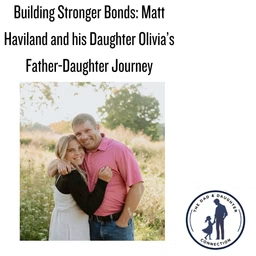
Building Stronger Bonds: Matt Haviland and his Daughter Olivia's Father-Daughter Journey
The Dad & Daughter Connection
At the heart of The Dad and Daughter Connection, featured in this week's episode, is the steadfast belief that the strongest father-daughter relationships are built one intentional moment at a time. In a conversation brimming with honesty and warmth, Dr. Christopher Lewis sits down with Matt Haviland and his 20-year-old daughter, Olivia Haviland, to explore what it truly means to connect, support, and empower our daughters to become confident, independent women.
Listening With Intent
One of the most powerful themes from this episode is the importance of truly listening. Olivia Haviland reflects on her high school years, sharing how her dad's willingness to listen without judgment made her feel seen and valued. Rather than resorting to harsh discipline, Matt Haviland chose to open a dialogue, striving to understand Olivia's perspective and guide rather than simply correct. This practice, inspired by a national survey in which teens wished their dads would "listen more," is a reminder for all fathers: be present, and let your daughter's voice be heard.
Meaningful Moments Big and Small
Connection isn't always about the grand gestures. Matt Haviland and Olivia share memories ranging from epic squirt gun battles to heartfelt college essays, and even "loud and obnoxious" declarations of love at McDonald's. Whether it's a shared joke, a drive together, or simply showing up at a dance recital, these moments accumulate into a reservoir of trust and comfort. As Olivia Haviland puts it, time spent together outweighs any material gift.
Guidance and Independence
Balancing guidance with independence is a recurring theme. Matt Haviland, a former single dad, emphasizes being intentional with the time he shared with Olivia, supporting her dreams while encouraging self-reflection and growth. For Olivia, this support translated into confidence in her career and life decisions—bolstered by her dad's encouragement to think long-term and his faith-based guidance.
Real Advice for Real Dads
This episode wraps with practical wisdom: prioritize time with your kids, apologize for your mistakes, and let your actions reflect your family values. Both Matt Haviland and Olivia Haviland urge dads everywhere to listen deeply and value presence over presents.
Ready to strengthen your bond with your daughter? Listen to this heartfelt episode of The Dad and Daughter Connection and discover how every day can be an opportunity to connect, grow, and become the dad she needs.
If you enjoyed this episode we ask you to take a moment to take our Dad and Daughter Connection Survey to let us know more about you as a dad. You can also sign up to get our newsletter to stay connected to our community and we will send items of interest to you to help you to be the dad that you want to be. Feel free to follow me on the following social media platforms: Facebook, Facebook Group, Instagram, LinkedIn, X.
TRANSCRIPT
Dr. Christopher Lewis [00:00:02]:
Welcome to The Dad and Daughter Connection, the podcast for dads who want to build stronger bonds and raise confident, independent daughters.
Dr. Christopher Lewis [00:00:12]:
If you're looking to build a stronger bond with your daughter and help her grow into a confident, independent woman, you're in the right place. I'm Dr. Christopher Lewis, and The Dad and Daughter Connection is the podcast where we dive into real stories, expert advice, and practical tips to help you navigate the incredible journey of fatherhood. In every episode, we'll bring you conversations that inspire, challenge, and equip you to show up as the dad your daughter needs. So let's get started, because being a great dad isn't just about being there. It's about truly connecting. Welcome back to the Dad and Daughter Connection, where every week we have a great opportunity to be able to work together to build those connections that we want to have with our daughters one day at a time. You know, I love it that you come back every week because that shows a lot about who you want to be as a father, but also who you want to be and what type of relationship you want to have, relationship that you want to have with your daughter.
Dr. Christopher Lewis [00:01:16]:
And it takes time, it takes effort, and it takes work. And we have to keep showing up. And it is so important for us to be able to put the work in for ourselves, but also put in the work with our daughters to be able to have that solid relationship that we wanna have. And that's why this podcast exists. Every week, I love being able to bring you different people with different experiences that allow for you to be able to learn, to grow, to get some tools for your toolbox, and to be able to take those and use them for the future. So I am really excited today to have a, I'm gonna say a return guest. It's not really a return guest on this show, but Matt Haviland, is with us. And Matt and his daughter are with us today, his daughter Olivia.
Dr. Christopher Lewis [00:02:02]:
And Matt is a past guest of a past podcast that I did called Dads with Daughters about 4 years ago. And I'm really excited to be able to have Matt on, but also this time his daughter Olivia, to be able to talk about the relationship that they've been able to build together and also what they've learned along the way to share that with you. Matt, Olivia, thanks so much for being here today.
Matt Haviland [00:02:26]:
Yeah, Chris, thanks again for having me back. And this is a really It's a really special moment to have Olivia with me today. So say hi.
Olivia Haviland [00:02:33]:
Hi.
Dr. Christopher Lewis [00:02:33]:
I'm really excited to have you both here. And I want to go back a little bit because I know, Olivia, you're 20. You know, you're an adult now. You're doing the life thing. You're doing the work thing. You're out there. And as you think back to the relationship that you've been able to build with your dad, what's one thing that your dad did for you that helped you and made you feel truly seen, heard, and valued as a daughter?
Olivia Haviland [00:03:02]:
Um, I would say in high school, I was struggling a lot with my mental health. And then I was getting myself into a little bit of trouble. And he didn't ground me. Well, there was like boundaries where he grounded me a little bit, but he was more open to like listening as of like why I did the things that I did, instead of just like not hearing me out and just screaming at me, taking my phone, not letting me hang out with my friends and everything. So that meant a lot to me.
Dr. Christopher Lewis [00:03:32]:
And Matt, I guess, take me back to that point for you, because I know you had your own journey as a youth and went through your own stuff. And we talked about, we talked about a lot of that in the first interview that we did. So talk to me about that for you and hearing that from Olivia and how you had to be able to kind of take what you learned to be able to help her?
Matt Haviland [00:03:57]:
Yeah, I was very grateful for a lot of the experiences that I had, not only personally but also professionally or through mentorship as well. I guess where I can go with that, Chris, is Olivia was born when I was 30 years old, so I wasn't super young. So by the time she's in high school, you know, I'm in my mid-40s. I would like to say I've learned a few things over those 14 or 15 years of parenting her, but I also Just like a lot of people, either parents or— I, I work with fathers also in a professional setting. You know, we learn a lot from our own previous experiences. So the things my own parents did or did not do, so learning how to correct that and apply that as much as possible. Plus working in a fatherhood field for so long, I've obviously picked up tips, either again things that I've taught guys or other men have taught me as well. But it really becomes a lot different instead of me just telling a dad what to do when I actually have to live this out.
Matt Haviland [00:04:54]:
But I think I could attribute a lot of it to— I was at a conference many years ago, probably 2010, 2012, and they revealed a survey result, a national survey, and they said all these teen kids wish their dad would fill in the blank. And the number one answer was listen more. And that was something that, just like Olivia just said, instead of flying off the handle, telling her how much trouble she's in, let me hear her out first.
Olivia Haviland [00:05:18]:
Yeah.
Matt Haviland [00:05:19]:
And then we can go from there.
Dr. Christopher Lewis [00:05:20]:
Now I know that a lot of times, Matt, we as fathers are trying to build those moments, those meaningful moments that connect us with our kids. And what is one of the most meaningful moments that you've been able to share with Olivia and what made it so special?
Matt Haviland [00:05:35]:
Okay, she said the water fight, so clearly that must have been one. It was April Fool's Day, probably about 4 or 5 years ago. She pranked me in the house and that turned out to a full-blown squirt gun war in the house, actually Super Soakers in the house.
Olivia Haviland [00:05:49]:
Well, I pranked him once and then he forgot to take the tape off the faucet and pranked himself again.
Matt Haviland [00:05:55]:
Yeah, she did the old, you know, she tied the rubber band around the sprayer on the kitchen sink. So when I turned on the kitchen sink faucet, it hit me, and then I shut it off and hit myself again. And yes, that is a very— we're gonna remember that forever, having a squirt gun fight in the house. Not recommended. My wife had something to say about it when she got home, but it was very meaningful. Another really meaningful moment on a more emotional level was a couple years ago, Olivia wrote a paper for college, and they were to choose somebody that's inspired them inspired them, and she wrote the paper about me. And it starts out with the words, I am who I am today because of my dad. And I don't think, Christopher, I don't think there's any greater words that a parent can hear than something like that.
Matt Haviland [00:06:34]:
And she went on to say a lot of like what she just said about me being there and communicating with her mom and just so many other things. So that was a special moment. The fact that of all the times I've screwed up as a dad over, at that point, over 18 years, and then just to receive the gift like that that says, no, Dad, you did a lot of screwing up, but you did it right as well. And Really, that meant so much. To this day, there's no greater gift I've ever been given than that paper.
Dr. Christopher Lewis [00:06:59]:
And Olivia, what are some things that you wish your dad had done differently when it came to building your relationship?
Olivia Haviland [00:07:05]:
I don't know. I can't really think of much because from our situation of like me growing up, it was really hard to make time to see me and everything, but he was doing all that he could. From what I noticed, I would just say maybe less of the dad jokes for sure. On a serious note, I can only flash back to when I was little and I wish he learned to cook more things rather than turkey burger and rice and sometimes mac and cheese.
Dr. Christopher Lewis [00:07:34]:
That's fair.
Matt Haviland [00:07:35]:
I was a bachelor for 29 years. Okay, so but just for your audience though, to just kind of backtrack our story, I was a single dad, Olivia's mom and I never married. So I was a single father for the first 9 years of her life too. So just trying to navigate what that was like raising a child in 2 different homes.
Olivia Haviland [00:07:52]:
Because rules would would be different at my mom's and then rules would be different here. I would say like not anything that he could do different, but like something I take back is like when we would get in arguments, I would like not talk to him for the rest of the night. But like, he— I'm thankful that you respected my space, but I kind of wish you would have like pushed me a little bit to like talk more. But other than that, I can't really think of anything.
Dr. Christopher Lewis [00:08:16]:
Now, Matt, all of us are trying to help our daughters to be able to become the people that they're becoming. Talk to me about how you you balanced guiding Olivia while also giving her the independence to grow into the person that she has become?
Matt Haviland [00:08:31]:
Yeah, speaking from personal experience, so being a single father— and I've often defined single dads especially as it could be a man who has full custody, maybe it's split custody, maybe it's minimal custody— I would be what was defined as a non-custodial parent, meaning I had less than 50% of the parenting time. Because of that, I was really intentional about the time I had with her. But I think that's just a good lesson for any parent, is to be intentional intentional. I have the privilege of working with new first-time fathers in some of the work that I do, and I'll talk to them about making time for their kids. You know, there's a great quote that says, you'll never have the time for your kids, you have to make time. There's no other way. And really putting that into practice, um, you know, you go to parks— and this isn't to shame anybody listening, but it's a good reminder— and you'll see all the parents looking down at their phones while the kids are playing. And it's about getting engaged in their life.
Matt Haviland [00:09:24]:
And I think for having Olivia, because I didn't have her all the time. I did not want to take her time— the time with her for granted. But any— even for parents that are raising their kids together in the same household, I mean, the reminder still goes that there's no greater gift that we can give our kids than our time. And being present isn't just being in the same room, it's being, you know, mentally and emotionally present. And I know there's probably a lot of people that have heard that before, but I think it's true. I mean, just to be there, to be involved with raising kids— yes, you're going to have the serious moments, But then also, it's just kind of spending time together. Maybe it's going for a walk, and maybe at first it's a goofy conversation, or, or it's, uh, it gets more serious. When I had Olivia, the average drive home to her mom was about 15 or 20 minutes each way.
Matt Haviland [00:10:09]:
So every time I picked her up, I mean, that's 20 minutes of car time that we can kind of talk a little bit. So I think it was not just anything one specific, but it was just that continual over and over and over for 18 years of trying to be as intentional as I can, listening to her, correcting mistakes when I, I can, and then Everybody will say it, she is a carbon copy of me. She is literally— I mean, she's cuter than me, but just, I mean, personality-wise, she is a carbon copy.
Olivia Haviland [00:10:36]:
We stand the same.
Matt Haviland [00:10:37]:
Yeah, our mannerisms are all the same. But really understanding that too, that I'm looking in a mirror here. So when I am raising her, disciplining her, engaging with her, how would I react to that as well?
Dr. Christopher Lewis [00:10:49]:
And speaking to that, Olivia, how has your relationship with your dad influenced the way in which you navigate life, relationships, or challenges? challenges today?
Olivia Haviland [00:10:59]:
Um, I would say, I mean, definitely he— I obviously wasn't alive, but he did struggle when he was a teenager and in his 20s. And I feel like when I got into that point, when I was getting in some trouble my sophomore year of high school and everything, just like for him to know exactly what it was like to do the same things helped him guide me out of it instead of, like I said earlier, yelling at me, screaming at me. He would actually like hear me out and be like, hey, I was in your position once and this is how I got through it. But he would also always bring faith into it and keep me strong in my faith. Like he would always end a conversation with a Bible verse or bring in a passage or a verse just to help me through something.
Dr. Christopher Lewis [00:11:47]:
Now, Matt, we talked about— Olivia's just talking about some challenging times, and all of us go through those challenging times as we're raising kids. There's great times and there's where you might hit rock bottom as well. And what are some intentional ways that you worked to strengthen your bond with Olivia, especially during those challenging times?
Matt Haviland [00:12:05]:
I've always had, since I've become a dad, and I am one to really— I'm a huge advocate for everyone to have a mentor. You know, I've always had a mentor. I wasn't raised in a two-parent home. My parents were never married. My dad was minimally engaged in my life. So not having that strong father figure in my life, growing up and understanding what that's like. But when I did become a dad, I've always had strong mentor men in my life in various capacities. Some might be in work, some might be in parenting, or whatever it may be.
Matt Haviland [00:12:38]:
So I think being able to talk it through with a mentor who also was a father, and maybe even perhaps depending on who it was, a grandfather— so a mentor just being somebody that's a little older and has more experience And hearing that out. And Chris, there was a ton of mistakes along the way. I mean, I'm not going to lie. There was— I've had some really bad moments as parents, never in a, like, an abusive way or anything, but where I really dropped the ball. And just understand, I don't ever want to feel like that again. Apologizing to her, admitting that I screwed up and doing my best not to go through that again. But by the time she was really struggling, especially in the late middle school, early high school years, again, by this point, I'm in my mid-40s. I had been parenting her for a long time.
Matt Haviland [00:13:22]:
So, I knew Olivia. I was able to read her cues. And, I understand that might be a little different in every family dynamic, but I was able to read her cues. And, the girl talks all the time. So, when Olivia's quiet, there's obviously there's something going on. And, like she said, I mean, I was in some— my teen and 20s were some pretty dark years in my life and never wanting her to go through that. I struggled with substance abuse and a lot of other I didn't go that far. No, but I'm just saying I didn't want you to go that far.
Matt Haviland [00:13:53]:
So being able to kind of curb that beforehand. But there's always— I think there also was a special bond. And again, this isn't to take away from anybody in other family dynamics, but because I was a single father, when I had Olivia, it was me and Olivia. So for 9 years, it was just us. We were like a team, you know? And just to be able to read— and I mean, she's my heart, and I wanted to in so many ways, give her what I was never given from an upbringing even though it wasn't perfect because she was still being raised in 2 different homes. But nonetheless, giving her the holidays or the Christmases or the love—
Olivia Haviland [00:14:28]:
Dance recitals and games.
Matt Haviland [00:14:29]:
Yeah, attending. My dad made 2 of my baseball games over 12 years. And, I was at almost every game I could make for her or her dance recitals and understanding how important that is for her to look out in the crowd And to see me there.
Dr. Christopher Lewis [00:14:41]:
You know, Olivia, earlier I asked your dad about how he worked to be able to provide you with that independence that you needed. Talk to me on your side of how your dad encouraged you to be confident and independent in your life.
Olivia Haviland [00:14:56]:
I would say he's always been my biggest cheerleader, even if it's loud and obnoxious at my games. Or there was one time he was saying how much he loved me in the middle of McDonald's, just screaming it.
Matt Haviland [00:15:09]:
On purpose.
Dr. Christopher Lewis [00:15:10]:
On purpose.
Matt Haviland [00:15:11]:
To embarrass her on purpose.
Olivia Haviland [00:15:12]:
But I would say, like, he's always been like, he'll send me a, hey, good morning, I hope you have an amazing day. It's not every day, but I think that's what makes it more special is that it'll be like out of the blue or it'll be like a Bible verse or like I'll tell him, I'm like, hey, I had a really bad day today. And then he'll send me a Bible verse or be like, hey, I have time to call. I would say that's really encouraging. And then also just like, you know, I'll be at work and then he'll show up and bring Dunkin' or Subway, just like showing that even like if he can see me for 5 minutes, like it still matters. So that means a lot to me too.
Dr. Christopher Lewis [00:15:51]:
And Matt, we talked before we started today about what Olivia is doing and she's working in healthcare right now. And I guess as you have been fathering Olivia, how do you support Olivia in pursuing her passions and her dreams?
Matt Haviland [00:16:04]:
Great question. I, first of all, I'm very impressed because Olivia has a career focus already at 20. And I know that's not rare, but I, at 20, I mean, I was completely in the opposite direction. So I'm already just so proud of her because, I mean, she is very motivated, she's very determined, she has an excellent work ethic. I mean, she works hard and she really respects the job that she has, even if she doesn't like it a lot. So, so to encourage her again— Yeah, she likes her job right now, so that's good. But to encourage her, I would say again, just listening, kind of maybe as she's talking, processing, like, okay, what's this going to look like in your life? Is this going to require more schooling? Sometimes I ask her questions like, how do you see this playing out long-term? If you want to get advanced in your career, what's that going to look like? How's that going to affect the other areas of your life? And kind of just helping her think through. You know, she doesn't have all the weight that, you know, we as adults have right now, you know, carrying a lot of mortgages or payments or, you know, other bigger obligations.
Matt Haviland [00:17:09]:
Not to minimize what she's doing, but—
Olivia Haviland [00:17:10]:
Right.
Matt Haviland [00:17:11]:
But she has some opportunity and some room right now to really dream, like, hey, what do I want to do for a career? And if I do change my career, that's okay. But she has tremendous skills. I think that's one thing, is to let her know what skills she has. She's definitely a people person. She has a hard work ethic. She's a great communicator. So just kind of saying, hey, these are the things you're really good at. So where would that fit for you in your career field?
Dr. Christopher Lewis [00:17:35]:
And Olivia, if you could spend an entire day with your dad doing anything, what would it look like?
Olivia Haviland [00:17:39]:
Oh, no. No signs, no dad jokes. That would be—
Matt Haviland [00:17:44]:
You gotta explain the signs.
Olivia Haviland [00:17:46]:
He is obsessed. I will be trying, like, you know, we go to a zoo, I want to see the animals, and he's like, oh, I want to know where the animals lived, um, where they came from, how old are they, how many, like, claws do they have, how many teeth. Like, it doesn't matter. Like, I just— I want to see the animals. And it kind of just began as, like, a running joke. Every time he sees a sign, he sends it to me. I reply with, I'm not reading that. But I would say a perfect day, honestly, I love our beach days because he's very— I mean, we're like the same person.
Olivia Haviland [00:18:19]:
Like, we don't want to get out of the water, but we've always played stupid games like how many times can we catch the ball in a row throwing trick shots. And then like during COVID we were hitting a ball on our roof with a tennis racket, like, and made that like a whole summer competition. So I would say just like Like little games, like beach day getaway, just the two of us. And then probably Star Wars at the end. Star Wars are an old movie, but something we do like monthly.
Dr. Christopher Lewis [00:18:48]:
Sounds like a good day. Now we always finish our interviews with what I like to call our Dad Connection 6, 6 more questions. And I usually ask them just to dads, but I'm gonna ask both of you some different questions or questions for both of you. Uh, first and foremost, Olivia, what's one word that describes your relationship with your dad?
Olivia Haviland [00:19:04]:
Comforting.
Dr. Christopher Lewis [00:19:05]:
And Matt, what's your word?
Matt Haviland [00:19:06]:
I'd say solid.
Dr. Christopher Lewis [00:19:07]:
And Matt, what's the best piece of dad advice you've ever received?
Matt Haviland [00:19:12]:
I think it's honestly, it's been in multiple forms and it's what I've already mentioned. It's just spending time with them. Other things can wait. And I've heard a million different quotes in that way, but it all boils down to spending undivided, just they got my attention or she has my attention. Everything else can wait and it's just our time. So yeah, time.
Dr. Christopher Lewis [00:19:33]:
And Olivia, what's the best piece of dad advice you've ever received?
Olivia Haviland [00:19:37]:
I would honestly say, like, like he said earlier, the, like, talking me through it. Where can you see yourself from this? Let's, you know, visualize what even is it gonna look like in a month versus 5 years. And I would say that's gotten me a lot of places because before I make decisions now, I always, like, stop and think, like, hey, like, I may like it right now, but in 3 months, am I gonna like what I'm doing? In a year, am I gonna like what I'm doing? Am I gonna wanna be doing this when I'm older?
Dr. Christopher Lewis [00:20:06]:
Yeah.
Olivia Haviland [00:20:06]:
I'm 60 or 70 years old kind of thing. So I would say that's gotten me far in a lot of places.
Dr. Christopher Lewis [00:20:12]:
Matt, what's one activity that you and Olivia love doing together?
Matt Haviland [00:20:15]:
You're gonna appreciate this one, Christopher. Going to University of Michigan football games.
Musical Outro Performer [00:20:20]:
Okay.
Dr. Christopher Lewis [00:20:21]:
And I'm gonna throw it back to you too, Olivia. And it doesn't have to be the same thing. It'd be something different.
Olivia Haviland [00:20:25]:
Daddy-daughter dances or like donuts with dad or anything that's like one-on-one mini golf, golf, and football games, definitely.
Dr. Christopher Lewis [00:20:33]:
Matt, if you could give Olivia one life lesson in a single sentence, What would it be?
Matt Haviland [00:20:37]:
Love God, love others.
Dr. Christopher Lewis [00:20:38]:
And Matt, what's one thing you've learned about yourself since becoming a dad?
Matt Haviland [00:20:42]:
I think—
Olivia Haviland [00:20:43]:
The girl version of you.
Matt Haviland [00:20:45]:
That too. But I would say since becoming a dad, I think you learn how the word selfish feels strong, but I don't think it's out of line of when it's just us. But when it was just me as a single dad or a single man versus becoming a father, it was all about me. I tell my new guys, I think I think being a parent drives you to a level of commitment to your children that would not be attained any other way.
Dr. Christopher Lewis [00:21:09]:
And Olivia, what advice would you give to other dads who want to build a lasting and meaningful relationship with their daughters?
Olivia Haviland [00:21:16]:
I would say put aside anything that can wait, and then also listen before either conversating or just listen to the full story instead of, like, interrupting, getting down to the point.
Dr. Christopher Lewis [00:21:32]:
And Matt?
Matt Haviland [00:21:32]:
Yeah, I think it's so important to live out your values and what's important to your family. We have a culture that is in many ways just so antagonistic and assaulting our daughters, and to be able to speak against that, letting our daughters know how beautiful they are, how valued they are, their virtue, their beauty, their tenderness. And this is an appropriate conversation for whether you're raising a 5-year-old or a 20-year-old as well.
Olivia Haviland [00:21:58]:
I would also always say time over items too, because I know A lot of my friends' parents will be like at work because they work third shift or something. They'll be like, here's money to go get something because I didn't see you all day, or here's money because I yelled at you kind of thing, instead of just sitting down, actually talking everything out. It helps grow a relationship too.
Dr. Christopher Lewis [00:22:20]:
Well, Matt, Olivia, I just want to say thank you. Thank you for spending time with me today, for sharing your journey in your own relationship. Matt is an author as well, and I should mention that he did write a book a number of years back called A Father's Walk, a Christian-based resource for single fathers. And if people want to find out more about you, Matt, and what you're doing, where should they go?
Matt Haviland [00:22:43]:
I don't have a website, but you can email me. I'm completely open to that. My email is afatherswalk@gmail.com. That's a fathers with an S on the end, walk at Gmail.
Dr. Christopher Lewis [00:22:54]:
Well, again, I want to say thank you. Thank you to both of you for your time, for sharing your And I wish you both all the best.
Matt Haviland [00:23:01]:
Thanks, Christopher.
Olivia Haviland [00:23:01]:
Thank you.
Dr. Christopher Lewis [00:23:02]:
That's a wrap for this episode of The Dad and Daughter Connection. Thanks for joining us on this journey to build stronger bonds and raise confident, independent daughters. Remember, being an engaged dad isn't about being perfect. It's about being present. If you enjoyed this episode, be sure to subscribe and share it with a fellow dad. And don't forget, you can find all our episodes at dadanddaughterconnection.com. Until next time, keep showing up, keep connecting, and keep being the dad she needs.
Musical Outro Performer [00:23:33]:
We're all in the same boat and it's full of tiny screaming passengers. We spend the time, we give the lessons. We make the meals, we buy them presents. Bring your A-game, 'cause those kids are growing fast. The time goes by just like a dynamite blast. Calling astronauts and firemen, carpenters and muscle men, get out and be the world to them. Be the best dad you can be. Be the best dad you can be.