About
By Steven Jonathan Rummelsburg
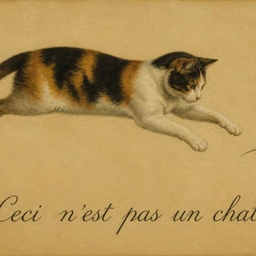
When I ask my classes, "What is a cat?" inevitably the answer is, "Whatever someone says it is." Not so long ago, every seventh grader knew what a cat was. Now, that certainty has evaporated into subjectivity. But after a few months of instruction in logic, a kind of mass awakening occurs: the class discovers that "truth is not consensus, but the convergence of the mind and reality." That moment is a glimpse of what our Catholic Tradition teaches about language, and of what is at stake when words lose their grounding in reality.
"Cat" is not the eternally correct sound for the purring, sharp-clawed mouse predator curled up in the corner. Nor is it an arbitrary noise, infinitely malleable, determined by our desires and consent. Somewhere between those two errors of excess and defect is an elevated golden mean of what our Catholic Tradition teaches about language. Anyone raising and educating children today is submerged in the wreckage of both errors; grammar, rightly understood, is the remedy.
Before any grammar lesson can be taught, however, three preliminary questions must be answered: What is the origin of language? What is the nature of a word? And what is the purpose of human speech? The answers to these vital questions are not principles belonging to grammar itself. They are borrowed from higher science, the way a carpenter builds a house to a set of principles that belong properly to the architect. Grammar is a construction project subordinated to reality itself.
The most important question about the origin of human language is: Does it come from man, or from God? Scripture is explicit. In Genesis, God spoke the universe into existence. St. John tells us, "In the beginning was the Word," and He is the Second Person of the Trinity. Man's capacity for language proceeds from his creation in the image and likeness of that Word, and every true act of naming is a participation in the Logos through whom all things were made.
God gifts man the power to name things properly. In Genesis 2:19, God brought every animal to Adam "to see what he would call them, and whatever Adam called every living creature, that was its name." The task of naming was entrusted to man as an act of vicegerency, the exercise of delegated headship, undertaken in true freedom by man made in the divine image. (ST I, q.96, a.1)
Adam named each creature according to what it truly was, not according to what he wished it to be. If we lose sight of this distinction, we drift into wishful thinking about language and its proper use. But if we recover this distinction, we are reminded that language is a covenant, a gift bequeathed to a communion of souls who are bound, generation to generation, to hand it on faithfully.
So, what is a word? A word is not merely a sound or a random collection of phonemes. A word has a material body, made manifest in the syllables we utter, and a soul – the immaterial concept or intelligibility it conveys. St. Thomas calls this the verbum mentis, the inner word the intellect abstracts from a real thing; the audible word is only the outward sign of a form conceived in the mind.
Say "cat," and the sound carries us past itself and the cat to "catness," an essence we recognize whether the animal before us is calico, Siamese, or Persian. Essence is one thing in a cat and another thing in a word about a cat. A word is an artifact of reason, bound to its concept not as a natural being but as a sign is bound to what it signifies. A word is a small act of communion between a mind and the real. Because it is communion and not composition, the bond can be broken, but not without cost – and even abuse.
St. Thomas teaches that the purpose of speech is to convey reality in the charitable service of the other. Reality and truth are convertible. Truth is a virtue bound to justice, what we owe to the other. To speak falsely is to fail justice. To convey reality in service of the other requires charity, exercised prud...
When I ask my classes, "What is a cat?" inevitably the answer is, "Whatever someone says it is." Not so long ago, every seventh grader knew what a cat was. Now, that certainty has evaporated into subjectivity. But after a few months of instruction in logic, a kind of mass awakening occurs: the class discovers that "truth is not consensus, but the convergence of the mind and reality." That moment is a glimpse of what our Catholic Tradition teaches about language, and of what is at stake when words lose their grounding in reality.
"Cat" is not the eternally correct sound for the purring, sharp-clawed mouse predator curled up in the corner. Nor is it an arbitrary noise, infinitely malleable, determined by our desires and consent. Somewhere between those two errors of excess and defect is an elevated golden mean of what our Catholic Tradition teaches about language. Anyone raising and educating children today is submerged in the wreckage of both errors; grammar, rightly understood, is the remedy.
Before any grammar lesson can be taught, however, three preliminary questions must be answered: What is the origin of language? What is the nature of a word? And what is the purpose of human speech? The answers to these vital questions are not principles belonging to grammar itself. They are borrowed from higher science, the way a carpenter builds a house to a set of principles that belong properly to the architect. Grammar is a construction project subordinated to reality itself.
The most important question about the origin of human language is: Does it come from man, or from God? Scripture is explicit. In Genesis, God spoke the universe into existence. St. John tells us, "In the beginning was the Word," and He is the Second Person of the Trinity. Man's capacity for language proceeds from his creation in the image and likeness of that Word, and every true act of naming is a participation in the Logos through whom all things were made.
God gifts man the power to name things properly. In Genesis 2:19, God brought every animal to Adam "to see what he would call them, and whatever Adam called every living creature, that was its name." The task of naming was entrusted to man as an act of vicegerency, the exercise of delegated headship, undertaken in true freedom by man made in the divine image. (ST I, q.96, a.1)
Adam named each creature according to what it truly was, not according to what he wished it to be. If we lose sight of this distinction, we drift into wishful thinking about language and its proper use. But if we recover this distinction, we are reminded that language is a covenant, a gift bequeathed to a communion of souls who are bound, generation to generation, to hand it on faithfully.
So, what is a word? A word is not merely a sound or a random collection of phonemes. A word has a material body, made manifest in the syllables we utter, and a soul – the immaterial concept or intelligibility it conveys. St. Thomas calls this the verbum mentis, the inner word the intellect abstracts from a real thing; the audible word is only the outward sign of a form conceived in the mind.
Say "cat," and the sound carries us past itself and the cat to "catness," an essence we recognize whether the animal before us is calico, Siamese, or Persian. Essence is one thing in a cat and another thing in a word about a cat. A word is an artifact of reason, bound to its concept not as a natural being but as a sign is bound to what it signifies. A word is a small act of communion between a mind and the real. Because it is communion and not composition, the bond can be broken, but not without cost – and even abuse.
St. Thomas teaches that the purpose of speech is to convey reality in the charitable service of the other. Reality and truth are convertible. Truth is a virtue bound to justice, what we owe to the other. To speak falsely is to fail justice. To convey reality in service of the other requires charity, exercised prud...