About
By Auguste Meyrat
With many members of the Gen Z cohort (b. 1997-2012) coming of age and entering public life, it behooves older generations to understand them better. I can recall the many essays, books, and movies examining my own generation, the millennials (b. 1981-1996), as well as those assessing Generation X (b. 1965 -1980) before that. While they were not always accurate or entirely enlightening, they helped ease tensions between generations.
Unfortunately, with Gen Z, the differences may be so vast and deep that understanding them will prove more difficult. So much of their formative experience is unprecedented. Not only have they grown up with smartphones, high-speed Internet, and now AI, but they have also experienced a number of widespread social disruptions, including the Covid lockdowns. Altogether, this makes their integration into adult life especially challenging – and I say this as a teacher who has worked closely with Zoomers for decades.
As my friend and fellow teacher-writer Jeremy Adams explains in his book Hollowed Out (which I reviewed here), much about Gen Z is a paradox. On the outside, they have the knowledge of the world at their fingertips (theoretically: many will not even be aware of what today's date, 9/11, signifies). And they enjoy countless amenities. On the inside, many of them still feel empty and resentful. In response, Adams calls for a nation-wide intervention to help these youths discover the blessings of American democracy and Western wisdom.
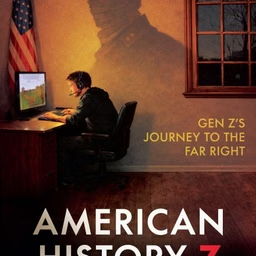
While this solution makes sense to older generations, Zoomers would likely scoff at the very idea. As Joey Oliver makes clear in his new book American History Z: Gen Z's Journey to the Far Right, the situation for Zoomers has deteriorated well beyond Adams's modest proposal. A Zoomer himself, Oliver gives a detailed account of how these ostensibly privileged people have grown up to despise their cultural patrimony and embrace radicalism. The account is hard to read at times, but sheds light on a host of blind spots that everyone who hopes to improve the outlook of today's young adults should understand.
Far from growing up in an idyllic culture of stability, respectability, and technological advancement, Oliver and his peers witnessed firsthand the great crumbling of every narrative that had earlier defined the West. Race, immigration, feminism, free speech, economic opportunity, public health, American history, or democracy – all these subjects were reopened and recast despite inherent contradictions, corrupt leadership, and online polarization in Zoomer circles.
This was not all bad. Secular leftist narratives tend to target Oliver's own demographic – white conservative males – making them a scapegoat for all the world's ills. For decades, the great majority of institutions had thoughtlessly reinforced this toxic messaging while simultaneously lamenting the sudden rise in political and cultural polarization in American life.
But other voices arose to challenge these narratives and restore a degree of sanity to public discourse, bravely running through the gauntlet of censors and cancellers. While some of these advocates held steadfast in their positions, many were either silenced or pressured to recant, leaving much of their Zoomer audience to fend for themselves.
This collective abandonment of Zoomers makes up the darkest aspects of Oliver's story. Yes, secular leftism (popularly known as "woke culture") was slowed down by countervailing forces, but it has not gone away. The conflict between right and left simply became more intense as political violence became common and public discourse degenerated into hate-filled propaganda. The revival of democratic virtues that Adams recommended in his book was replaced with partisan tribalism.
In the end, Oliver loses faith in the whole American project. All the people he followed have let him down, making him a cynic before even reaching age 30. What's even more striking is his overwhelming scorn fo...
With many members of the Gen Z cohort (b. 1997-2012) coming of age and entering public life, it behooves older generations to understand them better. I can recall the many essays, books, and movies examining my own generation, the millennials (b. 1981-1996), as well as those assessing Generation X (b. 1965 -1980) before that. While they were not always accurate or entirely enlightening, they helped ease tensions between generations.
Unfortunately, with Gen Z, the differences may be so vast and deep that understanding them will prove more difficult. So much of their formative experience is unprecedented. Not only have they grown up with smartphones, high-speed Internet, and now AI, but they have also experienced a number of widespread social disruptions, including the Covid lockdowns. Altogether, this makes their integration into adult life especially challenging – and I say this as a teacher who has worked closely with Zoomers for decades.
As my friend and fellow teacher-writer Jeremy Adams explains in his book Hollowed Out (which I reviewed here), much about Gen Z is a paradox. On the outside, they have the knowledge of the world at their fingertips (theoretically: many will not even be aware of what today's date, 9/11, signifies). And they enjoy countless amenities. On the inside, many of them still feel empty and resentful. In response, Adams calls for a nation-wide intervention to help these youths discover the blessings of American democracy and Western wisdom.
While this solution makes sense to older generations, Zoomers would likely scoff at the very idea. As Joey Oliver makes clear in his new book American History Z: Gen Z's Journey to the Far Right, the situation for Zoomers has deteriorated well beyond Adams's modest proposal. A Zoomer himself, Oliver gives a detailed account of how these ostensibly privileged people have grown up to despise their cultural patrimony and embrace radicalism. The account is hard to read at times, but sheds light on a host of blind spots that everyone who hopes to improve the outlook of today's young adults should understand.
Far from growing up in an idyllic culture of stability, respectability, and technological advancement, Oliver and his peers witnessed firsthand the great crumbling of every narrative that had earlier defined the West. Race, immigration, feminism, free speech, economic opportunity, public health, American history, or democracy – all these subjects were reopened and recast despite inherent contradictions, corrupt leadership, and online polarization in Zoomer circles.
This was not all bad. Secular leftist narratives tend to target Oliver's own demographic – white conservative males – making them a scapegoat for all the world's ills. For decades, the great majority of institutions had thoughtlessly reinforced this toxic messaging while simultaneously lamenting the sudden rise in political and cultural polarization in American life.
But other voices arose to challenge these narratives and restore a degree of sanity to public discourse, bravely running through the gauntlet of censors and cancellers. While some of these advocates held steadfast in their positions, many were either silenced or pressured to recant, leaving much of their Zoomer audience to fend for themselves.
This collective abandonment of Zoomers makes up the darkest aspects of Oliver's story. Yes, secular leftism (popularly known as "woke culture") was slowed down by countervailing forces, but it has not gone away. The conflict between right and left simply became more intense as political violence became common and public discourse degenerated into hate-filled propaganda. The revival of democratic virtues that Adams recommended in his book was replaced with partisan tribalism.
In the end, Oliver loses faith in the whole American project. All the people he followed have let him down, making him a cynic before even reaching age 30. What's even more striking is his overwhelming scorn fo...