About
By Fr. Peter M. J. Stravinskas.
But first a note from Robert Royal: Friends: We're in the last week of our funding drive. We're close, but need one last push to bring things to a successful conclusion. I won't belabor the obvious. Now's the time to support The Catholic Thing.
Now for today's column...
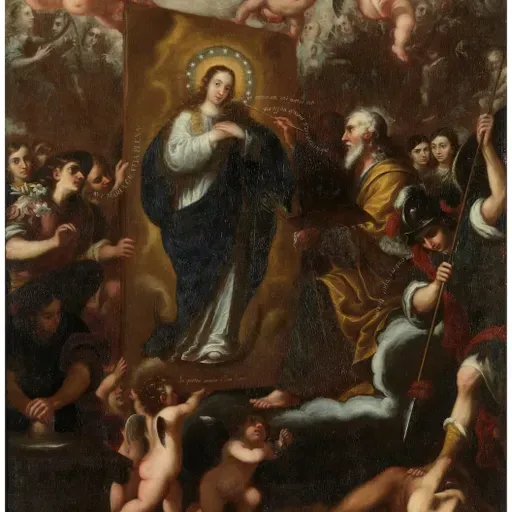
Many Catholics misunderstand today's feast, which is also the patronal feast of our nation (the first country to claim her under this title). They confuse the Immaculate Conception of Mary with the virginal conception of Jesus. But today we celebrate the fact that Mary was sinless from the very first moment of her existence - which is extremely important because it demonstrates the care with which God guided the entire process of our salvation.
It's no sheer accident that the Church celebrates this feast at the outset of Advent. This privilege accorded to Our Lady was part of the work of salvation begun at the very moment when sin itself first entered the world. The experience of sin and its reign in our world came about because of human weakness and pride. Just as a woman made possible the first sin, so too a woman would make possible the work of our salvation. Mary was God's answer to Eve.
Christians today and throughout the ages love Mary because she embodies, literally, all that we hope to be. That is why Wordsworth could rhapsodize on her as "our tainted nature's solitary boast." By her faith and willingness to cooperate with God, Mary showed herself to be a true daughter of Abraham. The humble maid of Nazareth further demonstrated that genuine liberation consists not in doing one's own thing as much as it consists in doing God's thing. She proved the angel right, that the Lord was truly with her, as she pronounced that fearful but firm "yes" which reversed every previous "no" in history.
This solemnity gives us a golden opportunity to consider various theological dimensions of the Immaculate Conception.
First, original sin. Original sin is not something we can grasp; it's an absence of original holiness, grace, and unity with the Creator. And it is an "inheritance" from our first parents. Original sin is "hard-wired" into our nature. This caused St. Paul to muse about why we find it easier to do evil than to do good (cf. Romans 7:19).
Second, original sin constitutes us as "children of wrath." (Ephesians 2:3) It's common to gaze upon an infant and declare, "What an angel!" However, that is more a wish than a reality. An infant is totally self-absorbed and demanding. G.K. Chesterton called original sin "the only part of Christian theology which can really be proved." Saint John Henry Newman identifies it as "some terrible aboriginal calamity."
Third, baptism, which is necessary because it moves us from the Kingdom of Darkness into the Kingdom of Light. It returns us to the prelapsarian Garden of Eden. Georges Bernanos, in a charming phrase, referred to Our Lady in her Immaculate Conception as "younger than sin." Baptism, we can say, then, is a Christian's "fountain of youth" as it returns us to that state of original holiness, justice and grace. Hence, Our Lord's assertion to Nicodemus: "Truly, truly, I say to you, unless one is born of water and the Spirit, he cannot enter the kingdom of God" (Jn 3:5).
Fourth, we have to deal with a common Protestant objection to the Immaculate Conception, namely, that it "divinizes" Mary. But several major Protestant Reformers believed in the doctrine of the Immaculate Conception - four centuries before its dogmatic definition! Similarly, Cardinal Newman, thirteen years before his conversion, could preach:
Who can estimate the holiness and perfection of her, who was chosen to be the Mother of Christ? If to him that hath, more is given, and holiness and divine favour go together (and this we are expressly told), what must have been the transcendent purity of her, whom the Creator Spirit condescended to overshadow with His miraculous presence? What must have been her gifts, who was chose...
But first a note from Robert Royal: Friends: We're in the last week of our funding drive. We're close, but need one last push to bring things to a successful conclusion. I won't belabor the obvious. Now's the time to support The Catholic Thing.
Now for today's column...
Many Catholics misunderstand today's feast, which is also the patronal feast of our nation (the first country to claim her under this title). They confuse the Immaculate Conception of Mary with the virginal conception of Jesus. But today we celebrate the fact that Mary was sinless from the very first moment of her existence - which is extremely important because it demonstrates the care with which God guided the entire process of our salvation.
It's no sheer accident that the Church celebrates this feast at the outset of Advent. This privilege accorded to Our Lady was part of the work of salvation begun at the very moment when sin itself first entered the world. The experience of sin and its reign in our world came about because of human weakness and pride. Just as a woman made possible the first sin, so too a woman would make possible the work of our salvation. Mary was God's answer to Eve.
Christians today and throughout the ages love Mary because she embodies, literally, all that we hope to be. That is why Wordsworth could rhapsodize on her as "our tainted nature's solitary boast." By her faith and willingness to cooperate with God, Mary showed herself to be a true daughter of Abraham. The humble maid of Nazareth further demonstrated that genuine liberation consists not in doing one's own thing as much as it consists in doing God's thing. She proved the angel right, that the Lord was truly with her, as she pronounced that fearful but firm "yes" which reversed every previous "no" in history.
This solemnity gives us a golden opportunity to consider various theological dimensions of the Immaculate Conception.
First, original sin. Original sin is not something we can grasp; it's an absence of original holiness, grace, and unity with the Creator. And it is an "inheritance" from our first parents. Original sin is "hard-wired" into our nature. This caused St. Paul to muse about why we find it easier to do evil than to do good (cf. Romans 7:19).
Second, original sin constitutes us as "children of wrath." (Ephesians 2:3) It's common to gaze upon an infant and declare, "What an angel!" However, that is more a wish than a reality. An infant is totally self-absorbed and demanding. G.K. Chesterton called original sin "the only part of Christian theology which can really be proved." Saint John Henry Newman identifies it as "some terrible aboriginal calamity."
Third, baptism, which is necessary because it moves us from the Kingdom of Darkness into the Kingdom of Light. It returns us to the prelapsarian Garden of Eden. Georges Bernanos, in a charming phrase, referred to Our Lady in her Immaculate Conception as "younger than sin." Baptism, we can say, then, is a Christian's "fountain of youth" as it returns us to that state of original holiness, justice and grace. Hence, Our Lord's assertion to Nicodemus: "Truly, truly, I say to you, unless one is born of water and the Spirit, he cannot enter the kingdom of God" (Jn 3:5).
Fourth, we have to deal with a common Protestant objection to the Immaculate Conception, namely, that it "divinizes" Mary. But several major Protestant Reformers believed in the doctrine of the Immaculate Conception - four centuries before its dogmatic definition! Similarly, Cardinal Newman, thirteen years before his conversion, could preach:
Who can estimate the holiness and perfection of her, who was chosen to be the Mother of Christ? If to him that hath, more is given, and holiness and divine favour go together (and this we are expressly told), what must have been the transcendent purity of her, whom the Creator Spirit condescended to overshadow with His miraculous presence? What must have been her gifts, who was chose...