About
By Michael Pakaluk
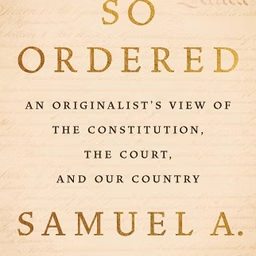
I read Supreme Court Justice Samuel Alito's So Ordered: An Originalist's View of the Constitution, the Court, and Our Country backwards, chapter-wise, and I'd recommend you do the same. The end of the book tells us about Samuel Alito, the great-hearted man and patriot, while the beginning of the book, academically more respectable, to be sure, dives right into the state of the debate over textualism and originalism, which are not everyone's cup of tea.
The final chapter, "The Real Counterculture," is an address commemorating the fiftieth anniversary of the founding of Thomas Aquinas College in Santa Paula, California. In this essay, as in almost all the other essays, Justice Alito's exquisite historical sense is on display. I take it that a true originalist must be a true historian, since the originalist's aim is to let Chesterton's "democracy of the dead" exercise its merited authority.
Justice Alito refers to the 30,000 hippies who gathered in San Francisco for the Human Be-In in 1967; the first Earth Day in 1970; and the student protests against Nixon's bombing of Cambodia. None of these storied counter-movements from around the time of the college's founding, he points out, has proved to be a lasting counterculture, and yet the college's devotion to truth and civil disagreement remains countercultural, different, and vital.
What follows includes a chapter on the necessity of faith in a secular and materialistic age; another, "Four Men of the American Experience," which weaves the story of Theodore Roosevelt together with those of the Justice's grandparents and Clarence Thomas's family, attempting to define the distinctively American character; and an astonishing chapter on "Achievements of Italian Americans."
After recounting the terrible prejudice that Italian immigrants faced, he asks whether we know, for instance, that at least twenty-seven Italian Americans have been awarded the Congressional Medal of Honor. Many have been great artists such as Constantino Brumidi, the "Michelangelo of the United States Capitol," operatic composer Gian Carlo Menotti, and the singer Frank Sinatra.
"In religion," he says, "think of Mother Cabrini, the first American saint, who overcame enormous obstacles to aid suffering Italian immigrants. Think of Rita Antoinette Rizzo, better known as Mother Angelica, who founded EWTN." And that's not all. "Is it possible to think of the history of baseball without Joe DiMaggio or Yogi Berra?" Indeed.
In the midst of reading the essays on threats to the Constitution and the primacy of the right to religious liberty, I began saying to myself, "How did we come to deserve a high-ranking government official with such extraordinary character? How is it even possible that this man has attained a seat on the highest court? If we fail at this project, will we have anyone else to blame but ourselves?"
Conveyed throughout the book is the relentless workload of a contemporary Justice. Writing on Learned Hand, Justice Alito yearns for the days when a judge enjoyed the leisure to practice judging as a craft: "If Learned Hand's opinion writing is akin to producing a custom-made garment, the judges who sign off on fifty opinions per day are more like factory managers."
A striking humility about the role of a judge is also evident throughout this book. Again and again, Justice Alito insists that he isn't a philosopher. Dealing with abstract questions in the way that might make a law professor celebrated has little to do with the practice of judging. Judges, he observes, are not trained to decide deep questions; most of their work is extremely narrow and technical.
Certainly one should not seek praise and fame by judging; done rightly, it ought to draw little of either. A judge on a state supreme court and a low-level administrative judge differ in scope and in the reach of their decisions, but the nature of the task is the same.
I confess to being puzzled by the absence of any essay in the volu...