About
By Brad Miner
In 2019, I wrote here that, "When I was a 4-year-old, I sat on the fire escape of our apartment and thought: 'What if there were nothing?' (But I'm sure, back then, I didn't use the subjunctive.) And then thought: 'I'm here.' I stared into the slate-gray sky and knew or sensed that 'nothing' is the one thing that cannot be."
It was that slate-gray sky, of course. I don't suppose I've ever seen anything else that so suggested emptiness, nothingness. I don't remember which of my parents was home at the time. Likely it was my mother, and perhaps she had shooed me from the kitchen so she could begin dinner preparations, and I may have been feeling lonely. That was my normal state, and it would not change until we moved from the city to the suburbs, and home became a ranch-style house in a newly built neighborhood in what had once been a park or, as we kids called what little greenery remained, the woods.
Once I was old enough for school, my loneliness evaporated, which was not entirely a good thing, because all I wanted to do was play (there were always playmates), and that was mostly the case all the way through college, after which I began to worry about my soul – and it was about time I did.
According to the Council of Vienne (1312), the rational soul is "per se and essentially the form of the human body." And the Catechism of the Catholic Church (§ 365) explains that "spirit and matter, in man, are not two natures united, but rather their union forms a single nature."
So, the "I" about which I was contemplating at age 4 anticipated my later, adult understanding of my immortal soul.
I was not, of course, any sort of theological Mozart. I was never any kind of prodigy, except for my fearlessness in climbing the sycamore tree in the lot next to the old apartment all the way to the top – something that gave terror to my parents and caused admiration among the older boys (and the girls we used to call tomboys). Plus, I wasn't raised Catholic.
Even after I became Catholic at 25, I still had a lot of growing up to do. Something to do with maturation of the prefrontal cortex, probably. But at 35, I'd fully embraced the Faith and its demands. Now, 40+ years later, it's time to get ready for the endgame.
When I die, I must go to Heaven. I say that not as an imperative, as though it were God's rule that all go to Heaven, for God does not have such a rule. Being a sensible sinner, I'll happily take Purgatory along the way. But the corollary is: I must not go to Hell – again, not an imperative statement.
This is an occasion to recall the famous Léon Bloy quote: "The only real sadness, the only real failure, the only great tragedy in life, is not to become a saint." So, I (and you) must stay focused on that, which, arguably, is the hardest thing for any man or woman to "achieve." Without grace, of course, it will not happen.
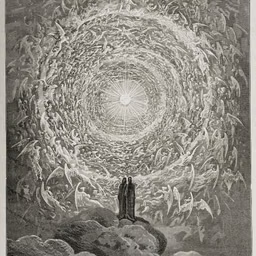
Thinking about this has got me wondering about Heaven, which is the end for the soul and, later, the body. What is Heaven like? What will the blessed see when they arrive?
Well, we begin with a caution – St. Paul (1 Corinthians 2:9) quoting Isaiah (64:4):
But as it is written:
"What no eye has seen, nor ear heard,
nor the human heart conceived,
what God has prepared for those who love him"—
So, neither I nor anyone else can describe this ultimate glory. Some mystics have claimed to have had a glimpse, but that just leads to another caution. After such a mystical experience on December 6, 1273, St. Thomas Aquinas abruptly stopped writing his Summa. According to his secretary/companion/confessor, Reginald of Piperno, Thomas said all his work now seemed to him like "straw" compared with what he had seen. He refused to speak of it again.
Other saints (almost always women), from Hildegard of Bingen to Faustina Kowalska, have had visions of Heaven, and they seem to converge on joy and light and love. (You can check here to read what the Catechism says.) It's living in the perfect "communion of life and love ...