About
By Steven Jonathan Rummelsburg
Few criticisms of modern education have aged as well as C.S. Lewis's 1943 The Abolition of Man. In "Men without Chests," Lewis explains, "we remove the organ and demand the function. We make men without chests and expect of them virtue and enterprise. . . .We castrate and bid the geldings be fruitful." The chest, in this context, is the trained heart that subordinates the appetites to the right use of reason. While Lewis focused on the chest, we can extend the analysis to the head, where the same surgery is performed on both the "mind" and "intelligence."
Lewis presaged the current crisis of intellect when he described the men that a debunking education produces. He called them Men without Chests; we call them "critical thinkers." Of them he wrote: "It is an outrage that they should be commonly spoken of as Intellectuals. This gives them the chance to say that he who attacks them attacks Intelligence." Today, "intelligence" has suffered the same fate as the "intellectual."
"Mind" and "intellect" are words that point to realities that are immaterial in nature. Consistently eradicating all immaterial things from educational theory leaves these concepts especially vulnerable to abuse. Ask any school faculty to explain "intelligence," and you will likely hear modifiers like multiple, emotional, and artificial. The noun they modify has become an organ donor.
The word "intellect" comes from the Latin intus legere – to read the interior. Our senses perceive outward qualities; the intellect grasps what things are, conceptually. A man sees and recognizes a particular dog, but his intellect grasps the nature it shares with all dogs. Unlike sight, it is not tied to a bodily organ; schools should cultivate its use and proper end. Aquinas teaches that the intellect's end is truth, the conformity of mind to reality, and thus our intellectual nature bears the image of God, a likeness that finds its fulfillment in Christ the Logos who is Truth Himself.
Intellect is a power of the soul with two operations Aquinas calls intellectus and ratio. Josef Pieper, in Leisure, the Basis of Culture, describes intellectus as "simply looking," the mind at rest receiving reality. The student who grasps the structure of a fugue, a proof, or a proverb is doing more than perceiving: he is apprehending what the thing is. Ratio, or reasoning, is the active capacity to move from what is known by first principles to what was previously unknown.
Reasoning becomes rootless when it is not preceded by the intellect's apprehension of the first principles. Yet we still demand "higher-order thinking" after we have banished the receptive mode of intellectus. By this removal, we produce an army of men without minds, well trained to criticize but rendered incapable of begetting higher culture.
Severed from the truth it exists to know, intelligence becomes simply technical skill, leaving no room for true erudition. St. Paul described a generation such as ours as "ever learning, and never attaining to the knowledge of the truth." (2 Timothy 3:7)
Three modern notions illustrate St. Paul's words, and each takes the name of the mind and gives it to something lesser. Howard Gardner's "multiple intelligences" splits the unity of intellect into eight or more capacities, such as mathematical, kinesthetic, and musical; the intellect exercises these abilities, but they are not the intellect itself. "Emotional intelligence," the premise of the social-emotional learning programs, inverts the order of intellect and passions. Artificial intelligence is no more like intelligence than fake flowers are like flowers; it simulates its effects, not the thing itself. Only the habit of judging by appearances lets us confuse the two.
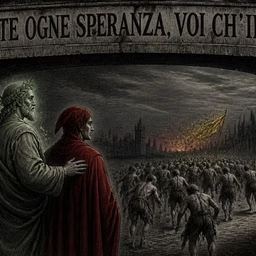
Dante, passing through the gate of Hell in Canto III of the Inferno, learns from Virgil that he will see the sorrowful who have "lost the good of the intellect," not the power to think, but its object, the truth that is God – the Goo...