About
By Brad Miner
By first a note from Robert Royal: There's just over a week until I begin my brief course on Pope Leo and the Augustinian tradition. Don't miss this chance to learn more about our American pope, the religious tradition he was formed by, and the ways in which he seems to follow or depart from the legacy of perhaps the greatest thinker in the early Church, St. Augustine of Hippo. You can register easily and quickly by clicking here. I hope to see you then. Now for today's column...
First, let's review the Corporal Works of Mercy, which are seven in number:
1. To feed the hungry
2. To give water to the thirsty
3. To clothe the naked
4. To shelter the homeless
5. To visit the sick
6. To visit the imprisoned
7. To bury the dead
There's a church in Naples, Italy, devoted to them. And its founding is a lovely story.
In 1601, seven (how appropriate) young Neapolitan noblemen, all in their 20s or 30s, joined together to form Pio Monte della Misericordia (the Pious Mount of Mercy). And on every Friday, they gathered at the Hospital for Incurables (Ospedale degli Incurabili) to minister to the sick. Then they decided to elevate their commitment by founding the Mount – and a church with it. The charitable institution and the church survive to this day; the hospital is long gone.
But when the construction of the church was finally completed, an altarpiece was needed, so one of the seven young nobles, Giovan Battista Manso, a patron of the arts (and a friend of the poets Torquato Tasso and Giovan Marino, and the scientist Galileo Galilei), knew that a certain young painter, Michelangelo Merisi, had just arrived in Naples.
We know him, of course, by the name of his birthplace, Caravaggio, and he was on the run from the law for having murdered (on May 29, 1606), a young Roman nobleman, Ranuccio Tomassoni (noble only in the sense of his family's "dignity"). Giovan Manso did not care about that, and he was happy to shelter Caravaggio – if he would paint an altarpiece for the Pio Monte della Misericordia. Besides, Caravaggio had been spirited to Naples by the Colonna family, and though I don't wish to evoke vile stereotypes, that bunch stepped right out of a Baroque-era version of The Godfather.
Of course, what we think of today as "the law" was rather ad hoc in the 17th century
Caravaggio didn't hesitate to accept the commission. Work was his drug. Besides, Manso and the Monte didn't nickel-and-dime the artist. His fee is estimated to have been in the range of $150,000 to $220,000 in 2026 U.S. dollars! That's more than a fair wage for the amount of time the painter spent creating it between September 23, 1606, and January 9, 1607. Three months and a skosh, for heaven's sake.
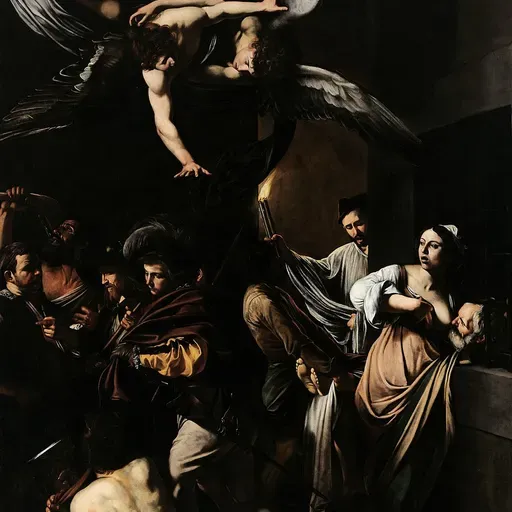
The painting is extraordinary. It is also, perhaps, the most difficult to "see." Caravaggio was the preeminent tenebrist. That term comes from the Italian word tenebroso, meaning dark or brooding or mysterious, and the words tenebrist or tenebrism likely weren't used in the 17th century – may, in fact, be 20th-century coinages. But I think we can be confident that when Giovan Manso – or if not he another – first saw the finished work, there was a whispered, "Tenebroso."
Being an art lover but not an art historian, I can only speculate that Caravaggio's development of the technique (and he was surely its master) had something to do with his love of the human figure and the drama in humanity, and with his rather unique process (working quickly, painting directly on canvas without sketching), and (here I speculate) looking over his shoulder to see if the law was about to kick down the door.
Whatever the reasons, the results were always stunning, and you see it from his earliest work all the way to the last: from Boy Peeling Fruit (c. 1592) to Martyrdom of Saint Ursula (1610). But it was never so stunning or as impenetrable as in The Seven Works of Mercy.
Let's break down The Seven Works of Mercy into four parts: top, middle (right and left), and bottom.
At t...
By first a note from Robert Royal: There's just over a week until I begin my brief course on Pope Leo and the Augustinian tradition. Don't miss this chance to learn more about our American pope, the religious tradition he was formed by, and the ways in which he seems to follow or depart from the legacy of perhaps the greatest thinker in the early Church, St. Augustine of Hippo. You can register easily and quickly by clicking here. I hope to see you then. Now for today's column...
First, let's review the Corporal Works of Mercy, which are seven in number:
1. To feed the hungry
2. To give water to the thirsty
3. To clothe the naked
4. To shelter the homeless
5. To visit the sick
6. To visit the imprisoned
7. To bury the dead
There's a church in Naples, Italy, devoted to them. And its founding is a lovely story.
In 1601, seven (how appropriate) young Neapolitan noblemen, all in their 20s or 30s, joined together to form Pio Monte della Misericordia (the Pious Mount of Mercy). And on every Friday, they gathered at the Hospital for Incurables (Ospedale degli Incurabili) to minister to the sick. Then they decided to elevate their commitment by founding the Mount – and a church with it. The charitable institution and the church survive to this day; the hospital is long gone.
But when the construction of the church was finally completed, an altarpiece was needed, so one of the seven young nobles, Giovan Battista Manso, a patron of the arts (and a friend of the poets Torquato Tasso and Giovan Marino, and the scientist Galileo Galilei), knew that a certain young painter, Michelangelo Merisi, had just arrived in Naples.
We know him, of course, by the name of his birthplace, Caravaggio, and he was on the run from the law for having murdered (on May 29, 1606), a young Roman nobleman, Ranuccio Tomassoni (noble only in the sense of his family's "dignity"). Giovan Manso did not care about that, and he was happy to shelter Caravaggio – if he would paint an altarpiece for the Pio Monte della Misericordia. Besides, Caravaggio had been spirited to Naples by the Colonna family, and though I don't wish to evoke vile stereotypes, that bunch stepped right out of a Baroque-era version of The Godfather.
Of course, what we think of today as "the law" was rather ad hoc in the 17th century
Caravaggio didn't hesitate to accept the commission. Work was his drug. Besides, Manso and the Monte didn't nickel-and-dime the artist. His fee is estimated to have been in the range of $150,000 to $220,000 in 2026 U.S. dollars! That's more than a fair wage for the amount of time the painter spent creating it between September 23, 1606, and January 9, 1607. Three months and a skosh, for heaven's sake.
The painting is extraordinary. It is also, perhaps, the most difficult to "see." Caravaggio was the preeminent tenebrist. That term comes from the Italian word tenebroso, meaning dark or brooding or mysterious, and the words tenebrist or tenebrism likely weren't used in the 17th century – may, in fact, be 20th-century coinages. But I think we can be confident that when Giovan Manso – or if not he another – first saw the finished work, there was a whispered, "Tenebroso."
Being an art lover but not an art historian, I can only speculate that Caravaggio's development of the technique (and he was surely its master) had something to do with his love of the human figure and the drama in humanity, and with his rather unique process (working quickly, painting directly on canvas without sketching), and (here I speculate) looking over his shoulder to see if the law was about to kick down the door.
Whatever the reasons, the results were always stunning, and you see it from his earliest work all the way to the last: from Boy Peeling Fruit (c. 1592) to Martyrdom of Saint Ursula (1610). But it was never so stunning or as impenetrable as in The Seven Works of Mercy.
Let's break down The Seven Works of Mercy into four parts: top, middle (right and left), and bottom.
At t...