About
By Stephen P. White
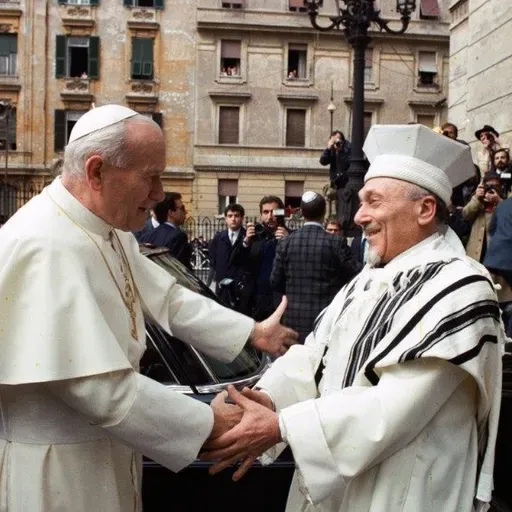
Forty years ago, Pope John Paul II made a historic visit to the Great Synagogue of Rome. He was the first bishop of Rome to visit a synagogue (though presumably Peter, at least, made an appearance now and again). John Paul's visit, so pregnant with symbolism and historical import, was much more than an occasion for "interreligious dialogue" – a phrase that can sometimes suggest a lowest-common denominator approach to religious belief.
Much more than a "celebration of differences," as today's parlance might frame it, this was a meeting of brothers, as Pope John Paul II famously put it on that occasion:
The Church of Christ discovers her "bond" with Judaism by "searching into her own mystery.". . .The Jewish religion is not "extrinsic" to us, but in a certain way is "intrinsic" to our own religion. With Judaism therefore we have a relationship which we do not have with any other religion. You are our dearly beloved brothers and, in a certain way, it could be said that you are our elder brothers.
As we know – or ought to know from history, Scripture, and perhaps personal experience – friendship between brothers can be a sublime thing. By the same token, few things are more bitter than enmity between brothers.
This claim of brotherhood between Christians and Jews is perhaps more significant than we at first would acknowledge.
Forty years ago (and 1986 was itself barely forty years after the end of the Second World War) a pope claiming brotherhood with the Jewish people was an unmistakable gesture of reconciliation, of friendship. Coming as it did from a Polish pope, was all the more poignant.
From John Paul II's boyhood home in Wadowice to the yawning gates of the "Golgotha of the modern world" (as he called the Nazi death camp of Auschwitz-Birkenau) it is a little less than 18 miles. That enduring symbol of the Holocaust was in Karol Wojtyla's home diocese, the diocese he himself led as archbishop before his election as pope.
The point is that the horrors of the Holocaust, which were inflicted especially (though far from exclusively) upon Jews, were much more than abstractions of history for Pope John Paul II. These atrocities happened to his neighbors, to his friends, and in his own back yard. For the Polish pope, accepting an invitation to the synagogue of Rome bore great personal significance.
In this context, the kinship – the brotherhood – of Christians and Jews was, in the eyes of Pope John Paul II much more than a mere post-war piety articulated as a vague, humanistic affinity. It was a kinship rooted in the historical faith in the God of Abraham. It was also a kinship marked and tested by profound suffering – of looking for the face of God amidst the worst horrors that human beings visit upon one another.
This kinship of Christians and Jews has always been of greater theological importance to Christianity than to Judaism. Simply put, according to Christianity's own claims, the truth of the Christian faith hangs upon the truth of Judaism. The Church cannot forget, as Nostrae aetate puts it, that she "draws sustenance from the root of that well-cultivated olive tree onto which have been grafted the wild shoots, the Gentiles." It matters to all Christians that the God of Abraham, Isaac, and Jacob really is the Lord.
The converse does not hold. The truth of Christianity is not a theological (still less an historical) prerequisite for Judaism. This means that Jewish willingness to engage with Christians as brothers always entails a kind of generosity and disinterestedness. So, it ought to be noted that Pope John Paul II was invited by Rabbi Elio Toaff to the synagogue of Rome, a detail that might be easily passed over but which bears a significance of its own.
For Christians to claim kinship with Jews is, in a sense, a kind of imposition. I don't mean it is impertinent for Christians to claim such kinship, rather that it is a claim which demands a kind of response, as all such claims do. To claim kinshi...
Forty years ago, Pope John Paul II made a historic visit to the Great Synagogue of Rome. He was the first bishop of Rome to visit a synagogue (though presumably Peter, at least, made an appearance now and again). John Paul's visit, so pregnant with symbolism and historical import, was much more than an occasion for "interreligious dialogue" – a phrase that can sometimes suggest a lowest-common denominator approach to religious belief.
Much more than a "celebration of differences," as today's parlance might frame it, this was a meeting of brothers, as Pope John Paul II famously put it on that occasion:
The Church of Christ discovers her "bond" with Judaism by "searching into her own mystery.". . .The Jewish religion is not "extrinsic" to us, but in a certain way is "intrinsic" to our own religion. With Judaism therefore we have a relationship which we do not have with any other religion. You are our dearly beloved brothers and, in a certain way, it could be said that you are our elder brothers.
As we know – or ought to know from history, Scripture, and perhaps personal experience – friendship between brothers can be a sublime thing. By the same token, few things are more bitter than enmity between brothers.
This claim of brotherhood between Christians and Jews is perhaps more significant than we at first would acknowledge.
Forty years ago (and 1986 was itself barely forty years after the end of the Second World War) a pope claiming brotherhood with the Jewish people was an unmistakable gesture of reconciliation, of friendship. Coming as it did from a Polish pope, was all the more poignant.
From John Paul II's boyhood home in Wadowice to the yawning gates of the "Golgotha of the modern world" (as he called the Nazi death camp of Auschwitz-Birkenau) it is a little less than 18 miles. That enduring symbol of the Holocaust was in Karol Wojtyla's home diocese, the diocese he himself led as archbishop before his election as pope.
The point is that the horrors of the Holocaust, which were inflicted especially (though far from exclusively) upon Jews, were much more than abstractions of history for Pope John Paul II. These atrocities happened to his neighbors, to his friends, and in his own back yard. For the Polish pope, accepting an invitation to the synagogue of Rome bore great personal significance.
In this context, the kinship – the brotherhood – of Christians and Jews was, in the eyes of Pope John Paul II much more than a mere post-war piety articulated as a vague, humanistic affinity. It was a kinship rooted in the historical faith in the God of Abraham. It was also a kinship marked and tested by profound suffering – of looking for the face of God amidst the worst horrors that human beings visit upon one another.
This kinship of Christians and Jews has always been of greater theological importance to Christianity than to Judaism. Simply put, according to Christianity's own claims, the truth of the Christian faith hangs upon the truth of Judaism. The Church cannot forget, as Nostrae aetate puts it, that she "draws sustenance from the root of that well-cultivated olive tree onto which have been grafted the wild shoots, the Gentiles." It matters to all Christians that the God of Abraham, Isaac, and Jacob really is the Lord.
The converse does not hold. The truth of Christianity is not a theological (still less an historical) prerequisite for Judaism. This means that Jewish willingness to engage with Christians as brothers always entails a kind of generosity and disinterestedness. So, it ought to be noted that Pope John Paul II was invited by Rabbi Elio Toaff to the synagogue of Rome, a detail that might be easily passed over but which bears a significance of its own.
For Christians to claim kinship with Jews is, in a sense, a kind of imposition. I don't mean it is impertinent for Christians to claim such kinship, rather that it is a claim which demands a kind of response, as all such claims do. To claim kinshi...