About
By Msgr. Charles Fink
Why is there something rather than nothing? Why is that something such that it has the remarkable capacity to evolve into the complex yet orderly universe we behold, so orderly that predictability and science are possible? Why do even the simplest living cells contain genetic information analogous to complex computer codes?
These are not meaningless questions. Nor is it obvious why the only intelligent answer to such questions is simply a roll of the dice. Or that's just the way things are. In all areas of human endeavor, we look for reasons and causes to account for the way things are. It's hard to see why the hypothesis underlying all these extraordinary realities makes simpletons of those who propose it.
Bumper sticker philosophy like "Atheism is a myth understood" or "Religion stops a thinking brain" or references to "flying spaghetti monsters" may be entertaining, but, surely, they don't qualify as loftily intellectual.
English philosopher Anthony Flew, after a lifetime of scholarship and atheism, came to see the existence of God as a cogent explanation for the seemingly miraculous fine-tuning of the universe in its apparent origin.
Alex O'Connor, a contemporary online podcaster, invariably thoughtful and gracious, though still an unbeliever, concedes that Thomas Aquinas' demonstrations for the existence of God and the evidence for Christ's Resurrection are much more compelling than he previously thought, certainly not dismissible as the musings of fools.
I often wonder how rabid atheists, so dismissive of belief in God and inclined to conflate belief with stupidity or superficiality, explain people like the late Father Stanley Jaki, who had doctorates in theology and physics and spoke seven languages. Believing geniuses like Jaki may not be legion, but they're by no means unheard of and suggest that lack of intelligence can hardly be accepted as a legitimate explanation of religious belief.
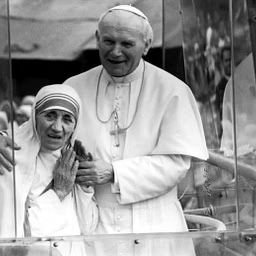
Nor can the view that faith in God is simply a crutch for weaklings and those otherwise incapable of dealing with the rigors of life; you know, people like Saints John Paul II and Mother Teresa of Kolkata – the one who helped bring down the Soviet empire, the other living among the poorest of the poor in the slums of India. Pathetic weaklings both, we're supposed to think, no match for the brave, bright, muscular atheists teaching in our universities or working in the media or Hollywood.
Of course, it's true that many believers are simple souls lacking advanced degrees and that many, too, need their religious faith to get through another day. There's a moving scene in the film "Steel Magnolias" where the Daryl Hannah character says just that to Sally Field, who's devastated by the death of her daughter. Their exchange doesn't minimize the tragedy of that death. But to cope with life, Field needs to believe that God is in charge and that after death, there's something beyond.
I've been a Catholic priest for fifty years and have dealt with some unbelievably heartbreaking tragedies, including the triple funeral of a woman and her two nieces, killed in a car accident that wasn't their fault. The mother of the two girls had recently divorced. The girls were her only children. I still have the pyx, the small metal container used to bring Communion to the sick, given to me by that mother, engraved with the names of her daughters whom she described as God's angels.
Let's concede that this woman's faith at that point was in good measure a crutch. I presided at her funeral years later, and I know she was never the same after the devastating loss of her beautiful teenage girls. Nevertheless, she endured until her death with faith, hope, and love. Would she have been better off without all that? I've known hundreds, maybe thousands like her, facing unspeakable sorrows, some their heads just above water, others amazingly buoyant in spite of tragedy, and all largely because of their faith.
So here's a question for all who ...
Why is there something rather than nothing? Why is that something such that it has the remarkable capacity to evolve into the complex yet orderly universe we behold, so orderly that predictability and science are possible? Why do even the simplest living cells contain genetic information analogous to complex computer codes?
These are not meaningless questions. Nor is it obvious why the only intelligent answer to such questions is simply a roll of the dice. Or that's just the way things are. In all areas of human endeavor, we look for reasons and causes to account for the way things are. It's hard to see why the hypothesis underlying all these extraordinary realities makes simpletons of those who propose it.
Bumper sticker philosophy like "Atheism is a myth understood" or "Religion stops a thinking brain" or references to "flying spaghetti monsters" may be entertaining, but, surely, they don't qualify as loftily intellectual.
English philosopher Anthony Flew, after a lifetime of scholarship and atheism, came to see the existence of God as a cogent explanation for the seemingly miraculous fine-tuning of the universe in its apparent origin.
Alex O'Connor, a contemporary online podcaster, invariably thoughtful and gracious, though still an unbeliever, concedes that Thomas Aquinas' demonstrations for the existence of God and the evidence for Christ's Resurrection are much more compelling than he previously thought, certainly not dismissible as the musings of fools.
I often wonder how rabid atheists, so dismissive of belief in God and inclined to conflate belief with stupidity or superficiality, explain people like the late Father Stanley Jaki, who had doctorates in theology and physics and spoke seven languages. Believing geniuses like Jaki may not be legion, but they're by no means unheard of and suggest that lack of intelligence can hardly be accepted as a legitimate explanation of religious belief.
Nor can the view that faith in God is simply a crutch for weaklings and those otherwise incapable of dealing with the rigors of life; you know, people like Saints John Paul II and Mother Teresa of Kolkata – the one who helped bring down the Soviet empire, the other living among the poorest of the poor in the slums of India. Pathetic weaklings both, we're supposed to think, no match for the brave, bright, muscular atheists teaching in our universities or working in the media or Hollywood.
Of course, it's true that many believers are simple souls lacking advanced degrees and that many, too, need their religious faith to get through another day. There's a moving scene in the film "Steel Magnolias" where the Daryl Hannah character says just that to Sally Field, who's devastated by the death of her daughter. Their exchange doesn't minimize the tragedy of that death. But to cope with life, Field needs to believe that God is in charge and that after death, there's something beyond.
I've been a Catholic priest for fifty years and have dealt with some unbelievably heartbreaking tragedies, including the triple funeral of a woman and her two nieces, killed in a car accident that wasn't their fault. The mother of the two girls had recently divorced. The girls were her only children. I still have the pyx, the small metal container used to bring Communion to the sick, given to me by that mother, engraved with the names of her daughters whom she described as God's angels.
Let's concede that this woman's faith at that point was in good measure a crutch. I presided at her funeral years later, and I know she was never the same after the devastating loss of her beautiful teenage girls. Nevertheless, she endured until her death with faith, hope, and love. Would she have been better off without all that? I've known hundreds, maybe thousands like her, facing unspeakable sorrows, some their heads just above water, others amazingly buoyant in spite of tragedy, and all largely because of their faith.
So here's a question for all who ...