About
By Brad Miner.
"The sculptor arrives at his end by taking away what is superfluous."
– Michelangelo to Benedetto Varchi, 1549
The greatest artist of the Renaissance is famous for something he may never have said: "I saw the angel in the marble and carved until I set him free." There are other versions of the quotation, as in the epigraph above, that are genuine, and they may seem to suggest that Michelangelo believed he merely liberated a form trapped in stone.
Anyone who has visited the Accademia in Florence will appreciate the idea, because resident in the Hall of Prisoners there are Michelangelo's "slaves" – unfinished sculptures intended for the never-constructed tomb of Pope Julius II. The figures do seem to be struggling to escape:
But stone is stone – even though quarks within are in constant, rapid motion – and the block of marble won't cough up a statue like a cat disgorging a hairball. It takes the mind, muscle, and imagination of a sculptor, not to mention his hands and eyes, to chisel a statue into existence.
Thorne Smith, American humorist of the Great Depression (most famous for Topper), wrote a screwball comedy called The Night Life of the Gods (1931) in which an amateur scientist discovers a way, Medusa-like, to turn living matter into stone and vice versa. He animates sculptures of the Greek gods in New York's Metropolitan Museum, who escape to the streets of Manhattan. Chaos and hilarity follow.
The ancient Greeks and Romans made sculptures, and they painted them. Some of that statuary still exists, and even more was standing or lying about in Rome in Michelangelo's time, at which point (as today) the paint (polychrome) had long ago worn off, and an erroneous theory arose in Renaissance Italy that classical artists glorified in the purity of plain, white stone. That has mostly remained the standard for figurative sculpture ever since.
For Michelangelo, Carrara marble was the ideal medium, and, as the MET Museum's Carmen C. Bambach writes, he spent:
long stretches of time on-site at the marble quarries in Carrara and Pietrasanta, where he not only selected marbles and gave precise orders regarding the sizes and shapes of the blocks being quarried, but even concerned himself with the building of roads to transport the stone.
And that Tuscan quarry was the same one used by the Romans and is still used today.
Michelangelo lived a long time – 88 years. At 13, he was apprenticed to Domenico Ghirlandaio, a very fine painter, but this most famous of his students was more interested in stone than paint. At 15, Michelangelo joined the school of the Florentine sculptor Bertoldo di Giovanni. This was a savvy move because Bertoldo's patron was Lorenzo de' Medici, ill Magnifico.
It was Leonardo da Vinci who wrote in one of his notebooks (likely comparing himself to his mentor, Andrea del Verrocchio): "Poor is the pupil who does not surpass his teacher." Michelangelo certainly outshone Ghirlandaio and Bertoldo.
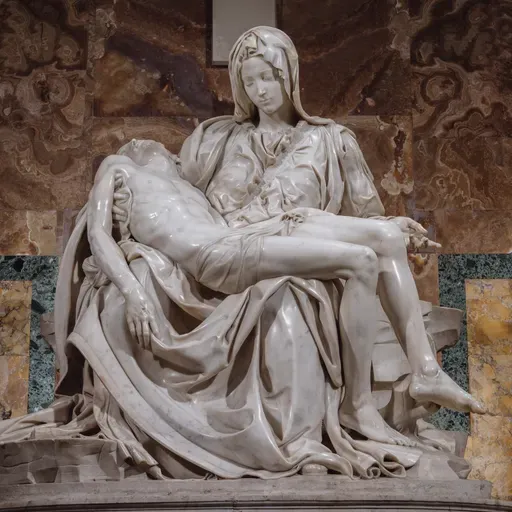
One may debate which of Michelangelo's sculptures is his greatest, but, in my opinion, it's his Pietà. His David (also at the Accademia) is the most imposing, especially when you see it in person: it's 17 feet tall. His Moses (about which I've written here) has fascinated many, not least Sigmund Freud.
But Pietà is best. Pietà means "pity," but in the secondary sense in English: "tenderness and concern aroused by the suffering or misfortune of another; compassion, sympathy." (O.E.D.)
Unlike many other artists of the Renaissance, nearly all of whom were Roman Catholic, Michelangelo di Lodovico Buonarroti Simoni was among the most Catholic, by which I mean the most devout. He has also proved to be the most catholic, by which I mean the most universally recognized and admired, although much of that is thanks to that ceiling in Rome.
Pietà may also have been Michelangelo's favorite sculpture. Certainly, it's the only one he ever signed. But it's also one he hoped would make him famous. Not an unholy ambition, it s...
"The sculptor arrives at his end by taking away what is superfluous."
– Michelangelo to Benedetto Varchi, 1549
The greatest artist of the Renaissance is famous for something he may never have said: "I saw the angel in the marble and carved until I set him free." There are other versions of the quotation, as in the epigraph above, that are genuine, and they may seem to suggest that Michelangelo believed he merely liberated a form trapped in stone.
Anyone who has visited the Accademia in Florence will appreciate the idea, because resident in the Hall of Prisoners there are Michelangelo's "slaves" – unfinished sculptures intended for the never-constructed tomb of Pope Julius II. The figures do seem to be struggling to escape:
But stone is stone – even though quarks within are in constant, rapid motion – and the block of marble won't cough up a statue like a cat disgorging a hairball. It takes the mind, muscle, and imagination of a sculptor, not to mention his hands and eyes, to chisel a statue into existence.
Thorne Smith, American humorist of the Great Depression (most famous for Topper), wrote a screwball comedy called The Night Life of the Gods (1931) in which an amateur scientist discovers a way, Medusa-like, to turn living matter into stone and vice versa. He animates sculptures of the Greek gods in New York's Metropolitan Museum, who escape to the streets of Manhattan. Chaos and hilarity follow.
The ancient Greeks and Romans made sculptures, and they painted them. Some of that statuary still exists, and even more was standing or lying about in Rome in Michelangelo's time, at which point (as today) the paint (polychrome) had long ago worn off, and an erroneous theory arose in Renaissance Italy that classical artists glorified in the purity of plain, white stone. That has mostly remained the standard for figurative sculpture ever since.
For Michelangelo, Carrara marble was the ideal medium, and, as the MET Museum's Carmen C. Bambach writes, he spent:
long stretches of time on-site at the marble quarries in Carrara and Pietrasanta, where he not only selected marbles and gave precise orders regarding the sizes and shapes of the blocks being quarried, but even concerned himself with the building of roads to transport the stone.
And that Tuscan quarry was the same one used by the Romans and is still used today.
Michelangelo lived a long time – 88 years. At 13, he was apprenticed to Domenico Ghirlandaio, a very fine painter, but this most famous of his students was more interested in stone than paint. At 15, Michelangelo joined the school of the Florentine sculptor Bertoldo di Giovanni. This was a savvy move because Bertoldo's patron was Lorenzo de' Medici, ill Magnifico.
It was Leonardo da Vinci who wrote in one of his notebooks (likely comparing himself to his mentor, Andrea del Verrocchio): "Poor is the pupil who does not surpass his teacher." Michelangelo certainly outshone Ghirlandaio and Bertoldo.
One may debate which of Michelangelo's sculptures is his greatest, but, in my opinion, it's his Pietà. His David (also at the Accademia) is the most imposing, especially when you see it in person: it's 17 feet tall. His Moses (about which I've written here) has fascinated many, not least Sigmund Freud.
But Pietà is best. Pietà means "pity," but in the secondary sense in English: "tenderness and concern aroused by the suffering or misfortune of another; compassion, sympathy." (O.E.D.)
Unlike many other artists of the Renaissance, nearly all of whom were Roman Catholic, Michelangelo di Lodovico Buonarroti Simoni was among the most Catholic, by which I mean the most devout. He has also proved to be the most catholic, by which I mean the most universally recognized and admired, although much of that is thanks to that ceiling in Rome.
Pietà may also have been Michelangelo's favorite sculpture. Certainly, it's the only one he ever signed. But it's also one he hoped would make him famous. Not an unholy ambition, it s...