About
By Fr. Paul D. Scalia
Soon-to-be-Blessed Fulton Sheen once quipped, "The questions of God are more satisfying than the answers of man." (That's a variation on his friend G.K. Chesterton's line, "The riddles of God are more satisfying than the solutions of man.") Today's Gospel (Matthew 16:13-20) gives evidence of this truth. God doesn't ask questions because He needs the answers, but because we need to reflect on them and to find in them more spiritual fruit than human answers can provide.
Our Lord has taken His Apostles into the pagan territory of Caesarea Philippi. It's a calmer place because it's free of the scribes and Pharisees. He can speak openly without having to deal with their traps. This time of more explicit instruction centers around two questions to His Apostles: "Who do people say that the Son of Man is?" and "Who do you say that I am?"
Who do people say that the Son of Man is? The response to this first question immediately reveals just how unsatisfying the answers of man can be: "Some say John the Baptist, others Elijah, still others Jeremiah or one of the prophets." John, Elijah, and Jeremiah all resembled the Christ because they pointed to Him. The crowds confuse a similarity for our Lord Himself. This is just religious opinion.
Thus, the first question reveals our need for divine instruction. On our own, we seek and cast about for the true God, dimly perceiving Him, and in many ways coming close to the truth. But we inevitably latch on to false images or understandings of Him. The idols of pagans are an obvious example.
But we – who, like the crowds, have followed, watched, and listened to Jesus for some time – also can get it wrong. We have ideas and opinions about Him that stray, to some degree or another, from the truth about Him. All of which means, not that we do not believe, but that our understanding of Him needs constant purification and enlightenment. In short, we don't want to be like the crowds, straying into mere religious opinion.
Which brings us to the second question: But who do you say that I am? This question prompts profound doctrinal statements about Jesus and His Church. But rather than rushing into the doctrine itself, let's consider its purpose. Jesus doesn't ask the question as if it were a catechetical test or theological exam. It's a personal appeal of His Sacred Heart to His followers. He desires that His closest friends and coworkers know Who He is. Every human heart desires that, of course. How much more our Lord's Sacred Heart.
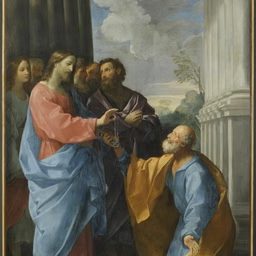
We cannot respond accurately on our own. Peter's answer – "You are the Christ, the Son of the living God" – is not human but divine: "For flesh and blood has not revealed this to you, but my heavenly Father." Unlike the crowds, because of his faith, Peter doesn't have a religious opinion about Jesus. He has the truth and his speaking of it brings joy to our Lord's Heart.
With Peter, we receive from the Father the ability to confess the true faith. Ours is not the answer of a man but the revelation of God, not our own discovery but the Father's gift. The Father alone gives us the true faith by which we console His Son's Sacred Heart.
This also teaches us something about the Church. Founded on Peter and his divinely inspired response, the Church proclaims not only human wisdom but most of all the saving doctrine revealed by the Father. The Church is present in the world not as an NGO or another participant in international discussions on integral human development. She is the authoritative voice of God. Yes, the Church is "an expert in humanity" (Paul VI). But only because she possesses the faith that "purifies reason" (John Paul II).
But back to the personal dimension of this exchange. Doctrine is given to us not simply so that we can be theologically right but, even more so, that we can pray rightly. Uncle Screwtape knows how prone we are to mistaken prayer. He fears that we might recognize the subjective nature of our thoughts and images of God, that...
Soon-to-be-Blessed Fulton Sheen once quipped, "The questions of God are more satisfying than the answers of man." (That's a variation on his friend G.K. Chesterton's line, "The riddles of God are more satisfying than the solutions of man.") Today's Gospel (Matthew 16:13-20) gives evidence of this truth. God doesn't ask questions because He needs the answers, but because we need to reflect on them and to find in them more spiritual fruit than human answers can provide.
Our Lord has taken His Apostles into the pagan territory of Caesarea Philippi. It's a calmer place because it's free of the scribes and Pharisees. He can speak openly without having to deal with their traps. This time of more explicit instruction centers around two questions to His Apostles: "Who do people say that the Son of Man is?" and "Who do you say that I am?"
Who do people say that the Son of Man is? The response to this first question immediately reveals just how unsatisfying the answers of man can be: "Some say John the Baptist, others Elijah, still others Jeremiah or one of the prophets." John, Elijah, and Jeremiah all resembled the Christ because they pointed to Him. The crowds confuse a similarity for our Lord Himself. This is just religious opinion.
Thus, the first question reveals our need for divine instruction. On our own, we seek and cast about for the true God, dimly perceiving Him, and in many ways coming close to the truth. But we inevitably latch on to false images or understandings of Him. The idols of pagans are an obvious example.
But we – who, like the crowds, have followed, watched, and listened to Jesus for some time – also can get it wrong. We have ideas and opinions about Him that stray, to some degree or another, from the truth about Him. All of which means, not that we do not believe, but that our understanding of Him needs constant purification and enlightenment. In short, we don't want to be like the crowds, straying into mere religious opinion.
Which brings us to the second question: But who do you say that I am? This question prompts profound doctrinal statements about Jesus and His Church. But rather than rushing into the doctrine itself, let's consider its purpose. Jesus doesn't ask the question as if it were a catechetical test or theological exam. It's a personal appeal of His Sacred Heart to His followers. He desires that His closest friends and coworkers know Who He is. Every human heart desires that, of course. How much more our Lord's Sacred Heart.
We cannot respond accurately on our own. Peter's answer – "You are the Christ, the Son of the living God" – is not human but divine: "For flesh and blood has not revealed this to you, but my heavenly Father." Unlike the crowds, because of his faith, Peter doesn't have a religious opinion about Jesus. He has the truth and his speaking of it brings joy to our Lord's Heart.
With Peter, we receive from the Father the ability to confess the true faith. Ours is not the answer of a man but the revelation of God, not our own discovery but the Father's gift. The Father alone gives us the true faith by which we console His Son's Sacred Heart.
This also teaches us something about the Church. Founded on Peter and his divinely inspired response, the Church proclaims not only human wisdom but most of all the saving doctrine revealed by the Father. The Church is present in the world not as an NGO or another participant in international discussions on integral human development. She is the authoritative voice of God. Yes, the Church is "an expert in humanity" (Paul VI). But only because she possesses the faith that "purifies reason" (John Paul II).
But back to the personal dimension of this exchange. Doctrine is given to us not simply so that we can be theologically right but, even more so, that we can pray rightly. Uncle Screwtape knows how prone we are to mistaken prayer. He fears that we might recognize the subjective nature of our thoughts and images of God, that...