About
By Michele McAloon.
But first a note from Robert Royal: Friends: Today is the last day of our end-of-year fundraising campaign. We'll be happy to accept your donation anytime, of course. But why wait? We're already working at plans for the shape of TCT, new courses, our other educational campaigns, podcasts, Posses, videos, and much more. We'd like to be able to have a full picture of the resources we'll have in 2026. So now's the time to join in and become part of the process by which we reach out into the Church and the world. Giving NOW makes your contribution even more valuable. And it's tax deductible, And. . .enough. You get the point. Click the button. Write the check. Sign up for a one time donation, monthly, quarterly, annual. But just do it. Please. Today.
Now for today's column...
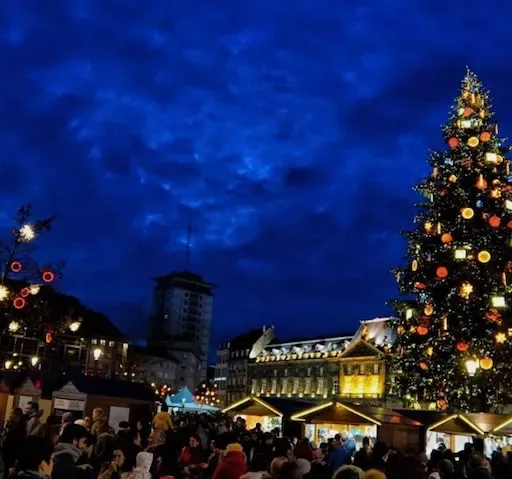
Advent in Germany is brightened by its world-famous Christmas markets. The smell of grilled sausage, Germany's famous mulled gluhwein, and gingerbread (Lebkuchen) blend together under multicolored lights creating a cheerful experience in anticipation of Christ's birth. Whether it is a two-day affair at a local monastery or the town fire station, or one of the huge metropolitan markets in Munich, Berlin, or Dresden, Christmas markets, now, as in centuries past, are an integral part of the economic and social fabric of Germany, and a potential sign of hope. Though they are also currently threatened by dark shadows.
Tragically, in the past ten years, festivities have been marred by violence. Terrorists have murdered market-goers in Magdeburg, Trier, Berlin and in several markets in France. German and French authorities have now been forced to take measures to prevent these threats almost everywhere.
Today, pedestrian zones typically have a hard barrier to prevent the ramming of automobiles into crowds. In many markets, entrance is strictly controlled with bag and body searches. Unusually for Germany, where police are rarely seen in everyday life, there is a heavy police presence, and surveillance cameras watching over every corner of the markets.
Thankfully, terrorism has not intimidated the people. This year, attendance at the Christmas markets is projected to break record numbers finally returning to pre-pandemic levels.
Despite everything, more than 3000 Christkindlmarkt or Weihnachtsmarkt, as they are referred to regionally, occur in Germany today. Generating billions in Euros, these markets are vital to a struggling German economy. And this is nothing new. Although they've become associated with Christmas, the oldest Christmas markets started as secular, not religious events. Medieval communities would gather in late fall and early winter to sell products and purchase supplies needed before the arrival of the harsh winter months.
Market days often coincided with Christian feast days. Local people would walk to town to worship and then stay to shop at the market. Before the Protestant Reformation, December 6, the Feast of St Nicholas, was a traditional time for children to receive gifts. Parents would buy their children toys at the market and leave them in their children's shoes during the night to honor the good bishop of Myra (a charming custom but also a precursor of Western consumerism).
The Dresden Christmas market is known as the Striezelmarkt and began in 1434, not as a Christmas market but as a meat market where town citizens could purchase Christmas roasts to break the Advent fast. Christmas liturgical symbols were adapted and assimilated as these December markets grew in popularity.
The relationship between the Church and the Christmas markets has always been somewhat ambivalent. Catholic and Protestant clergy understood both the spiritual and economic importance of these markets. They encouraged worship during the season, but were also happy to charge rent for vendors' stalls, often located in the churchyard.
German bishops today are notoriously reticent about evangelization in the public square. But at least some view the ...
But first a note from Robert Royal: Friends: Today is the last day of our end-of-year fundraising campaign. We'll be happy to accept your donation anytime, of course. But why wait? We're already working at plans for the shape of TCT, new courses, our other educational campaigns, podcasts, Posses, videos, and much more. We'd like to be able to have a full picture of the resources we'll have in 2026. So now's the time to join in and become part of the process by which we reach out into the Church and the world. Giving NOW makes your contribution even more valuable. And it's tax deductible, And. . .enough. You get the point. Click the button. Write the check. Sign up for a one time donation, monthly, quarterly, annual. But just do it. Please. Today.
Now for today's column...
Advent in Germany is brightened by its world-famous Christmas markets. The smell of grilled sausage, Germany's famous mulled gluhwein, and gingerbread (Lebkuchen) blend together under multicolored lights creating a cheerful experience in anticipation of Christ's birth. Whether it is a two-day affair at a local monastery or the town fire station, or one of the huge metropolitan markets in Munich, Berlin, or Dresden, Christmas markets, now, as in centuries past, are an integral part of the economic and social fabric of Germany, and a potential sign of hope. Though they are also currently threatened by dark shadows.
Tragically, in the past ten years, festivities have been marred by violence. Terrorists have murdered market-goers in Magdeburg, Trier, Berlin and in several markets in France. German and French authorities have now been forced to take measures to prevent these threats almost everywhere.
Today, pedestrian zones typically have a hard barrier to prevent the ramming of automobiles into crowds. In many markets, entrance is strictly controlled with bag and body searches. Unusually for Germany, where police are rarely seen in everyday life, there is a heavy police presence, and surveillance cameras watching over every corner of the markets.
Thankfully, terrorism has not intimidated the people. This year, attendance at the Christmas markets is projected to break record numbers finally returning to pre-pandemic levels.
Despite everything, more than 3000 Christkindlmarkt or Weihnachtsmarkt, as they are referred to regionally, occur in Germany today. Generating billions in Euros, these markets are vital to a struggling German economy. And this is nothing new. Although they've become associated with Christmas, the oldest Christmas markets started as secular, not religious events. Medieval communities would gather in late fall and early winter to sell products and purchase supplies needed before the arrival of the harsh winter months.
Market days often coincided with Christian feast days. Local people would walk to town to worship and then stay to shop at the market. Before the Protestant Reformation, December 6, the Feast of St Nicholas, was a traditional time for children to receive gifts. Parents would buy their children toys at the market and leave them in their children's shoes during the night to honor the good bishop of Myra (a charming custom but also a precursor of Western consumerism).
The Dresden Christmas market is known as the Striezelmarkt and began in 1434, not as a Christmas market but as a meat market where town citizens could purchase Christmas roasts to break the Advent fast. Christmas liturgical symbols were adapted and assimilated as these December markets grew in popularity.
The relationship between the Church and the Christmas markets has always been somewhat ambivalent. Catholic and Protestant clergy understood both the spiritual and economic importance of these markets. They encouraged worship during the season, but were also happy to charge rent for vendors' stalls, often located in the churchyard.
German bishops today are notoriously reticent about evangelization in the public square. But at least some view the ...