About
By Brad Miner
There was once a monument in Rome called Milliarium Aureum: the Golden Milestone. The Emperor Augustus erected it in the Forum in about 20 B.C. All distances in Ancient Rome were said to be marked from (or to) that spot. There's still a round remnant of it in the Roman Forum.
It gave rise to the phrase, "All roads lead to Rome," for the very good reason that they did. The 12th-century poet-theologian Alain de Lille was the first to use the phrase, as Mille viae ducunt homines per saecula Romam: Qui dominum toto quaerere corde volunt ("A thousand roads lead forever to Rome, the men who desire to seek the Lord with all their heart."). Chaucer (A Treatise on the Astrolabe in 1391) was the first to recast de Lille's proverb into English as "Right as diverse pathes leden diverse folk the righte way to Rome."
And, my friends, this was never about geography.
Jump ahead to the 16th and 17th centuries (and later), and artists found their many ways to the Eternal City along earthly roads to discover ways of expressing the glory of God. Some – painters especially – were merely talented copyists; others were visionaries who found inspiration in the work of Leonardo, Michelangelo, Raphael, and other greats of the Renaissance, but also the Baroque greats, and the greatest of those was Michelangelo Merisi da Caravaggio.
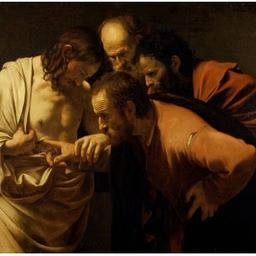
I wrote here recently about my favorite work of art, Joan of Arc by Jules Bastien-Lepage, but that is not the painting I consider the greatest. That dubious honor (dubious because it's simply my opinion and because no serious art historian would ever plant such a flag) belongs to Caravaggio's The Incredulity of St. Thomas. I'm merely an art lover and have my reasons for esteeming this great work.
The painting was commissioned by Vincenzo Giustiniani (1564-1627), a successful banker, financier to the Vatican, and a patron of the arts, who acquired 15 paintings by Caravaggio.
(An interesting aside: Giustiniani's first Caravaggio purchase was Saint Matthew and the Angel after it was rejected by the church of San Luigi dei Francesi in Rome, intended for the Contarelli Chapel there. Giustiniani bought the painting to protect Caravaggio from a financial loss, and the painter did another, more glorious version, The Inspiration of Saint Matthew, which is now the center panel in the Chapel, flanked by The Calling of Saint Matthew and The Martyrdom of Saint Matthew. Years later, Saint Matthew and the Angel ended up in Berlin, where it was destroyed by fire near the end of WWII.)
Rome is clearly the place Caravaggio wished to call home. It was the center of the Faith he loved, and it was where the money was. He first came to Rome at 21, and he was on his way back to Rome when he died at 38.
Giustiniani must have found this moment in Scripture utterly fascinating. He didn't commission the painting for a church but for his own villa.
We all know the moment Caravaggio is capturing because John tells us (20:24-29). Christ had appeared to the Apostles, but Thomas was not among them. So, when they told him the Lord had returned, Thomas said, "Unless I see in his hands the print of the nails and place my finger in the mark of the nails, and place my hand in his side, I will not believe." And then:
Eight days later, his disciples were again in the house, and Thomas was with them. The doors were shut, but Jesus came and stood among them, and said, "Peace be with you." Then he said to Thomas, "Put your finger here, and see my hands; and put out your hand, and place it in my side; do not be faithless, but believing." Thomas answered him, "My Lord and my God!"
It's interesting to me that Caravaggio puts Peter in the painting. It makes sense that John would be there: he's the one who has given us the story. For me, the extraordinary scene (a proof for "doubting" Thomas of the divinity of Jesus) is frozen in the moment when Thomas believes – so much so that his proclamation of faith trumps Peter's earlier one. The Rock upon which C...
There was once a monument in Rome called Milliarium Aureum: the Golden Milestone. The Emperor Augustus erected it in the Forum in about 20 B.C. All distances in Ancient Rome were said to be marked from (or to) that spot. There's still a round remnant of it in the Roman Forum.
It gave rise to the phrase, "All roads lead to Rome," for the very good reason that they did. The 12th-century poet-theologian Alain de Lille was the first to use the phrase, as Mille viae ducunt homines per saecula Romam: Qui dominum toto quaerere corde volunt ("A thousand roads lead forever to Rome, the men who desire to seek the Lord with all their heart."). Chaucer (A Treatise on the Astrolabe in 1391) was the first to recast de Lille's proverb into English as "Right as diverse pathes leden diverse folk the righte way to Rome."
And, my friends, this was never about geography.
Jump ahead to the 16th and 17th centuries (and later), and artists found their many ways to the Eternal City along earthly roads to discover ways of expressing the glory of God. Some – painters especially – were merely talented copyists; others were visionaries who found inspiration in the work of Leonardo, Michelangelo, Raphael, and other greats of the Renaissance, but also the Baroque greats, and the greatest of those was Michelangelo Merisi da Caravaggio.
I wrote here recently about my favorite work of art, Joan of Arc by Jules Bastien-Lepage, but that is not the painting I consider the greatest. That dubious honor (dubious because it's simply my opinion and because no serious art historian would ever plant such a flag) belongs to Caravaggio's The Incredulity of St. Thomas. I'm merely an art lover and have my reasons for esteeming this great work.
The painting was commissioned by Vincenzo Giustiniani (1564-1627), a successful banker, financier to the Vatican, and a patron of the arts, who acquired 15 paintings by Caravaggio.
(An interesting aside: Giustiniani's first Caravaggio purchase was Saint Matthew and the Angel after it was rejected by the church of San Luigi dei Francesi in Rome, intended for the Contarelli Chapel there. Giustiniani bought the painting to protect Caravaggio from a financial loss, and the painter did another, more glorious version, The Inspiration of Saint Matthew, which is now the center panel in the Chapel, flanked by The Calling of Saint Matthew and The Martyrdom of Saint Matthew. Years later, Saint Matthew and the Angel ended up in Berlin, where it was destroyed by fire near the end of WWII.)
Rome is clearly the place Caravaggio wished to call home. It was the center of the Faith he loved, and it was where the money was. He first came to Rome at 21, and he was on his way back to Rome when he died at 38.
Giustiniani must have found this moment in Scripture utterly fascinating. He didn't commission the painting for a church but for his own villa.
We all know the moment Caravaggio is capturing because John tells us (20:24-29). Christ had appeared to the Apostles, but Thomas was not among them. So, when they told him the Lord had returned, Thomas said, "Unless I see in his hands the print of the nails and place my finger in the mark of the nails, and place my hand in his side, I will not believe." And then:
Eight days later, his disciples were again in the house, and Thomas was with them. The doors were shut, but Jesus came and stood among them, and said, "Peace be with you." Then he said to Thomas, "Put your finger here, and see my hands; and put out your hand, and place it in my side; do not be faithless, but believing." Thomas answered him, "My Lord and my God!"
It's interesting to me that Caravaggio puts Peter in the painting. It makes sense that John would be there: he's the one who has given us the story. For me, the extraordinary scene (a proof for "doubting" Thomas of the divinity of Jesus) is frozen in the moment when Thomas believes – so much so that his proclamation of faith trumps Peter's earlier one. The Rock upon which C...