About
By Brad Miner
But first a note from Robert Royal: Brad Miner. On movies. Enough said. Support The Catholic Thing.
Now for today's column...
Who was America's greatest Roman Catholic movie director? My answer is Leo McCarey. But I need to acknowledge other great Catholic directors.
There's John Ford, whose The Quiet Man is a candidate for the greatest Catholic movie – or should that be the greatest Irish movie?
There's Alfred Hitchcock, whose I Confess is certainly a candidate for the most interesting Catholic film.
There's Frank Capra. His It's a Wonderful Life is among the most beloved movies ever made, although it's not specifically Catholic. In fact, Capra never made what we could call a Catholic movie.
And there's Henry King, a Catholic convert, whose The Song of Bernadette received 11 Oscar nominations and has become a classic.
Martin Scorsese? Francis Ford Coppola? Mel Gibson? No. One sees Catholicism in their work, but it's subsumed under a veneer of, well, godlessness, in the case of the first two, and recklessness in the case of the third.
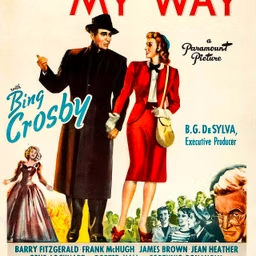
Which brings me to Leo McCarey. He's my choice, primarily because he made two of Hollywood's most explicitly Catholic films: Going My Way (1944) and The Bells of St. Mary's (1945). And there are two other films of great merit that I'll get to in a moment, although neither was "Catholic," except in the sense that everything McCarey directed was shaped by his Catholic humanism.
Let me define that: It's the deep respect for human dignity, reason, culture, and creativity. It's the idea that being fully Catholic and fully engaged with all that is human – through art, literature, philosophy, the sciences, and ordinary life – reinforces each other. Grace doesn't bypass nature but perfects it. So cultivating stories of the human person is itself an essential part of Christian life, and never a distraction from it.
For me, the best expression of what I think characterizes McCarey's view comes not from a Roman Catholic but from an ancient Roman, the playwright Terence: "I am a man; I consider nothing human alien to me."
McCarey often pursued this in his films through comedy, beginning with Laurel and Hardy and the Marx Brothers, the screwball comedies The Awful Truth (which catapulted Cary Grant to superstardom), Once Upon a Honeymoon, and My Favorite Wife, and then, of course, those two great films about the amiable priest, Fr. Chuck O'Malley.
Going My Way and The Bells of St. Mary's were almost unimaginably popular and, in my opinion, culturally transformational. I don't want to overstate the fact, but those films portrayed Catholic life in America in such a way as to diminish anti-Catholicism in the U.S. McCarey's films did not eliminate that prejudice, any more than the films starring Sidney Poitier eliminated racism a generation later. But those men did move the ball closer to the goal.
McCarey also directed one of Hollywood's most successful romantic films – actually, one film in two versions. He made Love Affair in 1929 (with Charles Boyer and Irene Dunne), and then remade it as An Affair to Remember in 1957, the latter being his fourth film with Cary Grant (and also starring Deborah Kerr).
The Awful Truth (1937) was an awful experience for Grant because McCarey favored improvisation to an extent that frazzled his star's nerves. But it was McCarey who taught Grant how to be a comic actor.
One sees Grant's comic timing and wonderful double takes in My Favorite Wife, and it is listed among McCarey's films, and it should be, despite the fact that he didn't direct it. He intended to (and it was based on his original story). But a horrific automobile accident, in which he was badly injured and lucky to survive, put him in the hospital just before filming began and kept him there until after the movie wrapped. It seems clear this near-death experience was very much why his next films were very Catholic.
Going My Way and The Bells of St. Mary's were the most commercially successful films...