About
By Amy Fahey
Norwegian soccer star Erling Haaland recently made news not for his playing or pseudo-Viking antics, but for his record-breaking purchase of a 1594 printed edition of the Heimskringla – the lives of the Norwegian kings from legendary beginnings to the death of Magnus V in 1184. Haaland and his father donated the volume to his hometown library to promote reading: "I want the book always to lie open so that people can read about those who came from where I come from. It's easier to feel drawn to reading when you can recognize yourself in the people and places being written about."
His father concurred: "roots are important deep roots that can be found in the stories of Snorre's kings' sagas."
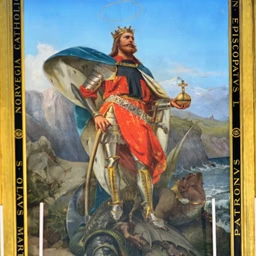
Nearly one-third of the volume recounts the life of King Olav Haraldsson (c.995-1030), now known as St. Olav, whose feast day is July 29, the date he fell at the Battle of Stiklestad in his attempt to unite the region's fractious and petty kingdoms under a single political structure grounded in Christian law.
Almost immediately after his death, rancor and division quieted, and Olav's holiness was confirmed through countless miracles. He was canonized locally by Bishop Grimkell of Nidaros in 1031, which was confirmed by Pope Alexander III in 1164.
St. Olav's Kristenret, or "Christ's law," contained prohibitions against infant exposure and infidelity in marriage, among other common pagan practices. He's a patron saint of troubled marriages – and of woodcarvers. My favorite story about him in the Heimskringla (one that impressed C.S. Lewis, too) tells of his woodcarving on the Sabbath while mentally preoccupied with worldly affairs.
He "fell into deep thought and heeded not the hours," the saga says. His serving boy then reminded him that it was Sunday. Olav asked him to "bring him a lighted taper and he swept into his hand all the shavings he had cut; he set light to it and let the shavings burn in the hollow of his hand. Thereby he let it be noticed that he would hold fast by God's law and commandment and would not set aside what he knew to be right."
Perhaps that's a bit of Viking showmanship, but anyone who has read the sagas knows that eradicating from the human heart what Tolkien rightly termed "self and indomitable will" requires radical measures in any age. Both saga writer and saint give us visceral evidence of that.
Someone who followed the desire to "recognize yourself" in the compelling and complicated story of St. Olav and found in it the "deep roots" she had been searching for is Norwegian novelist, Catholic convert, Nobel laureate, and now soon-to-be Servant of God Sigrid Undset. Dealing with the fallout of her own sins and self-will, the young Undset encountered in St. Olav a pattern of perseverance and redemption on which she could rebuild her own life.
In her Saga of Saints (1934), Undset notes: "[Olav] was a man in whose mind most other men could find something akin to themselves, but he had subdued his own heathen nature, had struggled in prayer so that God might mould him as he wished. And so God had lent him the power to become a friend to mankind."
In his 2025 homily on the Feast of St. Olav, Erik Varden, Bishop of Trondheim, remarked, "We revere and love St. Olav not because he was born a saint, but because he became one through persevering battle against all that was untrue, unworthy, and ugly in himself and in the world; he fought to let Christ's peace rule in his heart."
In Sigrid Undset's sweeping and masterful Kristin Lavransdatter, the titular character makes a penitential pilgrimage to the shrine of St. Olav with her newborn son. "She wept so hard that she didn't have the strength to rise when the others stood up during the service; she stayed there, collapsed in a heap, holding her child."
She then hears St. Olav speaking in her heart about his wayward nation: "Lord, hear my prayer for these people, whom I love so much that I would rather suffer exile and want and hatred and death than have a si...
Norwegian soccer star Erling Haaland recently made news not for his playing or pseudo-Viking antics, but for his record-breaking purchase of a 1594 printed edition of the Heimskringla – the lives of the Norwegian kings from legendary beginnings to the death of Magnus V in 1184. Haaland and his father donated the volume to his hometown library to promote reading: "I want the book always to lie open so that people can read about those who came from where I come from. It's easier to feel drawn to reading when you can recognize yourself in the people and places being written about."
His father concurred: "roots are important deep roots that can be found in the stories of Snorre's kings' sagas."
Nearly one-third of the volume recounts the life of King Olav Haraldsson (c.995-1030), now known as St. Olav, whose feast day is July 29, the date he fell at the Battle of Stiklestad in his attempt to unite the region's fractious and petty kingdoms under a single political structure grounded in Christian law.
Almost immediately after his death, rancor and division quieted, and Olav's holiness was confirmed through countless miracles. He was canonized locally by Bishop Grimkell of Nidaros in 1031, which was confirmed by Pope Alexander III in 1164.
St. Olav's Kristenret, or "Christ's law," contained prohibitions against infant exposure and infidelity in marriage, among other common pagan practices. He's a patron saint of troubled marriages – and of woodcarvers. My favorite story about him in the Heimskringla (one that impressed C.S. Lewis, too) tells of his woodcarving on the Sabbath while mentally preoccupied with worldly affairs.
He "fell into deep thought and heeded not the hours," the saga says. His serving boy then reminded him that it was Sunday. Olav asked him to "bring him a lighted taper and he swept into his hand all the shavings he had cut; he set light to it and let the shavings burn in the hollow of his hand. Thereby he let it be noticed that he would hold fast by God's law and commandment and would not set aside what he knew to be right."
Perhaps that's a bit of Viking showmanship, but anyone who has read the sagas knows that eradicating from the human heart what Tolkien rightly termed "self and indomitable will" requires radical measures in any age. Both saga writer and saint give us visceral evidence of that.
Someone who followed the desire to "recognize yourself" in the compelling and complicated story of St. Olav and found in it the "deep roots" she had been searching for is Norwegian novelist, Catholic convert, Nobel laureate, and now soon-to-be Servant of God Sigrid Undset. Dealing with the fallout of her own sins and self-will, the young Undset encountered in St. Olav a pattern of perseverance and redemption on which she could rebuild her own life.
In her Saga of Saints (1934), Undset notes: "[Olav] was a man in whose mind most other men could find something akin to themselves, but he had subdued his own heathen nature, had struggled in prayer so that God might mould him as he wished. And so God had lent him the power to become a friend to mankind."
In his 2025 homily on the Feast of St. Olav, Erik Varden, Bishop of Trondheim, remarked, "We revere and love St. Olav not because he was born a saint, but because he became one through persevering battle against all that was untrue, unworthy, and ugly in himself and in the world; he fought to let Christ's peace rule in his heart."
In Sigrid Undset's sweeping and masterful Kristin Lavransdatter, the titular character makes a penitential pilgrimage to the shrine of St. Olav with her newborn son. "She wept so hard that she didn't have the strength to rise when the others stood up during the service; she stayed there, collapsed in a heap, holding her child."
She then hears St. Olav speaking in her heart about his wayward nation: "Lord, hear my prayer for these people, whom I love so much that I would rather suffer exile and want and hatred and death than have a si...