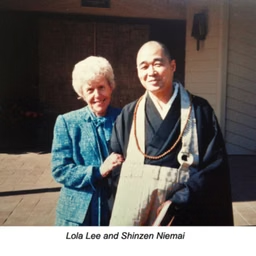
Where Taoism, Christianity and Zen meet. Delivered August 17, 1986
Talks by Zen Roshi, Lola McDowell Lee
Zen Roshi, Lola McDowell Lee explores the interplay between ego, consciousness, and the spiritual path, drawing on Taoist, Buddhist, and Christian traditions.
She explores the Taoist message of flowing with existence, free from effort or resistance. By aligning oneself with the totality of life, one can move beyond fear and obstruction.
Lola recounts the biblical narrative of Adam and Eve and the loss of innocence and the rise of the ego. If the Garden of Eden is a state of unconditioned innocence, then the Fall represents the emergence of self-consciousness, discrimination, and dualistic thinking.
Naming things acts as a barrier between humans and direct experience. By labeling the world, we create an illusion of knowledge, often losing sight of the underlying reality that exists beyond these labels.
One needs to move past this reliance on names and differentiation, which keeps us trapped in our egos.
She explains how the practice of the Zen koan is not to find rational answers but to exhaust the thinking mind. Through persistent meditation, the practitioner eventually reaches a point of mental fatigue, where language and dualistic logic dissolve, allowing for a non-linguistic experience of truth. This collapse of the ego allows one to experience reality as it is, unobstructed by concepts or names.
Lola explains that Zen is not about withdrawal from the world, but rather about cultivating an inner emptiness that supports one's engagement with daily life without being identified with the ego.
Wu Wei (non-action) is not passive inaction but a state of conscious alertness where one flows with life's natural rhythms. Letting go of the ego allows one to experience the joy and serenity of being truly awake. Delivered August 17, 1986