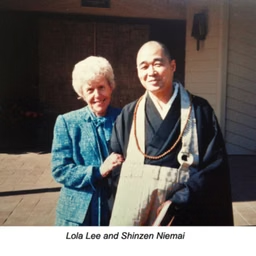
Zen Roshi, Lola McDowell Lee, reflects on the universal reality of death and the transition of consciousness, illustrated by the historical encounter between the legendary Zen master Ikkyu and his dying disciple Ninagawa.
When Ninagawa attempts to take comfort in traditional phrases about coming and going alone, Ikkyu challenges him, pointing to the path of no coming and no going.
Lola explains that at death, the physical senses and brain cortex are left behind, halting new sensory input into the psyche. Without fresh input, the mind loops over existing psychological contents.
True preparation through meditation allows a seeker to bypass unconsciousness and recognize that life and consciousness are an eternal continuum, whereas the ego remains the true source of bondage and illusion.
Lola delves deeply into the life and character of Ikkyu, describing him as a revolutionary, nonconformist Roshi, the illegitimate son of the emperor, disowned due to political friction between northern and southern Japanese factions. Despite early struggles with depression and an attempted suicide, Ikkyu transformed into a wandering monk who carried a seven-note flute, championing humaneness over the deceitful obligations of the feudal elite.
The father of wabi aesthetics, Ikkyu taught the beauty of poverty, simplicity, and spiritual independence.
Lola contrasts Hinayana strictness, which demands the absolute destruction of desires and avoidance of women, with Mahayana and Zen perspectives. Zen views passions and Bodhi (wisdom) as identical.
Ikkyu embodied this through his "Red Thread Zen," famously declaring that human existence is inextricably linked to women through a red thread, viewing them as the flowers of humanity.
Lola recounts several colorful anecdotes illustrating Ikkyu's radical iconoclasm—such as burning wooden Buddha statues in a freezing temple to warm the living Buddha within, and later worshipping a common stone with flowers. Outward forms and scriptures are merely symbols, while true spiritual alignment depends entirely on the inner state of consciousness rather than adherence to dogma.
Lola examines Ikkyu's profound enlightenment experience at age 26, triggered simply by hearing the piercing cry of a crow in the evening silence. In that instant, the illusion of the separate individual dissolved completely, merging his innermost being with non-being and the heartbeat of nature.
For Ikkyu, the void became plenitude, and life and death merged into a single joyous continuum. Delivered Sep 28, 1986