The positive and the negative paths to enlightenment. Delivered Sep 21, 1986
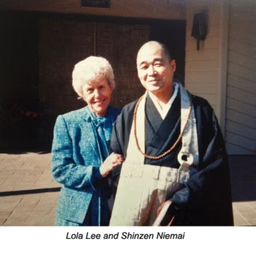
Talks by Zen Roshi, Lola McDowell Lee
Zen Roshi, Lola McDowell Lee, contrasts the "positive" and "negative" paths to enlightenment.
Drawing upon ancient Chinese Taoist, Li Tzu, she begins by questioning the value of emptiness. Because emptiness cannot be quantified, traded, or manufactured—unlike the walls of a house or the clay of a cup—it possesses an absolute value that transcends human commerce.
To abide in this emptiness one must embrace stillness and let go of the transactional nature of human existence.
She characterizes the positive path, often associated with asceticism and orthodox religious traditions, as one of accumulation. It involves specific techniques, incremental progress, and explainable methodologies.
While this path is valid, its primary danger is the subtle inflation of the ego, wherein a practitioner might proudly claim, "I am That," mistaking hallucination for realization.
In contrast, the negative path (via negativa) is the path of the mystic. It is sudden, unexplainable, and requires surrendering the ego-life. It involves taking a leap into the unknown without the comfort of gradual steps. However, this path also has its pitfalls, most notably the temptation of lethargy.
Lola distinguishes between "aloneness" and "loneliness." She describes aloneness as a majestic, essential state of being—a direct confrontation with oneself and the ultimate reality.
Loneliness, on the other hand, is an accidental, worldly state born of seeking oneself in others. By embracing true aloneness, the practitioner sheds ceaseless stream of thoughts and touches the core of one’s being.
Lola describes how different traditions map onto these paths: Islam, Judaism, and Christianity largely follow the affirmative route of prayer and contemplation, while Buddhism and Taoism follow the negative route of silent meditation.
Lola discusses the human tendency toward spiritual bargaining. Using a lighthearted allegory of an inventor who creates a "psychoscope" (a mind mirror), she shows how desperately people cling to their idealizations and self-projections. We prefer rose-tinted versions of ourselves to the unvarnished reality.
To enter emptiness, one must drop all masks, both the beautiful delusions and the hidden guilts. True discipline, she argues, is not imposed by teachers or rules, but arises from within as a sense of deep responsibility and a joie de vivre.
The ultimate realization is not a reward for a bargain struck with the universe, but a free gift accepted in the profound, cloudless silence of meditation. Delivered Sep 21, 1986