Send us Fan Mail
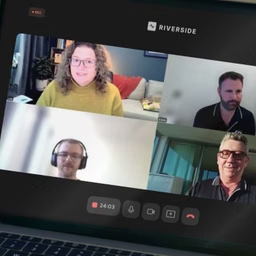
On this episode of Mondays Down Under, Lee Salisbury and Nick are joined by AIS Water’s Lee Moore and Technical Director Blake for a deep dive into commercial saltwater chlorination.
AIS Water has worked in salt chlorination for approximately 35 years, developing systems for everything from swim schools and splash parks to resorts, 50-meter competition pools, coastal pools, and enormous lagoons containing millions of liters of water.
The conversation explores why more commercial aquatic facilities are moving toward onsite chlorine generation—and why their success depends on selecting actual commercial equipment, correctly sizing the system, and maintaining proper water chemistry.
The three major benefits are convenience, safety, and long-term cost savings. Generating chlorine onsite can dramatically reduce the handling, storage, transportation, and manual transfer of liquid or granular chlorine. It can also reduce the risks associated with chemical spills, damaged dosing lines, incorrect chemical mixing, and chlorine gas entering an occupied pool.
But not every “commercial salt system” is truly commercial.
The guests discuss facilities that attempted to meet massive chlorine demand by plumbing together banks of residential chlorinators—including one installation containing an astonishing 95 residential units. Besides creating a maintenance nightmare, these improvised systems can introduce excessive head loss, restrict circulation, shorten cell life, and still fail to satisfy the pool’s chlorine demand.
Proper sizing requires far more than knowing the pool’s volume. AIS Water considers actual peak bather load, water temperature, turnover rate, sunlight exposure, cyanuric acid use, environmental conditions, operating hours, and the facility’s location. Two pools of identical size—even pools located only a suburb apart—may require substantially different chlorine production capacities.
And just when you thought pool chlorination could not get any stranger, the discussion turns to horse pools, seal enclosures, sea lions, natural salt contributions from swimmers, and one exceptionally important unanswered question:
Just how much chlorine does a sea lion prefer?
You will have to return next Monday for the conclusion.
In this episode:
- Why commercial aquatic facilities are adopting onsite chlorine generation The safety risks associated with storing and manually transporting chlorine How salt chlorination can reduce long-term operating costs Why an electrolytic cell is a consumable—not a failed chlorinator How commercial-grade anodes can provide significantly longer cell life The difference between residential and commercial chlorination equipment What happens when dozens of residential chlorinators are installed in one system How excessive head loss can compromise circulation and turnover Why peak bather load is critical when sizing a chlorinator How sunlight, shade, temperature, rainfall, and surrounding buildings affect chlorine demand Commercial systems ranging from low-salinity water to direct seawater The unusual challenges of chlorinating pools for horses, seals, and sea lions
Guests:
- Lee Moore, Sales and Marketing, AIS Water Blake, Technical Director, AIS Water
Hosted by Lee Salisbury and Nick on Mondays Down Under, part of the Talking Pools Podcast network.
US certifications for AIS Commercial products.
Certified to the Highest International Standards – AIS commercial chlorination systems are independently certified to NSF/ANSI 50 for swimming pool equipment safety and performance, UL 1081 for electrical safety, and are approved for installation in Los Angeles County, one of the world's most stringent regulatory environments. These certifications provide independent assurance that AIS products meet rigorous standards for quality, reliability, and safety, giving consultants, operators, and asset owners confidence in specifying AIS for demanding commercial aquatic facilities.
Support the show
Thank you so much for listening! You can find us on social media:
- FacebookInstagramTik Tok
Email us: talkingpools@gmail.com