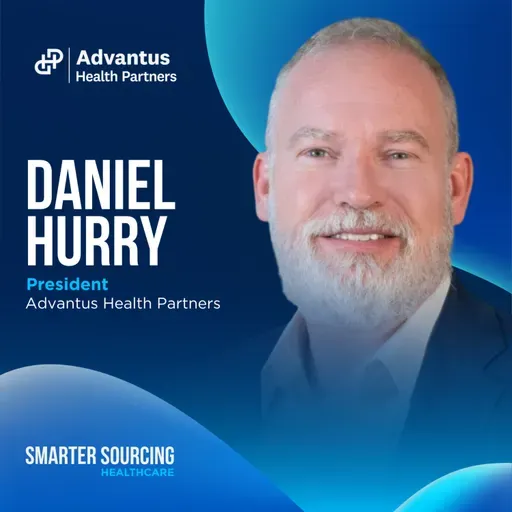
EP 40 – Bon Secours' Daniel Hurry on Industry Elevation over Retention in Leadership Development
Smarter Sourcing
Daniel Hurry, President at Advantus Health Partners & CSCO at Bon Secours Mercy Health, helped justify building Advantus Health Partners to their board by calculating the admin fee equation, then proving they could negotiate better pricing at their scale. Their commercialization strategy was to skip the crowded commodity categories where another contract for gloves or gowns adds no value, and focus on complex operational purchase services and hyper-complex implants where national GPOs have gaps.
Healthcare still lacks universal product codes, which means supply chain leaders can't access the real-time demand planning or behavior modification strategies that retail and energy industries built decades ago on UPC data. Instead, healthcare spawned entire cottage industries for data cleanup and item master enrichment, workarounds that other sectors never needed. Dan's leadership development program, built with Miami University's supply chain school through MBA residencies and internships, has now placed five former team members as chief supply chain officers at other health systems, treating talent development as an industry investment rather than internal retention problem.
Topics discussed:
Building Advantus by calculating admin fee equations versus internal operating costs to justify better pricing at scale
Commercializing GPOs by targeting complex operational purchase categories and hyper-complex implants where market gaps exist
Implementing single-partner category strategies with open-book economics and daily KPI-driven continuous improvement cycles
Addressing healthcare's universal product code gap that prevents real-time demand planning available in retail and energy industries
Managing dual chief supply chain officer and GPO president roles through execution excellence despite political and communication challenges
Developing supply chain talent through MBA residency programs with Miami University producing five chief supply chain officers
Navigating post-merger integration and pandemic disruptions while launching new commercial GPO operations and maintaining ministry focus
Shifting supply chain strategy from foundational pricing benchmarks toward utilization management and consumption analytics at point of use