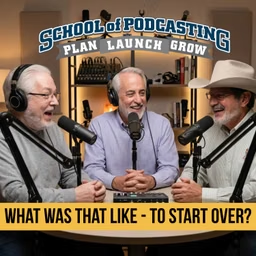
What Was That Like To Start Over? With Scott Johnson and Glenn Hebert
School of Podcasting: Expert Tips for Launching and Growing Your Podcast
What happens when two podcasters with decades of combined experience start a brand-new show from zero? Scott Johnson, of the wildly successful What Was That Like, has tested 140 different ways to grow a podcast, and he’ll tell you which ones still work today. Glenn Hebert, who has put out more than 4,100 episodes of Horses in the Morning, reveals where 70% of his new listeners actually come from. Hint: it isn’t an algorithm. Together they launched Did I Hear That Right?, and they’re sharing what has changed since they started, why they made a show with no pressure to earn a dime, how they find guests in a flood of AI pitches, and the one mistake that makes them stop listening within two minutes. If you’ve ever wondered whether you’re doing enough to grow your show, this episode will make you rethink “enough.”
Note: While these show notes were created by AI, the content is not. - Dave
140 Ways to Grow a Podcast (and Why There's No Magic Switch)What happens when two podcasters with more than 50 years of combined experience start a brand-new show from zero? Scott Johnson, of the wildly successful What Was That Like, has tested 140 different ways to grow a podcast, and he tells me which ones still work today. Glenn Hebert, who has put out more than 4,100 episodes of Horses in the Morning, reveals where 70% of his new listeners actually come from. Hint: it isn't an algorithm. Together they launched Did I Hear That Right?, and they're sharing what has changed since they started, why they made a show with no pressure to earn a dime, how they find guests in a flood of AI pitches, and the one mistake that makes them stop listening within two minutes. If you've ever wondered whether you're doing enough to grow your show, this episode will make you rethink "enough."
Meet Two Professional PodcastersScott was an early School of Podcasting member. He started with The Computer Tutor back in 2012 (he still has a few remote computer repair clients who beg him never to retire), then launched What Was That Like. Glenn has been on this show more than any other guest, and he still runs Horses in the Morning, the daily flagship show of the Horse Radio Network.
These two put serious time into every episode:
- Scott: about 15 hours per episode of What Was That Like, from idea to promotion.Glenn: five to eight hours per daily episode of Horses in the Morning, including booking five to six guests a week. (As he says, everybody knows booking guests is the biggest pain of all.)
What's the Difference Between a Hobby Podcaster and a Pro?
Glenn's definition comes from the horse world: in competition, a pro is someone who makes their living from competing. Same for podcasting. If you make your living from it, you're a pro. Scott agreed, then joked that the problem with the new show is figuring out what to do with all the money coming in.
140 Podcast Marketing Strategies (and Counting)Scott has documented every marketing strategy he's tried since starting his show almost nine years ago. The count is around 140. Did he just say 140? Yes, 140.
So while you're sitting there wondering, "Would that work? What's the return going to be?" Scott is out there trying it.
Scott's advice:
- Do the tried-and-true stuff. He still guests on other shows and does promo trades all the time.Think outside the box sometimes too.Stop looking for the one big thing. Instead of hunting for the switch that brings in hundreds of listeners, do 100 different strategies that each bring in a few.
Some of what he tried didn't work, and something that works for him may not work for you. You only find out by trying. I talked about this same idea in episode 1053, Attention vs. Connection: quit trying to hit a grand slam, and grow your audience one listener at a time.
And yes, Scott is going to write a book about all of this at some point. The line starts behind me.
Word of Mouth Still WinsGlenn has run enough listener surveys to know that 70% of his new listeners come from referrals. "But Dave, there's no algorithm. There's a discoverability problem in podcasting." Poppycock.
Glenn also points out that hitting "subscribe" is a bigger commitment than it was 10 years ago. There's more to listen to and less time, so people are doing math in their heads: "Do I have an extra hour a week for this?" Scott goes a step further. He thinks about which show he'd have to drop to make room for a new one.
That's also why I've never understood seasons for most independent shows. Take three weeks off, and you're hoping nobody takes your slot in a listener's routine.
How to Write Podcast Episode Titles People ClickWhen you're staring at 48 unplayed episodes, you cherry-pick, even from shows you love. Scott names his episodes for that person scrolling past. "Somebody got bitten by a rattlesnake? I want to hear that story."
A few titles from these guys:
- What Was That Like: "Matt Counseled New Millionaires," "Angel Tried to Kill His Father," "Felicia Was at the Pentagon on 9/11"Horses in the Morning: "Barn Hacks: It's Only Weird If It Doesn't Work," "Police Horse Retirement," "Horses and Halloween"Did I Hear That Right?: "Phil Won $500,000," "Robin Worked for Burt Reynolds," "She Lived in a Swiss Castle," "She Adopted the Neighbor"
Here's my test: does the title make you want to click? If it does, it's a good title.
Glenn uses the 80/20 rule, and his surveys back it up. About 20% of your audience loves you and will listen to anything you put out. The other 80% are reading titles. Write for the 80%. As Scott puts it: you've got to have a hook.
Starting a New Podcast From Square OneDid I Hear That Right? is a brand-new show trying to build a brand-new audience. The difference from What Was That Like: the stories are about people who chose to do something unusual, not things that happened to them. There's no trauma, less crying, and the interviews are cut off at 15 minutes.
What about going from four- and five-figure downloads back to small numbers? It doesn't bother them. They have no expectations. As Scott says, their why isn't 100,000 downloads an episode. They like hanging out with each other and talking to fun people.
That's the part people miss. Many shows start for fun, then decide they aren't "real" until they have sponsors, and stop enjoying the sun they're standing in. The shows that keep it fun keep going, and the ones that keep going grow. (Glenn admits they're already set up to monetize if the audience shows up. They just aren't putting a deadline on it.)
Tips for Podcast Co-Hosts- Have the awkward conversation. Every year, Jim Collison and I have the "awkward conversation" about who does what on Ask the Podcast Coach and who makes what. Glenn and Scott split the work almost down the middle, made a list, and didn't have to talk about it again.Sign an agreement, even if you never expect to make money. They did the legal agreement up front.Different styles help. Scott has three pages of checklist items for every episode. Glenn puts out a daily show and can wing it and still sound great. If your co-host is exactly like you, you have one of you too many. Find the same passion with a different viewpoint.
Give Your Audience Your Thoughts After the Interview
Glenn's pet peeve with interview shows: when the interview ends, the show ends, and the host never says what they thought. People come for the content and stay for the host. On Did I Hear That Right?, after the 15-minute interview, Scott and Glenn talk about it for up to 10 minutes. Did they ever win money? What would they have done?
I call this the Jerry Springer: after the chair-throwing, Jerry looked into the camera and asked what we learned today. It gives listeners your take on the guest, and it quietly reminds everyone whose show this is.
And please don't end with "visit my guest's website, see you next week." The last URL on your podcast should be yours.
How to Find Podcast Guests Through Your CommunityWith AI, we all get 30 bad pitches an hour. Did I Hear That Right? uses one question: "What's the one unusual thing you've done that no one else you know has?" Scott and Glenn post that question in their Facebook groups and...