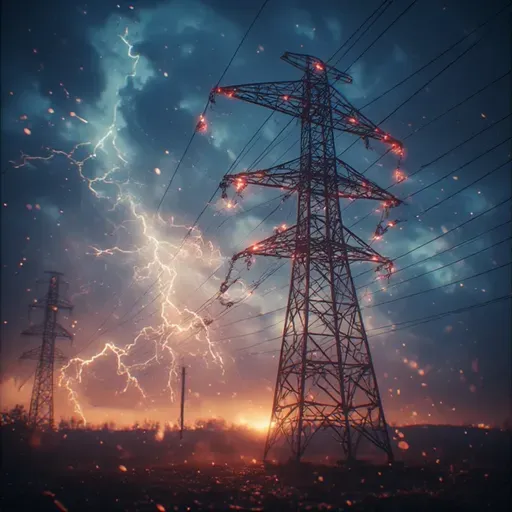
**Electricity** is a fundamental secondary energy source produced by converting primary resources like coal, wind, or solar into the movement of **charged particles**, specifically electrons. According to the sources, its physical properties are defined by **voltage (pressure)**, **current (flow rate)**, **resistance (opposition)**, and **power (usage rate)**, which are governed by mathematical principles like **Ohm’s Law**. Historically, understanding progressed from ancient observations of static electricity to the late 19th-century **"War of the Currents"** between Thomas Edison and George Westinghouse, which ultimately established **alternating current (AC)** as the global standard for efficient long-distance transmission.
In the modern era, electricity has evolved from a simple commodity into a **"digital-first" ecosystem** where **artificial intelligence (AI)** and software are inseparable from physical infrastructure. The sources highlight that advanced systems now utilize **predictive intelligence** to prevent outages and manage decentralized resources like **microgrids** and **virtual power plants (VPPs)**, which aggregate local energy for utility-scale use. Looking toward the future, the field is merging with **biology and quantum physics**, developing **neuromorphic chips** that mimic brain architecture and **bio-electronic circuits** that perform logic functions inside living cells, effectively transforming the global grid into a self-healing, intelligent organism.