25 October 2026
The Biology of Support: How Connection Shapes Learning, Growth and Performance
Neuroscience Meets Social and Emotional Learning
About
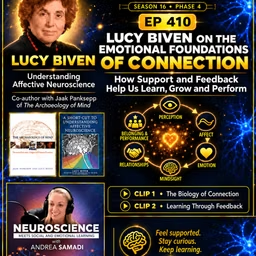
<p>Episode 410 explores what effective neuroscience reveals about emotion, connection, and learning. Andrea Samadi revisits conversation clips with Lucy Biven to distinguish observable behavior from private affect, examine the brain’s opioid and seeking systems, and introduce the connection loop for understanding others.</p>
<p>The episode also offers practical models—Ask, Respond, and Check Back for offering support, and Ask, Try, and Review for receiving guidance—applied to school, sports, and the workplace to build belonging and improve performance.</p>
<p>Welcome back to <em>Neuroscience Meets Social and Emotional Learning Podcast</em>, where we bridge neuroscience, social and emotional learning, and human performance so we can create measurable improvements in our well-being, achievement, leadership, productivity, and results.</p>
<p>I’m Andrea Samadi, and welcome to Episode 410.</p>
<p></p>
<p>On this episode, we will learn:</p>
<p>✔ What affective neuroscience can teach us about emotion, connection, and learning.</p>
<p>✔ Why the support we offer may differ from the comfort someone actually feels.</p>
<p>✔ How Panksepp’s SEEKING system helps us understand curiosity, exploration, and motivation.</p>
<p>✔ How to offer useful support: Ask → Respond → Check back.</p>
<p>✔ How to be coachable and apply feedback: Ask → Try → Review.</p>
<p>✔ How these practices connect to our Connection Loop, with examples for school, sports, and the workplace—helping us learn, grow, and perform.</p>
<p>Today, we begin our first anchor interview in Phase 4—Perception, Emotion, and Social Intelligence, revisiting two clips from our conversation with Lucy Biven.</p>
<p>WHERE WE ARE IN THE JOURNEY</p>
<p></p>
<p>Whether you’ve been following this series from the beginning or you’re joining us for the first time, welcome. I’m grateful you’re here.</p>
<p>Let’s take a moment to see where we are—and where we’re heading—on this journey through what I call The Brain’s Operating System for Human Performance.</p>
<p>Think of this as a framework for understanding how our brain “comes online” in different ways—how we become ready to learn, motivated to act, able to focus, and available to connect with others.</p>
<p>Of course, our brain is always active. “Coming online” is a metaphor for how we gain access to these capacities—and how that access changes with our physical state, our experiences, and the demands around us.</p>
<p>You might be focused at work, yet find it difficult to stay open and curious during a challenging conversation.</p>
<p>Our five phases help us explore these capacities and how they support one another—so we can better understand ourselves, respond more thoughtfully to others, and create measurable improvements in how we learn, connect, lead, and ultimately how we perform.</p>
<p>In Phase 1—Regulation and Safety, we explored the conditions that help us settle, engage, and become ready to learn.</p>
<p>In Phase 2—Neurochemistry and Motivation, we examined what sparks our interest, moves us toward action, and helps us persist.</p>
<p>In Phase 3—Movement, Learning, and Cognition, we connected movement with attention, learning, and performance.</p>
<p>Now, in Phase 4—Perception, Emotion, and Social Intelligence, we bring that understanding into our relationships. How do we experience one another? What shapes our reactions? And how can understanding our own inner world help us better understand someone else?</p>
<p>Next, in Phase 5—Integration and Human Performance, we’ll bring these foundations together and explore how to apply them to meaningful, measurable improvements in everyday life.</p>
<p>These phases overlap and influence one another. We revisit them as our needs and circumstances change.</p>
<p>Once we complete Phase 5—likely around January 2027—I plan to take some time away from recording new episodes to write <em>The Journey of the Mind Workbook</em>.</p>
<p>The workbook will help us put what we’ve learned on this podcast into practice through a pathway:</p>
<p>Understand → Reflect → Apply → Measure → (the end result) Become (more).</p>
<p>We’ll reflect on what these ideas mean in our own lives, choose actions to practice, and measure what changes over time.</p>
<p>OUR PHASE 4 CONNECTION LOOP</p>
<p></p>
<p>In Episode 409, we introduced our Connection Loop:</p>
<p>Perception → Affect → Emotion → Mindsight → Relationships → Belonging and Performance.</p>
<p>We begin with Perception: How am I interpreting what is happening?</p>
<p>We consider Affect: What is the private felt quality of this experience? Does it feel pleasant or unpleasant, calming or activating?</p>
<p>We explore Emotion: What response am I experiencing in my body and behavior? What do I feel moved to do?</p>
<p>Through Mindsight, we ask: Can I reflect on my own inner experience while remaining curious about another person’s?</p>
<p>That awareness influences our Relationships: How will I listen, communicate, respond, or repair a misunderstanding?</p>
<p>And we consider Belonging and Performance: Are our interactions helping people feel included, participate, learn, and contribute?</p>
<p>This is our organizing framework for the phase. These processes interact; they don’t always unfold in this order.</p>
<p>Today, we begin by looking beneath the behavior we can see.</p>
<p>Think about a student who withdraws, a colleague who responds sharply, or someone you care about who suddenly becomes quiet.</p>
<p>We can observe what they do. But what are they experiencing?</p>
<p>INTRODUCING LUCY BIVEN</p>
<p>To help us explore these questions, we’re returning to Lucy Biven, whom we first met on Episode 270<a href='#_edn1'>[i]</a> in January 2023.</p>
<p>Lucy co-authored <em>The Archaeology of Mind</em> with Jaak Panksepp and wrote <em>A Short-Cut to Understanding Affective Neuroscience</em>. She is the former Head of the Department of Psychotherapy at the Child and Adolescent Mental Health Service in Leicestershire, England.</p>
<p>Her journey into neuroscience began with a question her clinical experience alone couldn’t fully answer.</p>
<p>As she described in our original conversation, she was appointed by the Michigan Supreme Court to help develop and implement a plan to transfer a two-and-a-half-year-old girl from the caregivers she regarded as her parents to her biological parents.</p>
<p>Lucy and her colleagues were concerned about the child’s emotional development. Yet the child went on to do well.</p>
<p>That left Lucy asking: Where did it all go right?</p>
<p>Her search for answers led her to neuroscience and Jaak Panksepp’s work on the emotional systems of the mammalian brain.</p>
<p>Listen today for a distinction Lucy makes between emotional responses that can be observed and the private feeling experience she calls affect. Terminology varies across theories of emotion, but this distinction is important for understanding her perspective.</p>
<p>As you listen, hold one question in mind:</p>
<p>What might I understand differently if I became more curious about the feeling beneath the behavior? </p>
<p>Think of an interaction you’re navigating right now. How might your response change if you became curious about what the other person is experiencing, beyond the behavior you can see?</p>
<p>Let’s listen to the first clip.</p>
<p><a href='https://www.youtube.com/shorts/e76BsTdTRnM'>CLIP 1: THE BIOLOGY OF CONNECTION—FROM FEELING SUPPORTED TO BEING READY TO LEARN</a></p>
<p> In this clip, Lucy describes animal research suggesting that early social deprivation can affect the brain systems involved in comfort, distress, and attachment.</p>
<p>She explains that “The body produces its own opioids—chemical messengers involved in pain relief and reward, as well as aspects of social connection. These messengers act on receptors in the brain.”</p>
<p>The broader point is that experiences of care and isolation can influence the biology underlying our emotional lives. This gives us a powerful question to consider:</p>
<p>What if someone’s difficulty receiving comfort is part of what we need to understand to help them thrive in school, sports, or their work place?</p>
<p>We often focus on what someone needs to do: pay attention, accept feedback, practice a skill, or work with a team. But we also can consider how they experience the support we offer.</p>
<p>A teacher might say, “You can ask me for help,” yet a student remains silent. A coach might offer encouragement, yet an athlete still feels overwhelmed after a mistake. A manager might offer guidance, yet an employee worries that asking questions will make them look incapable.</p>
<p>In each situation, support is being offered—but we don’t yet know whether it feels supportive to the person receiving it.</p>
<p>That matters because learning and improving involve uncertainty. We need to ask questions, make mistakes, receive feedback, and try again. If those moments feel threatening or embarrassing, participating can become harder.</p>
<p>Our role is to become curious: “What would make it easier for you to ask for help?” “Would you prefer feedback privately?” “What helps you regroup after a mistake?” or “How else can I help you to keep moving forward?”</p>
<p>Then we can follow through consistently and notice what helps.</p>
<p>This brings us back to Affect in our Connection Loop: the person’s inner experience or what the experience feels like to that person. Through Mindsight, (or seeing the mind of another) we can become curious about that experience. We use what we learn to strengthen Relationships and create conditions that support Belonging and Performance.</p>
<p>To help someone thrive, we need to understand both the challenge they face and what helps them feel supported enough to engage with it.</p>
<p>Here are three takeaways.</p>
<p>First, connection has a biological dimension.</p>
<p>By this, we mean that relationships involve activity in our brains and bodies, as well as our thoughts about another person.</p>
<p>In this first clip, Lucy focuses on the brain’s endogenous opioid system. “Endogenous” means produced within the body. These natural chemical messengers—including endorphins—act on opioid receptors and help regulate pain, reward, and aspects of social comfort and attachment.</p>
<p>Think of the chemical messenger as a signal and the receptor as a structure that receives it. How this system functions contributes to how comforting or rewarding social contact feels.</p>
<p>Lucy describes animal research examining how social deprivation affects this system. The broader biological connection is that our social experiences can influence the systems involved in emotional experience—and those systems can influence how we experience relationships.</p>
<p>This doesn’t mean we can look at a student who withdraws and conclude that they have fewer opioid receptors. Nor does a simple receptor count determine someone’s capacity to feel loved.</p>
<p>It means that when we ask, “Does this person feel supported?” we are asking about an experience that involves both their relationships and their biology.</p>
<p>For school, sports, and workplaces, that encourages us to look beyond whether we offered reassurance and ask: Did our support help this person feel more able to engage, learn, or try again?</p>
<p>Feeling comforted involves more than hearing reassuring words. Our emotional systems participate in how we experience closeness and support. Again, Lucy’s example invites us to consider that care is something we experience internally as well as something another person offers.</p>
<p>Think about a moment when someone you trust sat beside you during a difficult experience. The problem may have remained, but perhaps you felt less alone and more able to face it.</p>
<p>In school, sports, or our work environments, that gives us a useful question: What helps another person to feel supported enough to participate, ask for help, and try again?</p>
<p>Encouragement matters. So does the relationship, the circumstances, and how the person experiences our approach. Here, we can pay attention to whether our support is helping another person to engage with us.</p>
<p> And if they aren’t engaging? That’s a reason to pause and become curious. It doesn’t automatically mean they don’t care, don’t trust us, or don’t want help.</p>
<p>We might ask ourselves: Have I made the next step clear? Is this a difficult time? Would a private conversation feel easier? Do they need space, a different kind of support, or someone else to connect with?</p>
<p>Then we can offer a small, manageable invitation:</p>
<p>“I noticed you’ve gone quiet. Would you like to talk now, or should I check back later?”</p>
<p>“Would it help if we worked through the first step together?”</p>
<p>“You don’t have to explain everything. What would make this next step easier?”</p>
<p>If they still don’t engage, we can respect that response, keep appropriate expectations clear, and follow through on an agreed check-in. Sometimes support means remaining available without pressing for immediate closeness.</p>
<p>In our Connection Loop, this is moves us from Perception (how we interpret an experience) to Mindsight (understanding our own minds first, and being curious about others): we notice the behavior, (in another person) recognize that we don’t yet understand the person’s inner experience, and adjust how we approach the relationship.</p>
<p>The question becomes: What conditions might make participation more possible for this person?</p>
<p>Since the end goal is to move us towards belonging, and performance, where we participate, learn, contribute and grow together.</p>
<p>Second, effective support bridges the gap between what we intend and what someone actually experiences.</p>
<p>We may intend to reassure someone, but our words don’t always land as we hope.</p>
<p>CLASSROOM EXAMPLE</p>
<p>A teacher saying, “This is easy—you’ve got this,” may intend to build confidence. A struggling student might hear, “I should already understand this” and feel pressure. The teacher could instead say, “Which part is confusing? Let’s work through the first step together” to take the pressure off the student.</p>
<p>SPORTS EXAMPLE</p>
<p>A coach saying, “Shake it off,” may intend to help an athlete move forward. The athlete might need a moment to regroup and a specific cue might direct them to do this: “Take a breath. On the next attempt, focus on your foot placement” gives them a focused direction on what to do next. </p>
<p>WORKPLACE EXAMPLE</p>
<p>A manager might say, “My door is always open,” meaning, “Come to me when you need help.”</p>
<p>But an employee might still think, “If I admit I don’t understand this assignment, will my manager think I can’t do my job?”</p>
<p>What matters is how the manager responds to a question they are asked.</p>
<p>If the employee says, “I’m not sure how to start this report,” the manager could respond: “Thanks for asking. Let’s look at an example, then identify your first step.”</p>
<p>The employee now has useful guidance—and an experience of asking for help without being embarrassed or dismissed. That can make it easier to ask questions again.</p>
<p>We don’t have to guess what someone needs. We can ask: “What part still feels difficult?” “Would it help to talk it through, see an example, or have a moment to think?”</p>
<p>Then we listen, adjust, and check whether our response helped.</p>
<p>The goal is for support to make participation more possible: the student asks a question, the athlete attempts the skill again, or the employee raises a concern before it becomes a larger problem.</p>
<p>In our Connection Loop, Mindsight helps us understand the person’s experience; responsive Relationships help build Belonging; and that support creates opportunities for learning and Performance.</p>
<p>Third, behavior gives us clues, but it doesn’t tell us the whole story.</p>
<p>We can see someone withdraw, reject receiving help, become frustrated, or stop participating. We cannot directly see what that experience feels like from the inside.</p>
<p>Silence might reflect confusion, embarrassment, exhaustion, concentration, or a wish for space. We need more information before deciding what it means.</p>
<p>This is where Mindsight enters our Connection Loop: remembering that another person has an inner world that may differ from what we imagine or understand.</p>
<p>Instead of saying, “It looks like you don’t care,” when someone withdraws, we might say, “I noticed you stopped participating. How are you experiencing this?”</p>
<p>We can maintain expectations while becoming more thoughtful about how we help someone meet them. Understanding what is happening may reveal a clearer instruction, a different way to offer feedback, or an opportunity to repair trust.</p>
<p>Across all three takeaways, the practice is the same: notice what we can observe, become curious about what we cannot see, and check whether our response helps.</p>
<p>We can’t read minds. In a future episode, we’ll explore how facial cues can help us notice possible emotions—but those cues are invitations to ask, rather than proof that we know what someone feels.</p>
<p>Our goal is to understand enough to offer support that helps someone engage, learn, and take their next step forward.</p>
<p>That is how we move from recognizing someone’s emotional experience to building relationships that support belonging, learning, and ultimately higher performance.</p>
<p>PUTTING CLIP 1 INTO PRACTICE</p>
<p></p>
<p>While writing this episode, I thought about how I experience support.</p>
<p>When I’m struggling, I like to talk things through with someone who has been successful in that area. What do they see that I might be missing? What would they try that I haven’t considered?</p>
<p>For me, feeling supported often means being heard, gaining a fresh perspective, and leaving with something concrete to try.</p>
<p>Someone else might need encouragement, quiet company, or time to process.</p>
<p>Our starting point is to learn what support means to the person in front of us. When offering support try three steps:</p>
<p>Ask → Respond → Check back.</p>
<p>In school, imagine a student staring at a blank page.</p>
<p>Ask privately: “I noticed you haven’t started. Can you show me where you’re getting stuck?”</p>
<p>They say, “I understand the question. I just don’t know how to start.”</p>
<p>Respond: “Let’s say your first idea out loud. Then you can write it in your own words.”</p>
<p>Check back: “Did talking it through help?”</p>
<p>You’ve helped the student cross a specific barrier (where they were stuck) while keeping the learning goal in place.</p>
<p>In sports, imagine an athlete becoming hesitant after a mistake.</p>
<p>Ask: “What’s making the next attempt difficult?”</p>
<p>They say, “There are too many things I’m trying to remember.”</p>
<p>Respond: “Let’s choose one skill to focus on.”</p>
<p>Choose a skill that’s appropriate to the athlete’s ability.</p>
<p>Check back: “Did narrowing the focus help?”</p>
<p>In the workplace, imagine an employee becoming quiet after receiving feedback.</p>
<p>Ask: “What still needs clarification?”</p>
<p>They say, “I’m not sure what to change.”</p>
<p>Respond: “Let’s identify the top priority and look at one example together.”</p>
<p>Check back: “Did that example give you enough direction to get started?”</p>
<p>In each case, we’re checking both the person’s experience (asking where they are stuck) and offering support.</p>
<p>If someone doesn’t want to talk, offer options:</p>
<p>“Would you prefer to write down your question, talk privately later.</p>
<p>If they still don’t engage, we can respect that response, keep expectations clear, and follow through on an agreed check-in. Sometimes support means remaining available without pressing for an immediate response.</p>
<p>WHERE CLIP 1 FITS IN OUR CONNECTION LOOP</p>
<p>This clip’s strongest anchor is Affect: the private felt quality of an experience. How does an experience feel? Is it pleasant/unpleasant, calming or activating?</p>
<p>We are practicing Mindsight when we recognize that behavior doesn’t give us direct access to someone’s inner experience, so we ask and listen. If you want to revisit EP 28<a href='#_edn2'>[ii]</a> with Dr. Dan Siegel, he explains what Mindsight looks like in action, and he even created a mediation to further develop this skill, that we reviewed on EP 60<a href='#_edn3'>[iii]</a>.</p>
<p>Our response shapes our Relationships. Consistent, responsive support can help strengthen Belonging and create opportunities for learning that eventually lead to higher Performance. Feeling included matters in its own right, even when progress takes time.</p>
<p>These examples don’t tell us anything about a person’s opioid receptors. They show how we can put curiosity and responsive care into practice.</p>
<p>The question to carry into your next conversation is:</p>
<p>What does support look like for this person—and did my response help them take their next step?</p>
<p><a href='https://www.youtube.com/shorts/bktdwJ32JTU'>CLIP 2: CONNECTION HELPS US LEARN FROM ONE ANOTHER</a></p>
<p>Our second clip shifts from receiving comfort to receiving guidance.</p>
<p>Listen for how someone else’s perspective can help us improve—and how, through practice, we make that learning our own.</p>
<p>Lucy describes a coach helping a runner improve through specific feedback. The coach notices something the runner might not recognize alone and offers an adjustment the runner can practice and evaluate.</p>
<p>Lucy connects this example with the SEEKING system. Let’s pause to understand what she means.</p>
<p></p>
<p>GRAPHIC: Panksepp’s Emotional Circuits of the Mammalian Brain]</p>
<p>Jaak Panksepp (who co-authored the famous <em>The Archeology of Mind</em> book with Lucy, created a framework that identifies seven primary emotional systems of the mammalian brain. For this clip, our focus is SEEKING, which involves exploration, interest, and the motivation to pursue possibilities.</p>
<p>If a coach simply says, “Run faster,” the runner may want to improve but have no idea what to change.</p>
<p>When the coach suggests a specific adjustment to their arm movement, the runner has something to investigate:</p>
<p>“Could this help my speed? Let me try.”</p>
<p>The feedback gives curiosity a direction. The runner can practice the adjustment, notice what changes, and discuss the result with the coach.</p>
<p>The coach helps the runner see a possibility. Through practice, the runner discovers whether it helps—and begins making that learning their own.</p>
<p>This connects back to Phase 2—Neurochemistry and Motivation. Here in Phase 4, we’re exploring the relationship that supports this process: how another person’s perspective can help us discover an opportunity to improve.</p>
<p>THREE KEY TAKEAWAYS</p>
<p>First, useful feedback makes improvement actionable.</p>
<p>“Do better” gives someone an expectation without explaining how to meet it.</p>
<p>Specific feedback identifies something they can work on: “Try this adjustment, then let’s review what changes.”</p>
<p>The person receiving guidance should leave with a clearer understanding of what to do next.</p>
<p>Second, being coachable means being willing to understand and test feedback.</p>
<p>We don’t have to accept every suggestion as correct. We can listen, ask questions, and try an appropriate adjustment before deciding whether it helps.</p>
<p>Instead of immediately defending our current approach, we might ask:</p>
<p>“Can you show me what you mean?”</p>
<p>“What are you noticing that I might be missing?”</p>
<p>“How will I know if this change is helping?”</p>
<p>This brings me back to how I experience support. I value talking with someone who has been successful in an area where I’m struggling. But seeking their perspective is only the beginning. I also need to remain open to examining their suggestions, and make them my own.</p>
<p>Sometimes my first thought might be, “I’ve tried that, and it didn’t work.”</p>
<p>A useful next question is:</p>
<p>“I’ve tried something similar. Can you show me what you did differently?”</p>
<p>There may be a detail I missed. Or I may need to explain why the suggestion doesn’t fit my situation. Either way, curiosity helps us have a more useful conversation.</p>
<p>Third, improvement becomes ours through application.</p>
<p>Hearing advice is the beginning. We build skill by practicing, noticing the result, and adjusting.</p>
<p>Ask yourself:</p>
<p>“What will I do differently on my next attempt?”</p>
<p>Over time, we may become better able to recognize and correct the issue ourselves. That growing independence is what Lucy points toward when she says the learning becomes yours.</p>
<p>PUTTING CLIP 2 INTO PRACTICE</p>
<p>When receiving guidance, try:</p>
<p>Ask → Try → Review.</p>
<p>Ask for enough detail to understand the suggestion. Try one appropriate adjustment. Then review the result to decide what to keep or change.</p>
<p>In school, a student receives the comment, “Your answer needs more evidence.”</p>
<p>Ask: “Can you show me where evidence would strengthen my answer?”</p>
<p>Try: Add one relevant example and explain how it supports the point.</p>
<p>Review: “Does this make my reasoning clearer? Can I do this in the next paragraph myself?”</p>
<p>In sports, a coach suggests changing an athlete’s arm movement while running.</p>
<p>Ask: “Can you show me the adjustment—and which part to focus on first?”</p>
<p>Try: Practice the adjustment using one clear cue from the coach.</p>
<p>Review: Ask your coach “Was that closer to what you meant? What did we notice about my form or pace?”</p>
<p>Some adjustments take practice before we can judge whether they’ve actually helped to impact a change.</p>
<p>At work, a colleague suggests making a presentation clearer.</p>
<p>Ask: “Where did you lose the main point?”</p>
<p>Try: Revise that section so the recommendation comes first, followed by the supporting evidence.</p>
<p>Review: Ask your colleague “Is the recommendation easier to understand now?”</p>
<p>The person giving feedback also has a responsibility: make it specific, invite questions, and allow time for practice and improvement.</p>
<p>WHEN SUPPORT ALSO REQUIRES ACCOUNTABILITY</p>
<p>But what happens when the same mistake keeps happening—and it affects other people?</p>
<p>Let’s take our sports example one step further.</p>
<p>Imagine an athlete repeatedly moving out of position, leaving an opening for the opposing team.</p>
<p>For an initial mistake, the emphasis can be on education: talk it through, explain the expectation, and practice the adjustment.</p>
<p>The coach asks the player his perspective:</p>
<p>“Walk me through what you saw before you moved.”</p>
<p>That helps the coach understand the difficulty. Did the athlete miss a cue? Misunderstand their role? Know what to do but struggle to execute it? That’s using Mindsight-to see through the eyes of the player.</p>
<p>The coach responds:</p>
<p>“Here’s the cue to watch for. When you see it, hold your position until your teammate is ready. Let’s practice that situation.”</p>
<p>The athlete asks:</p>
<p>“Can you show me what that looks like—and watch me try it?” This is the player using Mindsight. Seeing the mind of the coach.</p>
<p>Now both people have something specific to work on to apply the feedback, through the lens of the coach who has offered the advice for change.</p>
<p>Mistakes are part of developing a skill. The goal is to build a shared way of playing that reduces avoidable risks while helping athletes to make better decisions with the knowledge of their coach.</p>
<p>If the same costly mistake continues, the coach needs to investigate further.</p>
<p>Does the athlete understand the instruction? Can they apply it in practice? What makes it harder during competition?</p>
<p>Depending on the situation and level of competition, accountability might include a change in playing time or responsibilities. That conversation should explain both the decision and the pathway forward for change:</p>
<p>The Coach Shares “This situation keeps leaving a gap for the other team, so I’m adjusting your role for now. Here’s what we’ll work on, what improvement looks like, and when we’ll review your progress.”</p>
<p>The athlete can respond:</p>
<p>“What should I focus on in practice to show I’m ready for that responsibility again?”</p>
<p>Support and expectations work together when both people understand the next step.</p>
<p>Some lessons may help the whole team. Others are better addressed privately. The coach can teach a shared principle while preserving the athlete’s dignity while learning to correct their mistake.</p>
<p>Follow-up matters, too. Brief notes about the conversation—the person’s perspective, the agreed adjustment, and the next check-in—give both people a reference for reviewing progress.</p>
<p>What did we agree to practice? What changed? What still needs work?</p>
<p>This example applies in the classroom and workplace as well as in sports. Sometimes a difficulty raised by one person reveals something others also need help with.</p>
<p>In the classroom, a teacher and student might agree to work on supporting written answers with evidence. They record one next step: “Include an example and explain how it supports your point.”</p>
<p>At the next check-in, they review a new paragraph together: “Where did you apply that strategy? What can you now do independently? Where would another example help?”</p>
<p>If the teacher notices the same difficulty across several students’ work, that becomes an opportunity for a whole-class lesson.</p>
<p>The teacher might say:</p>
<p>“I’m noticing that we’re including examples, but we need more practice explaining how those examples support our ideas. Let’s work through one together.”</p>
<p>Using a teacher-created example, the class identifies the main point, selects evidence, and discusses the connection between them. Students then apply the strategy to their own writing.</p>
<p>The teacher checks a few new responses to see who understands and who needs further guidance. A question raised by one student has helped uncover a shared learning need—without making that student the focus of the lesson.</p>
<p>In the workplace, a manager and employee might agree that project updates need a clearer recommendation. They note the adjustment needed,</p>
<p>At their next meeting, they review an update: “Was the advice clear? Did the employee understand what action was needed? What should we refine?”</p>
<p>If several updates have the same issue, the manager can bring the learning to the team:</p>
<p>On the next team call, the manager can share that “We’ve had a few employees with the same challenge. We used this advice to move forward.” The manager can ask the team for other advice that might help everyone. </p>
<p>The team reviews the new advice, and suggestions to implement it.</p>
<p>What do others recommend? Why? What action or next step is needed next?</p>
<p>The manager invites questions and asks team members to something new. At their next meeting, they review whether the advice made a difference.</p>
<p>This also gives the manager an opportunity to reflect: “Have I explained how to effectively execute the expectation”</p>
<p>Across these settings, the practice expands from individual support to shared learning:</p>
<p>Notice a pattern → Teach or clarify together → Practice → Check progress.</p>
<p>Individual conversations still matter. Some people will need different explanations or additional practice. But when several people encounter the same difficulty, we can examine the instruction, expectations, or process they share.</p>
<p>Brief notes help us remember what we agreed to try and assess whether it helped in the next meeting.</p>
<p>Follow-up turns one conversation into an ongoing learning process—and sometimes, an opportunity for the whole class or team to improve together.</p>
<p>These questions keep feedback connected to learning.</p>
<p>WHERE CLIP 2 FITS IN OUR CONNECTION LOOP</p>
<p>Let’s look at this interaction from both perspectives: the coach (manager or teacher) offering support and the athlete (student or employee) receiving guidance.</p>
<p>Perception: How am I interpreting what is happening?</p>
<p>The coach notices a repeated mistake and asks:</p>
<p>“What am I assuming about why this keeps happening?”</p>
<p>The athlete hears the correction and wonders:</p>
<p>“What is my coach thinking— is there something specific I need to understand?” (using Midsight)</p>
<p>Both can check their interpretations through conversation.</p>
<p>Affect: What does this experience feel like?</p>
<p>The feedback may feel uncomfortable or overwhelming to the athlete, student or employee. Coming from experience, feedback can be difficult to receive, but it can really help us when we are open to it.</p>
<p>The coach (or teacher or manager) asks:</p>
<p>“How is this landing? Would it help to focus on one adjustment?” to make the feedback more specific.</p>
<p>The athlete replies:</p>
<p>“One instruction at a time would help me.”</p>
<p>Emotion: What response am I noticing?</p>
<p>The coach (teacher or manager) may notice frustration and pause before repeating the instruction more forcefully. Remember to use Mindsight here.</p>
<p>The athlete (student or employee) may notice they feel embarrassment and an urge to withdraw and not reveal that they are aware they are missing something. Instead of doing that, they can put that experience into words:</p>
<p>“I’m frustrated because I’m trying, but I’m not sure I’m doing it correctly.”</p>
<p>Now they have something they can discuss.</p>
<p>Mindsight: Can I reflect on my experience while remaining curious about yours?</p>
<p>The coach (teacher or manager) considers:</p>
<p>“I know what I mean. Have I explained it in a way this athlete (student or employee) can use?”</p>
<p>The athlete (student or employee) considers:</p>
<p>“I don’t like hearing this, but what might my coach see that I’m missing?”</p>
<p>Both make room for another perspective.</p>
<p>Relationships: How do we respond to one another?</p>
<p>The coach (teacher or manager) demonstrates a new skill, invites questions, and follows up.</p>
<p>The athlete (student or employee) asks for clarity, practices, and describes what they notice.</p>
<p>Here, our two practices work together:</p>
<p>Offering support: (Coach/Teacher/Manager) Ask → Respond → Check back.</p>
<p>Receiving guidance (Athlete/Student/Employee) : Ask → Try → Review.</p>
<p>The person offering support checks whether their help is useful. The person receiving guidance tests what they’ve learned.</p>
<p>Belonging and Higher Performance: (which is the entire goal of this lesson). What conditions are we creating—and what progress can we observe as we understand the biology of connection, and how we learn through feedback?</p>
<p>The coach (teacher/manager) communicates:</p>
<p>“You are a valued member of this team, and you have a responsibility we need to work on.”</p>
<p>The athlete (student/employee) can acknowledge difficulty, ask for help, and work toward meeting the expectation.</p>
<p>Together, they review whether the new skill is recognized, the adjustment has been made, and progress or improvement becomes more consistent over time with practice,</p>
<p>Belonging matters throughout that process, including when improvement takes time. Feeling valued can support participation, while clear instruction and practice give the athlete/student/employee opportunities to improve.</p>
<p>These elements overlap. Our Connection Loop helps us reflect on both people’s experiences and how their individual responses shape what happens next.</p>
<p>THE PRACTICE TO CARRY FORWARD</p>
<p>Choose one interaction this week.</p>
<p>When offering support, ask:</p>
<p>“Did I understand what this person needed, and was my response useful?”</p>
<p>When receiving guidance, ask:</p>
<p>“Did I understand the suggestion, and what happened when I tried it?”</p>
<p>Notice whether someone asks a question, attempts the task again, explains what they need, or becomes more independent. Notice, too, whether you need to adjust your own approach.</p>
<p>Lucy’s example reminds us that another person can help us recognize a possibility we hadn’t seen ourselves. Our part is to ask, practice, and reflect—until we can use that learning ourselves.</p>
<p>What can I learn from the person guiding me—and what will I try next to make that learning my own?</p>
<p>CLOSING EPISODE 410</p>
<p>To review and conclude this week’s EP 410, let’s bring these two clips together.</p>
<p>Lucy Biven has helped us explore two connected questions:</p>
<p></p>
<p>What helps someone to experience support? That’s understanding the Biology of Connection.</p>
<p>And how can guidance help them to learn and improve? That’s how we learn through feedback.</p>
<p>And sometimes, we are the person who needs someone else’s perspective.</p>
<p>There are two ways to practice the same interaction. (You can see a graphic in the show notes to explain each clip).</p>
<p>CLIP 1 </p>
<p>When offering support: You the Ask → Respond → Check back </p>
<p>Start by asking where the person is struggling. Respond with support that addresses that difficulty. Then check back to find out whether it helped.</p>
<p>A teacher might ask, “Where are you getting stuck?”</p>
<p>The student says, “I don’t know how to start.”</p>
<p>The teacher responds, “Let’s talk through your first idea together.”</p>
<p>Later, the teacher checks back: “Did that help you begin? What do you need now?”</p>
<p>CLIP 2 When receiving guidance: Ask → Try → Review </p>
<p>Ask for enough detail to understand the suggestion you are given to improve something.</p>
<p>Try that adjustment.</p>
<p>Then review the result to decide what to keep or change.</p>
<p>Let’s return to Lucy’s running example.</p>
<p>The runner might ask, “You mentioned my arm movement. Can you show me what to adjust?”</p>
<p>The coach demonstrates the change and gives the runner one specific cue to practice.</p>
<p>The runner tries it, then asks, “Was that closer to what you meant? What did you notice?”</p>
<p>Together, they review the attempt. Did the runner make the intended adjustment? Did it help their form or pace? Does it need more practice before they can judge the result?</p>
<p>The coach checks whether the guidance is clear and useful. The runner tests what they’ve learned.</p>
<p>That is how they turn feedback into an opportunity for progress.</p>
<p>And this brings us back to our Connection Loop—from both sides of the interaction: offering support and receiving guidance.</p>
<p></p>
<p>Let’s stay with the coach and runner.</p>
<p>Perception: How am I interpreting what is happening?</p>
<p>The coach notices the runner becoming quiet after feedback. Instead of assuming they aren’t interested, the coach asks, “How are you understanding the adjustment I suggested?”</p>
<p>The runner may initially think, “My coach is disappointed in me.” They can check that interpretation by asking, “Is this something you want me to focus on in my next practice?”</p>
<p>Both are checking their assumptions and making sure their perceptions are what is really happening.</p>
<p>Affect: What does this experience feel like?</p>
<p>The coach’s feedback may feel uncomfortable or overwhelming to the runner, even though it was intended to help.</p>
<p>The coach can ask, “Was that too much information at once?” keeping the runner’s feelings in mind.</p>
<p>The runner can notice their own experience: “I’m feeling overwhelmed. One instruction at a time would help.”</p>
<p>Emotion: What response am I noticing?</p>
<p>The coach might feel frustrated when the runner doesn’t make the adjustment. Recognizing that frustration gives the coach a chance to pause before repeating the instruction a second time.</p>
<p>The runner might feel embarrassed and want to withdraw. Recognizing that response creates an opportunity to say, “I’m frustrated because I’m trying, but I’m not sure I’m doing it correctly.”</p>
<p>Naming the experience gives them something they can talk about and move beyond.</p>
<p>Mindsight: Can I reflect on my experience while remaining curious about yours?</p>
<p>The coach considers, “I know what I mean, but have I explained it in a way this runner can use my advice?”</p>
<p>The runner considers, “This feedback feels uncomfortable, but there may be something useful here that I don’t understand yet.”</p>
<p>The coach asks, “Would a demonstration help?”</p>
<p>The runner replies, “Yes. Can you show me, then watch me try?”</p>
<p>Relationships: What do we do with that understanding of what we are learning?</p>
<p>The coach demonstrates one adjustment, invites questions, and checks back.</p>
<p>The runner asks for clarification, tries the adjustment, and describes what they notice.</p>
<p>This is where our two practices (clip 1- the biology of connection and clip 2-leanring through feedback) work together:</p>
<p>The coach (teacher or manager) : Ask → Respond → Check back.</p>
<p>The runner (student or employee) : Ask → Try → Review.</p>
<p>Both need to contribute to making the exchange useful.</p>
<p>Belonging and Performance: What conditions are we creating, and what progress can we observe?</p>
<p>The coach/teacher/manager communicates, “You’re a valued member of this team, and this is a skill we can work on.”</p>
<p>The runner/student/employee has room to acknowledge the difficulty they are experiencing and keep learning.</p>
<p>Together, they check: Was the cue or instruction understood? Did they make the intended adjustment? Did they become more able to recognize the changes on their own?</p>
<p>Belonging matters throughout that process.</p>
<p>These processes overlap. Our Connection Loop helps us reflect on both people’s experiences and responses while giving feedback to others and how we take feedback ourselves.</p>
<p>This week, notice one time when you offer support—and one when you receive guidance.</p>
<p>When offering support, ask: “Did I understand what the other person needed, and was my response useful?”</p>
<p>When receiving guidance, ask: “Did I understand the suggestion, and what happened when I tried it?”</p>
<p>For me, writing this episode reinforced how much I value being heard, gaining a different perspective, and leaving with something concrete to try.</p>
<p>My responsibility is to remain open enough to learn—and curious enough to discover what support means to someone else.</p>
<p>Today, we took a closer look at a very complex topic—affective neuroscience, the study of the neural foundations of emotion—and connected it to moments we recognize in school, sports, work, and our own lives.</p>
<p>It’s a reminder that we don’t have to understand everything the first time we hear it. With patience, useful guidance, and opportunities to practice, ideas that once felt out of reach can begin to make sense.</p>
<p>That’s what we’ve explored here with Lucy Biven: how we support someone who is struggling, and how we remain open to learning from someone else.</p>
<p>Sometimes progress begins with a question, a different explanation, or the willingness to try again.</p>
<p>As we continue through Phase 4, give yourself—and the people around you—room to learn.</p>
<p></p>
<p>In our next episode, Episode 411, we’ll continue Phase 4 with Marc Brackett and his famous book, <em>Permission to Feel</em> as it relates to the connection loop. Building on Lucy’s distinction between observable behavior and inner experience, we’ll turn toward understanding and naming our emotions—and considering how we respond to them. I</p>
<p>Will see you next time.</p>
<p>RESOURCES:</p>
<p>Watch the Full Interview and Featured Clips</p>
<p>Explore the emotional foundations of connection with Lucy Biven, co-author with Jaak Panksepp of <em>The Archaeology of Mind</em> and author of <em>A Short-Cut to Understanding Affective Neuroscience</em>.</p>
<p><a href='https://www.youtube.com/watch?v=wH3j5WDXvEk'>Full Interview: Lucy Biven on Understanding Affective Neuroscience</a></p>
<p><a href='https://www.youtube.com/shorts/e76BsTdTRnM'>Clip 1: The Biology of Connection—From Feeling Supported to Being Ready to Learn</a>
Explore the biological dimension of social comfort and why understanding someone’s emotional experience matters for connection and learning.</p>
<p><a href='https://www.youtube.com/shorts/bktdwJ32JTU'>Clip 2: Connection Helps Us Learn From One Another</a>
Discover how specific feedback, openness to coaching, and practice help us turn another person’s guidance into skills of our own.</p>
<p>Phase 4 Roadmap:</p>
<p>409<a href='#_edn4'>[iv]</a> — Daniel Siegel</p>
<p>Mindsight: understanding our inner world and the minds of others</p>
<p>410<a href='#_edn5'>[v]</a> — Lucy Biven</p>
<p>The emotional foundations of the brain</p>
<p>411<a href='#_edn6'>[vi]</a> — Marc Brackett</p>
<p>Recognizing, understanding, and regulating emotions</p>
<p>412<a href='#_edn7'>[vii]</a> — Greg Wolcott</p>
<p>Developing our discussion of perception and human performance</p>
<p>413<a href='#_edn8'>[viii]</a> — Lori Desautels & Michael McKnight</p>
<p>Applying nervous system awareness to relationships and learning</p>
<p>414<a href='#_edn9'>[ix]</a> — Dan Hill</p>
<p>Reading emotional signals and facial expressions</p>
<p>415<a href='#_edn10'>[x]</a> — Mary Helen Immordino-Yang</p>
<p>How emotion and social meaning shape learning</p>
<p> </p>
<p>REFERENCES</p>
<p> </p>
<p><a href='#_ednref1'>[i]</a> Neuroscience Meets Social and Emotional Learning Podcast EP 270 <a href='https://andreasamadi.podbean.com/e/lucy-biven/'>https://andreasamadi.podbean.com/e/lucy-biven/</a></p>
<p><a href='#_ednref2'>[ii]</a> Neuroscience Meets SEL Podcast #28 with Dr. Daniel Siegel on “Mindsight: The Basis for Social and Emotional Intelligence” <a href='https://podcasts.apple.com/us/podcast/clinical-professor-psychiatry-at-ucla-school-medicine/id1469683141?i=1000456048761'>https://podcasts.apple.com/us/podcast/clinical-professor-psychiatry-at-ucla-school-medicine/id1469683141?i=1000456048761</a></p>
<p> </p>
<p><a href='#_ednref3'>[iii]</a>Neuroscience Meets SEL Podcast #60 <a href='https://andreasamadi.podbean.com/e/the-science-behind-a-meditation-practice-with-a-deep-dive-into-dr-dan-siegel-s-wheel-of-awareness/'>https://andreasamadi.podbean.com/e/the-science-behind-a-meditation-practice-with-a-deep-dive-into-dr-dan-siegel-s-wheel-of-awareness/</a></p>
<p> </p>
<p><a href='#_ednref4'>[iv]</a> Neuroscience Meets SEL Podcast #28 with Dr. Daniel Siegel on “Mindsight: The Basis for Social and Emotional Intelligence” <a href='https://podcasts.apple.com/us/podcast/clinical-professor-psychiatry-at-ucla-school-medicine/id1469683141?i=1000456048761'>https://podcasts.apple.com/us/podcast/clinical-professor-psychiatry-at-ucla-school-medicine/id1469683141?i=1000456048761</a></p>
<p> </p>
<p><a href='#_ednref5'>[v]</a>Neuroscience Meets Social and Emotional Learning Podcast EP 270 <a href='https://andreasamadi.podbean.com/e/lucy-biven/'>https://andreasamadi.podbean.com/e/lucy-biven/</a></p>
<p> </p>
<p><a href='#_ednref6'>[vi]</a>Neuroscience Meets Social and Emotional Learning Podcast EP 22 <a href='https://andreasamadi.podbean.com/e/founding-director-of-the-yale-center-of-emotional-intelligence-on-his-new-book-permission-to-feel/'>https://andreasamadi.podbean.com/e/founding-director-of-the-yale-center-of-emotional-intelligence-on-his-new-book-permission-to-feel/</a></p>
<p> </p>
<p><a href='#_ednref7'>[vii]</a>Neuroscience Meets Social and Emotional Learning Podcast EP 7 <a href='https://andreasamadi.podbean.com/e/greg-wolcott-on-building-relationships-in-todays-classrooms/'>https://andreasamadi.podbean.com/e/greg-wolcott-on-building-relationships-in-todays-classrooms/</a></p>
<p> </p>
<p><a href='#_ednref8'>[viii]</a> Neuroscience Meets Social and Emotional Learning Podcast EP 16 <a href='https://andreasamadi.podbean.com/e/lori-desautels-and-michael-mcknight-on-the-future-of-educational-neuroscience-in-our-schools-and-communities/'>https://andreasamadi.podbean.com/e/lori-desautels-and-michael-mcknight-on-the-future-of-educational-neuroscience-in-our-schools-and-communities/</a></p>
<p> </p>
<p><a href='#_ednref9'>[ix]</a>Neuroscience Meets Social and Emotional Learning Podcast EP 163 <a href='https://andreasamadi.podbean.com/e/dan-hill-phd-the-faces-guy-on-how-to-read-the-emotions-in-others-for-schools-sports-and-the-workplace/'>https://andreasamadi.podbean.com/e/dan-hill-phd-the-faces-guy-on-how-to-read-the-emotions-in-others-for-schools-sports-and-the-workplace/</a></p>
<p> </p>
<p><a href='#_ednref10'>[x]</a>Neuroscience Meets Social and Emotional Learning Podcast EP 100 <a href='https://andreasamadi.podbean.com/e/professor-mary-helen-immordino-yang-on-the-neuroscience-of-social-and-emotional-learning/'>https://andreasamadi.podbean.com/e/professor-mary-helen-immordino-yang-on-the-neuroscience-of-social-and-emotional-learning/</a></p>
<p> </p>