Support & Resources
→ Support the show on Patreon
→ Bayesian Modeling Course (first 2 lessons free)
Our theme music is « Good Bayesian », by Baba Brinkman (feat MC Lars and Mega Ran). Check out his awesome work
Takeaways:
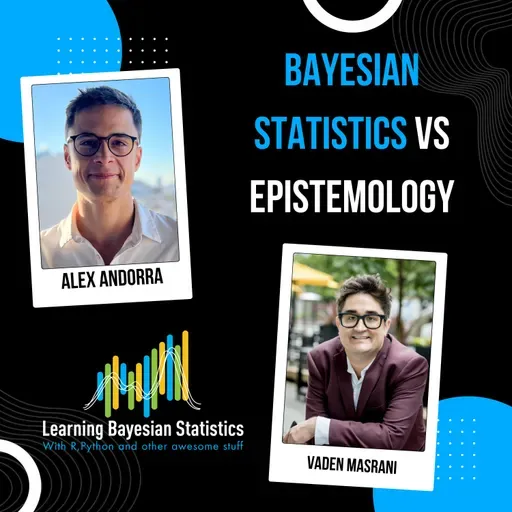
Q: What's the difference between Bayesian statistics and Bayesian epistemology?
A: Bayesian statistics uses Bayes' theorem on actual data: you put a prior over parameters, combine it with a likelihood, and the data is allowed to tell you your model is wrong. Vaden loves it. Bayesian epistemology, in his tongue-in-cheek phrase, is "Bayesian statistics minus the statistics" - taking Bayes' theorem as a general account of how anyone should reason under uncertainty, including about events where there is nothing to count. The first is falsifiable and grounded; the second, he argues, lets people attach authoritative-sounding numbers to pure belief.
Q: Why is it a problem to put a probability on a one-off future event like human extinction?
A: Because there are no statistics behind it. Vaden's trigger example is Toby Ord's The Precipice, where a data-derived probability (supervolcanoes per millennium) is placed side by side with a probability of extinction-by-superintelligence that came from no data at all. His reaction is the statistician's first instinct: where are the numbers coming from, and what could ever make them come out differently? A subjective degree of belief is fine as a hunch. The trouble starts when it is communicated as though it were an objective, data-grounded frequency.
Q: What does Vaden Masrani actually like about Bayesian statistics?
A: The freedom to encode domain knowledge as a prior and have the result respect common sense - estimating an average human height, you can rule out zero and a hundred feet before seeing a single measurement. But the part he keeps stressing is falsifiability: you fit the model, compare it to data, and the data can tell you the model was bad. That contact with reality is exactly what makes the statistics legitimate and what the epistemology lacks. On Bayesian-versus-frequentist for engineering problems, he says he has no dog in the fight -- both are useful, and any working statistician uses both.
Full takeaways here
Chapters:
00:24:01 What's the difference between Bayesian statistics and Bayesian epistemology?
00:33:12 How can Bayesian epistemology lead to bad real-world decisions?
00:36:36 Is Bayesian or frequentist statistics better for real-world problems?
00:39:31 What is the problem of induction, and how does Bayesian epistemology try to solve it?
00:43:50 What are the main logical problems with Bayesian epistemology?
00:48:40 What is Popper's critical rationalism, and how does falsifiability fit in?
00:52:31 How does critical rationalism work when you can't run a clean experiment?
01:15:03 Why should you treat criticism as a gift, even when it hurts?
01:19:54 How do Stoicism and equanimity help you handle criticism?
01:23:19 Why does critical rationalism apply to everyday life, not just science?
Thank you to my Patrons for making this episode possible!
Links from the show here