28 October 2026
The North vowed to resume its loudspeaker broadcasts. Will inter-Korean border tensions escalate again? Why is North Korea trying to resume broadcasts now? What does the move signify? Why do border loudspeakers matter? How will the South respond? What happens next?
Korea JoongAng Daily - Daily News from Korea
About
North Korea stated that it will resume propaganda loudspeakers by Oct. 31, which would mark the first broadcast in about 16 months, reversing South Korean President Lee Jae Myung's efforts toward easing inter-Korean tensions.
[EXPLAINER]
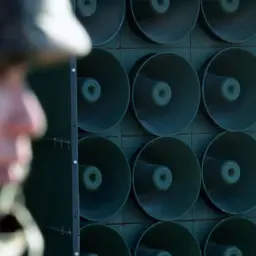
From July 2024 to June 2025, North Korean loudspeakers along the inter-Korean border played sounds of howling animals and scraping metal through the night.
Residents of Paju in Gyeonggi, a city about an hour's drive northwest of Seoul that borders North Korea, said that it sounded like ghosts wailing.
The noise stopped on June 12 last year, a day after the South halted its own propaganda broadcasts on President Lee Jae Myung's orders.
But Paju residents fear that the noise will soon return.
North Korea said on Oct. 21 that it will turn its loudspeakers back on before the end of this month.
If true, that would mark the first broadcast in about 16 months. It would also undo one of President Lee's main steps toward easing tensions with the North.
Border loudspeakers are a tool of psychological warfare.
For decades, the South used them to send news and K-pop to North Korean soldiers and residents near the border, who have little access to outside information. North Korea's most recent broadcasts carried only noise, no message, which South Korean officials saw as an attempt to drown out Seoul's broadcasts.
Seoul halted broadcasts from its fixed speakers and removed them — roughly 20 in total — last year; Pyongyang also stopped its broadcasts in return.
But this truce is now at risk, and the South Korean government has yet to agree on how to respond.
The North's threat to resume broadcasts stems from a dispute regarding the border itself.
Since 2024, North Korea has been laying mines and building fences and antitank barriers to establish what it calls a "permanent border" with the South.
North Korean soldiers doing this work have repeatedly crossed the military demarcation line (MDL) — which lies within the demilitarized zone (DMZ) — that divides the two Koreas. South Korean troops have answered with warning broadcasts and warning shots. Warning broadcasts are aimed at North Korean soldiers who cross the line and are separate from propaganda broadcasts.
Then on Sept. 21, a land mine explosion south of the MDL in the western DMZ wounded three South Korean soldiers, two of whom sustained serious injuries.
The South's military concluded that North Korean troops had planted the mine, but the North has repeatedly denied responsibility and called the incident a "fabrication" by the South.
Kim Yo-jong, the sister of North Korean leader Kim Jong-un and a department director of the ruling Workers' Party, first raised the idea of resuming broadcasts on Oct. 19, saying that Pyongyang would consider doing so in response to Seoul's warning shots.
She claimed that South Korean troops had issued 2,870 loudspeaker warnings and fired 201 warning shots between Aug. 1 and Oct. 17.
On Oct. 21, after touring border fortification sites with Marshal Pak Jong-chon, the North's top military official, she set a specific deadline.
"Within October, the loudspeakers for psychological warfare against the ROK will be in operation along the whole border," she said, referring to the Republic of Korea, South Korea's official name, in an English-language statement carried by the state-run Korean Central News Agency.
The next day, she said that the speakers "will be on standby in a matter of days."
During a parliamentary audit of South Korea's Ministry of Foreign Affairs and Ministry of Unification on Tuesday, Unification Minister Chung Dong-young told lawmakers that the North appears intent on completing its border work "on schedule" and remains steadfast in its stance that the Koreas are "two hostile states."
"The real intention [behind the North's promise to resume broadcasts] is an indirect demand for our side's restraint," said Yang Moo-jin, a distinguished professor at the University of North Korean Studies. "There would b...