03 August 2026
Real estate policies fuel housing anxiety and punitive taxation Real estate policies fuel housing anxiety and punitive taxation This article was originally written in Korean and translated by a bilingual reporter with the help of generative AI tools. It was then edited by a native English-speaking editor. All AI-assisted translations are reviewed and refined by our newsroom.
Korea JoongAng Daily - Daily News from Korea
About
Editorials
President Lee Jae Myung's real estate tax plan burdens homeowners, discourages transactions and risks worsening supply and rental pressures.
Opinion Desk
Opinion
Desk
Published
August 4, 2026 - 12:01 a.m.
Modified
August 5, 2026 - 8:58 a.m.
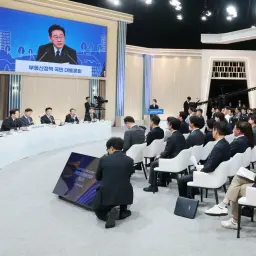
President Lee Jae Myung, fifth from left and on screen, speaks during the national debate on real estate policy at KBS in Yeouido, western Seoul, on July 23.
JOINT PRESS CORPS
The Lee Jae Myung administration has held five policy forums on housing supply, finance and taxation, promising to hear a wide range of views from the market. Yet the tax reform plan announced on Monday came down to one thing: higher taxes.
President Lee's pledge that he would "not use taxes as a tool of housing policy" has vanished, as has the Presidential policy chief Kim Yong-beom's call to "shut up and just build" more homes. Instead of expanding supply and encouraging transactions, the government has shifted its focus to raising the long-term burden of property ownership and transactions. In the end, it is simply "shut up and just raise taxes."
The government says it is normalizing property taxes, which are low compared to other major economies, while protecting genuine homebuyers. But the reality is different. The threshold for the comprehensive real estate tax on single-home owners has been raised from 1.2 billion won to 1.4 billion won ($839,500 to $979,5000) in assessed value, while the basic deduction for nonresident single-home owners has been cut from 1.2 billion won to 900 million won.
At the same time, the cap on annual increases in the tax burden will rise from 150 percent to 200 percent, while the fair market value ratio will increase from 60 percent to 70 percent next year. The tax rate on ultrahigh-end homes will nearly double, while rates on homes in the 600 million to 1.2 billion won taxable value bracket will rise from 1 percent to 1.3 percent.
The government is also making it harder to sell homes. Long-term capital gains deductions will be based more heavily on years of residence, while new limits will be imposed on the deduction. This runs counter to the basic principle of a functioning housing market: If property taxes rise, transaction taxes should be lowered to encourage homes to come onto the market.
President Lee had also promised before taking office to expand inheritance-tax deductions so that people would not have to sell their longtime homes because of taxes. That pledge is absent from the latest plan. With neither transaction-tax relief nor expanded inheritance-tax deductions, homeowners will face heavier burdens when they own, sell or pass on their homes. The policy amounts to punitive taxation of homeowners.
The consequences could be severe. The completion rate for Seoul apartments fell 58.4 percent in the first half of this year, while the average jeonse (lump-sum deposit) surpassed 700 million won. Regulatory side effects are spreading beyond southern Seoul into northern districts and the wider capital region, worsening rental-market pressures.
The lessons of the Roh Moo-hyun and Moon Jae-in administrations are clear: Housing markets cannot be stabilized by taxes alone. Higher costs will eventually be passed on to tenants.
The solution is equally clear. If property taxes are raised, transaction taxes must be boldly cut. Reconstruction and redevelopment should be encouraged, and housing supply expanded. Only a steady stream of new homes can restore the hope of homeownership, stabilize prices and normalize the market.
By trying to overpower the market, the government is leaving ordinary citizens to bear the burden of a tax bomb.
President Lee Jae Myung's real estate tax plan burdens homeowners, discourages transactions and risks worsening supply and rental pressures.
Opinion Desk
Opinion
Desk
Published
August 4, 2026 - 12:01 a.m.
Modified
August 5, 2026 - 8:58 a.m.
President Lee Jae Myung, fifth from left and on screen, speaks during the national debate on real estate policy at KBS in Yeouido, western Seoul, on July 23.
JOINT PRESS CORPS
The Lee Jae Myung administration has held five policy forums on housing supply, finance and taxation, promising to hear a wide range of views from the market. Yet the tax reform plan announced on Monday came down to one thing: higher taxes.
President Lee's pledge that he would "not use taxes as a tool of housing policy" has vanished, as has the Presidential policy chief Kim Yong-beom's call to "shut up and just build" more homes. Instead of expanding supply and encouraging transactions, the government has shifted its focus to raising the long-term burden of property ownership and transactions. In the end, it is simply "shut up and just raise taxes."
The government says it is normalizing property taxes, which are low compared to other major economies, while protecting genuine homebuyers. But the reality is different. The threshold for the comprehensive real estate tax on single-home owners has been raised from 1.2 billion won to 1.4 billion won ($839,500 to $979,5000) in assessed value, while the basic deduction for nonresident single-home owners has been cut from 1.2 billion won to 900 million won.
At the same time, the cap on annual increases in the tax burden will rise from 150 percent to 200 percent, while the fair market value ratio will increase from 60 percent to 70 percent next year. The tax rate on ultrahigh-end homes will nearly double, while rates on homes in the 600 million to 1.2 billion won taxable value bracket will rise from 1 percent to 1.3 percent.
The government is also making it harder to sell homes. Long-term capital gains deductions will be based more heavily on years of residence, while new limits will be imposed on the deduction. This runs counter to the basic principle of a functioning housing market: If property taxes rise, transaction taxes should be lowered to encourage homes to come onto the market.
President Lee had also promised before taking office to expand inheritance-tax deductions so that people would not have to sell their longtime homes because of taxes. That pledge is absent from the latest plan. With neither transaction-tax relief nor expanded inheritance-tax deductions, homeowners will face heavier burdens when they own, sell or pass on their homes. The policy amounts to punitive taxation of homeowners.
The consequences could be severe. The completion rate for Seoul apartments fell 58.4 percent in the first half of this year, while the average jeonse (lump-sum deposit) surpassed 700 million won. Regulatory side effects are spreading beyond southern Seoul into northern districts and the wider capital region, worsening rental-market pressures.
The lessons of the Roh Moo-hyun and Moon Jae-in administrations are clear: Housing markets cannot be stabilized by taxes alone. Higher costs will eventually be passed on to tenants.
The solution is equally clear. If property taxes are raised, transaction taxes must be boldly cut. Reconstruction and redevelopment should be encouraged, and housing supply expanded. Only a steady stream of new homes can restore the hope of homeownership, stabilize prices and normalize the market.
By trying to overpower the market, the government is leaving ordinary citizens to bear the burden of a tax bomb.