28 June 2026
Progressives blame Yoon Suk Yeol for North Korea's hostility. But the enmity goes back further. A hostile turn The turning point A disappearance of conciliatory language This article was originally written in Korean and translated by a bilingual reporter with the help of generative AI tools. It was then edited by a native English-speaking editor. All AI-assisted translations are reviewed and refined by our newsroom.
Korea JoongAng Daily - Daily News from Korea
About
A decade-long analysis of North Korean state media suggests Pyongyang 's break with Seoul started after the collapse of the 2019 Hanoi summit, when liberal South Korean President Moon Jae-in was in office.
[A STUDY OF KIM JONG-UN 9]
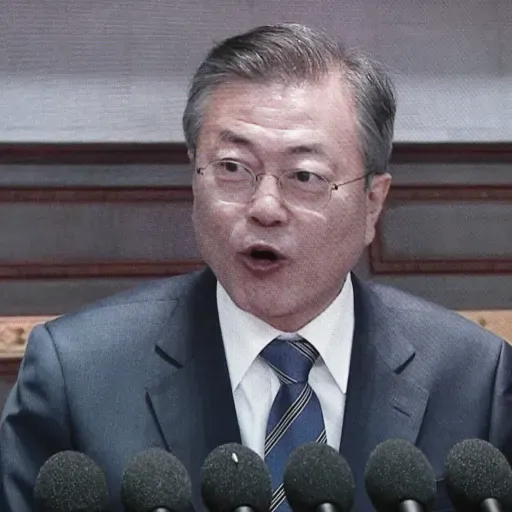
On the night of Sept. 19, 2018, at the Rungrado 1st of May Stadium on Rungra Island in Pyongyang, then-President Moon Jae-in stood before 150,000 cheering North Koreans.
After watching a mass games performance, Moon took the stage at the introduction of North Korean leader Kim Jong-un. His face was flushed with emotion. A smile spread across his face, reflecting both the elation of having personally steered the Korean Peninsula to what appeared to be the pinnacle of peace and the optimism that accompanied it.
Moon embraced the deafening cheers reverberating through the enormous stadium. His roughly seven-minute speech was interrupted by applause 12 times.
When he declared, "Kim Jong-un and I have pledged to make our beautiful land, from Mount Paektu to Mount Halla, a permanent home of peace free from nuclear weapons and nuclear threats, and pass it on to future generations," the stadium once again erupted in thunderous applause.
That night, North and South Korea appeared united, and Moon's dream seemed on the verge of becoming reality.
But the cheers of that day turned into insults just 11 months later.
"It is enough to make even a boiled cow's head burst into laughter."
This statement, made in August 2019 by a spokesperson for North Korea's Committee for the Peaceful Reunification of the Fatherland, a state agency that aimed to promote reunification, stunned both the Moon administration and the South Korean public. The statement went on to deride Moon as a "shameless person" and someone who was "laughable beyond measure."
A day earlier, Moon had promoted the idea of a "peace economy" in his Liberation Day speech on Aug. 15. Pyongyang responded by mocking him, using South Korea-U.S. joint military exercises as a pretext. As a prolonged period of strained inter-Korean relations followed, the phrase "boiled cow's head" became an enduring label attached to assessments of the Moon administration's North Korea policy.
In retrospect, the episode also served as a chilling foreshadowing of Kim 's doctrine of severing ties with South Korea and redefining it as an enemy.
Some in South Korea's progressive camp argue that the hardline North Korea policy of the subsequent Yoon Suk Yeol administration laid the groundwork for Pyongyang's "hostile two-state" doctrine.
One typical view, articulated by Jeong Tae-heung, head of policy at a research institute affiliated with South Korea's left wing Progressive Party, is that "the United States has been strengthening its New Cold War strategy, and the Yoon administration followed suit by intensifying hostile policies toward North Korea," and that this "became the direct cause of North Korea's declaration of a hostile two-state relationship and the resulting escalation of war risks."
Given that Kim first unveiled the hostile two-state doctrine at a Workers' Party plenary meeting at the end of 2023 and that inter-Korean tensions remained elevated throughout the Yoon administration, the argument appears persuasive.
But was Kim's declaration of a "struggle against the enemy" really nothing more than a passive response to policy changes in Seoul?
Big data tells a very different story.
Language data showed that the watershed moment in the breakdown of inter-Korean relations occurred not under the Yoon administration, but during the Moon administration.
There was also a reason Kim later doubled down on the enmity, even after the inauguration of the current Lee Jae Myung administration, by declaring that South Korea was "the most hostile state" and by expressing a sense of betrayal in rhetoric suggesting that it made little difference whether Seoul was governed by — in the words of Kim 's powerful sister, Kim Yo-jong — those "claiming to be democrats" or those "wearing t...
[A STUDY OF KIM JONG-UN 9]
On the night of Sept. 19, 2018, at the Rungrado 1st of May Stadium on Rungra Island in Pyongyang, then-President Moon Jae-in stood before 150,000 cheering North Koreans.
After watching a mass games performance, Moon took the stage at the introduction of North Korean leader Kim Jong-un. His face was flushed with emotion. A smile spread across his face, reflecting both the elation of having personally steered the Korean Peninsula to what appeared to be the pinnacle of peace and the optimism that accompanied it.
Moon embraced the deafening cheers reverberating through the enormous stadium. His roughly seven-minute speech was interrupted by applause 12 times.
When he declared, "Kim Jong-un and I have pledged to make our beautiful land, from Mount Paektu to Mount Halla, a permanent home of peace free from nuclear weapons and nuclear threats, and pass it on to future generations," the stadium once again erupted in thunderous applause.
That night, North and South Korea appeared united, and Moon's dream seemed on the verge of becoming reality.
But the cheers of that day turned into insults just 11 months later.
"It is enough to make even a boiled cow's head burst into laughter."
This statement, made in August 2019 by a spokesperson for North Korea's Committee for the Peaceful Reunification of the Fatherland, a state agency that aimed to promote reunification, stunned both the Moon administration and the South Korean public. The statement went on to deride Moon as a "shameless person" and someone who was "laughable beyond measure."
A day earlier, Moon had promoted the idea of a "peace economy" in his Liberation Day speech on Aug. 15. Pyongyang responded by mocking him, using South Korea-U.S. joint military exercises as a pretext. As a prolonged period of strained inter-Korean relations followed, the phrase "boiled cow's head" became an enduring label attached to assessments of the Moon administration's North Korea policy.
In retrospect, the episode also served as a chilling foreshadowing of Kim 's doctrine of severing ties with South Korea and redefining it as an enemy.
Some in South Korea's progressive camp argue that the hardline North Korea policy of the subsequent Yoon Suk Yeol administration laid the groundwork for Pyongyang's "hostile two-state" doctrine.
One typical view, articulated by Jeong Tae-heung, head of policy at a research institute affiliated with South Korea's left wing Progressive Party, is that "the United States has been strengthening its New Cold War strategy, and the Yoon administration followed suit by intensifying hostile policies toward North Korea," and that this "became the direct cause of North Korea's declaration of a hostile two-state relationship and the resulting escalation of war risks."
Given that Kim first unveiled the hostile two-state doctrine at a Workers' Party plenary meeting at the end of 2023 and that inter-Korean tensions remained elevated throughout the Yoon administration, the argument appears persuasive.
But was Kim's declaration of a "struggle against the enemy" really nothing more than a passive response to policy changes in Seoul?
Big data tells a very different story.
Language data showed that the watershed moment in the breakdown of inter-Korean relations occurred not under the Yoon administration, but during the Moon administration.
There was also a reason Kim later doubled down on the enmity, even after the inauguration of the current Lee Jae Myung administration, by declaring that South Korea was "the most hostile state" and by expressing a sense of betrayal in rhetoric suggesting that it made little difference whether Seoul was governed by — in the words of Kim 's powerful sister, Kim Yo-jong — those "claiming to be democrats" or those "wearing t...