22 October 2026
'Original reporting' critical to democracy's defense, says New York Times publisher Related Article
Korea JoongAng Daily - Daily News from Korea
About
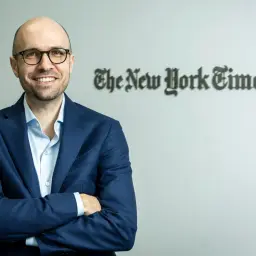
A.G. Sulzberger discusses press freedom under Donald Trump, AI-driven intellectual property theft and The New York Times' investment in independent journalism during a visit to his paper's Asia hub in Seoul.
As journalism faces unprecedented challenges amid growing threats to press freedom from authority figures and intellectual property theft in the AI era, The New York Times publisher underscored that "democracy depends on an informed public," which starts with "original reporting."
"Democracy depends on an informed public, and an informed public depends on truth-tellers who are willing to ask the tough questions of our representatives and of the most powerful people in society," A.G. Sulzberger, publisher of The New York Times and chairman of The New York Times Company, said as he sat for an interview with the Korea JoongAng Daily and JoongAng Ilbo at The Times' Asia hub in central Seoul on Wednesday. The Korea JoongAng Daily, which marked its 26th anniversary this month, is a publishing partner of The New York Times.
The New York Times marked its 175th anniversary this year, and Sulzberger stressed that there has never been a U.S. president more opposed to the press than Donald Trump, addressing the administration's threats and lawsuits against the paper.
"No president in modern history has employed more openly anti-press rhetoric," Sulzberger said. "When he, or the administration, is using unjust power to try to silence our reporting, we are standing up for the reporting and refusing to be silenced or intimidated."
Sulzberger, who was recently listed on TIME magazine's "100 Most Influential People in AI 2026," shared how his newspaper is adapting to the AI transformation while battling misinformation and fending off the "largest theft in the history of the industry."
He warned that "if the theft of intellectual property is allowed to stand, it is not clear to me that there is a sustainable path for journalism organizations."
During his time as an editor at The New York Times, Sulzberger authored the 2014 "Innovation Report," guiding the paper's successful "digital first" strategy. He joined The Times as a metro reporter in 2009 and is the sixth Ochs-Sulzberger family member to serve as publisher of The Times since Adolph Ochs purchased the newspaper in a bankruptcy sale in 1896.
The Times reached 13.35 million paid subscribers as of the second quarter and reported digital-only subscription revenue of $407.9 million, up 16.4 percent from the year before. It aims to reach 15 million subscribers by the end of 2027.
Sulzberger said the key to profitable journalism is ultimately "strong journalism," adding, "part of the secret to our success is that, rather than chase what everyone else is doing online, we continue to tell stories that others aren't telling."
In May 2021, The Times launched its new Asia hub in central Seoul after moving its digital news operation from its decades-old Hong Kong headquarters in response to concerns about a sweeping national security law passed by China and its implications for free speech and the press.
Regarding the growth of The Times' Asia hub, Sulzberger said, "Korea is such a distinct country in having technological, business and cultural strength, and so it's a great place to make journalism."
The following are edited excerpts from the interview.
Q. The New York Times is currently facing threats and multiple lawsuits under the Trump administration. Has there ever been a period in history with such direct pressure on freedom of speech? And what makes this current threat different from the past?
A. I often say, free people need a free press. And the reason for that is that democracy depends on an informed public, and an informed public depends on truth-tellers who are willing to ask the tough questions of our representatives and of the most powerful people in society. And part of what has made America so successful is that the so-called Founding Fathers of the country, people who wrote t...