10 May 2026
North Korea and Russia deepen ties as South Korea-U.S. alliance strains
Korea JoongAng Daily - Daily News from Korea
About
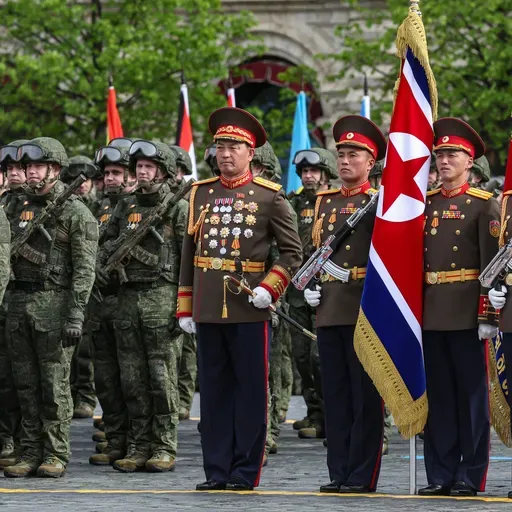
North Korean troops marched in Russia's Victory Day parade for the first time in Moscow's Red Square on Friday, underscoring how relations between Pyongyang and Moscow are evolving beyond wartime cooperation into what increasingly resembles a military alliance.
Among the roughly 11,000 North Korean troops reportedly dispatched to support Russia in the Ukraine war, more than 2,000 are believed to have been killed. Against that backdrop, the appearance of North Korean soldiers in the parade carried symbolic significance, publicly demonstrating the growing military alignment between the two countries.
Additional developments point in the same direction. Russian President Vladimir Putin reportedly awarded medals in secret to North Korean generals involved in operations in Kursk. Last month, Russia also sent its defense minister and lower house speaker to Pyongyang for the opening ceremony of a memorial complex honoring fallen North Korean troops. The relationship between the two countries is rapidly evolving into something far closer to a formal military partnership.
The growing military cooperation is already creating direct security concerns on the Korean Peninsula. North Korea is accumulating battlefield experience in drone operations, artillery tactics and electronic warfare through the Ukraine conflict. Concerns are also rising that Russian technical assistance may be helping Pyongyang develop a North Korean version of the K9 self-propelled howitzer, reportedly set for deployment near the front line within the year. Such a move would increase pressure on the Seoul metropolitan area.
North Korea has also amended its Constitution to formally reject denuclearization and reinforce its status as a nuclear weapons state.
At such a serious moment, signs of strain within the South Korea-U.S. alliance are troubling. Controversy has emerged over restrictions on intelligence sharing related to North Korea, while command gaps have been exposed by the monthlong absence of the deputy commander of U.S. Forces Korea.
Concerns are also growing that U.S. President Donald Trump could discuss North Korea directly with China during a summit with Chinese President Xi Jinping while sidelining Seoul. If the North Korean nuclear issue becomes merely another bargaining chip among major powers, the consequences for South Korea's security could be severe.
That is why the meeting between Defense Minister Ahn Gyu-back and U.S. Defense Secretary Pete Hegseth carries unusual importance. The government must quickly restore trust within the alliance and normalize intelligence-sharing mechanisms.
South Korea must also strengthen independent deterrence capabilities while carefully weighing any U.S. request related to military operations in the Strait of Hormuz. The marching boots in Red Square are warning of a changing security order. Seoul must respond with concrete action centered on both rebuilding the alliance and strengthening its own defense posture.
This article was originally written in Korean and translated by a bilingual reporter with the help of generative AI tools. It was then edited by a native English-speaking editor. All AI-assisted translations are reviewed and refined by our newsroom.