01 November 2026
Lawmakers' visa hurdles expose a wider problem in Korea-U.S. alliance as usual channels no longer work Two ministers for one visa Channels that no longer work A wider strain Visas as leverage
Korea JoongAng Daily - Daily News from Korea
About
After a visa for a top ruling party lawmaker was denied, a second refusal was resolved only after ministers intervened.
[NEWS ANALYSIS]
The chair of Korea's parliamentary defense committee is on his way to meet U.S. military commanders after days of uncertainty over his visa.
But the way the case was resolved has turned what might have been an individual visa matter into a question of communication and trust between allies.
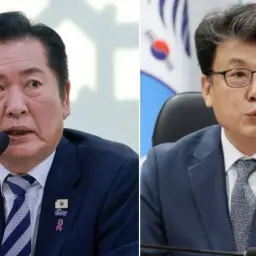
Democratic Party Rep. Jin Sung-joon, chair of the National Assembly's National Defense Committee, left for Hawaii on Sunday to lead a bipartisan delegation to the U.S. Indo-Pacific Command, a day after the U.S. Embassy in Seoul issued the official visa it had initially rejected.
The case was settled only after Korea's defense and foreign ministers stepped in and raised the issue with their U.S. counterparts.
It was the second time in a matter of weeks that a senior ruling party lawmaker's official trip to the United States had been held up, after Rep. Jung Chung-rae had to switch to a European audit team when his visa for a parliamentary audit of the Korean Embassy in Washington was not issued in time. Visas for Korea's National Intelligence Service (NIS) officers to be posted at the U.S. embassy have also been delayed.
The case coincided with comments by U.S. Ambassador to Korea Michelle Steel describing the 73-year-old alliance as going through "a kind of turbulence." Washington has limited intelligence sharing with Seoul, and U.S. lawmakers and officials have complained about Korea's treatment of U.S.-listed e-commerce company Coupang and other U.S. firms.
Analysts said that U.S. visa restrictions for people with records of anti-American activity have been tightening worldwide, not only for Koreans.
But the latest case showed that diplomatic channels that once resolved such frictions at the working level no longer appear to function as they did, with routine matters being pushed up to the ministerial level.
Rep. Jin posted a screen capture on Wednesday showing his application for an A-2 visa, issued to foreign officials on government business, as "Refused."
The U.S. side asked for court records from his 1991 conviction under the National Security Act, a law that bars activities seen as benefiting North Korea, Jin said. He had been accused of organizing a group during his military service that called for, among other things, the withdrawal of U.S. troops from Korea.
He was pardoned in 1995.
Defense Minister Kang Shin-chul asked U.S. Secretary of Defense Pete Hegseth to look into the case when they met in the Philippines on Wednesday.
Foreign Minister Cho Hyun also raised the issue with Secretary of State Marco Rubio on the sidelines of the Group of 20 (G20) foreign ministers' meeting in Atlanta on Friday.
The visa was issued the next day.
"I think there was one particular visa individually that there was an issue about regarding behavior perhaps a couple decades ago, but we'll work through that at a bilateral basis, not in a press conference," Rubio told reporters in Atlanta on Saturday.
While the rejections for lawmakers were atypical, even more unusual was how hard it was for Seoul to get an answer.
Minister Cho told lawmakers on Tuesday that he had raised Jung's case with the U.S. Embassy's chargé d'affaires on Oct. 8. He called U.S. visa measures "a bit haphazard" and said representatives from the U.S. side themselves said they did not know why and could not do anything about it.
He also said the United States of today is very different from that of before.
"The U.S. government lacks some consistency in its policies, and at times somewhat confusing situations unfold," Cho said. "All the more reason we are communicating closely with the United States at every level and managing [the relationship] so that the Korea-U.S. alliance is not shaken."
Robert Rapson, a former acting U.S. ambassador to Korea, said he found the refusals "somewhat unusual," but added, "given the so-called 'turbulence' curre...