28 May 2026
Korean libraries, reading spaces grow multilingual amid demographic shift, tourism boom
Korea JoongAng Daily - Daily News from Korea
About
This article is by Cho Jung-woo and read by an artificial voice.
As Korea grapples with changing demographics and a post-pandemic tourism boom, public libraries and municipal spaces are aggressively expanding their multilingual book collections.
Driven in part by the country's ongoing "text-hip" trend — where reading is embraced as a fashionable lifestyle — the broader policy shift aims to foster a more inclusive environment for international students, expatriates and tourists by ensuring access to publications in their native languages.
For Seven, a 21-year-old from the United States, who asked to be named only by her first name, libraries are a mandatory stop whenever she travels. Having previously worked at a library back home, she views these public spaces as a unique lens for experiencing local culture while also seeking a comforting sense of familiarity.
"I always try to look at the library when visiting a city in a new area," Seven said while walking around the newly opened Yeouido Brighten Library in Yeongdeungpo District, western Seoul, on Friday afternoon.
"I looked through the [English] books here, and there were far more than I expected."
Local authorities are steadily increasing foreign-language acquisitions in traditional brick-and-mortar facilities, while municipal flagship programs, such as the Seoul Outdoor Library initiatives, are intentionally placing multilingual texts into the hands of international visitors.
According to data from the National Library Statistics System, Korea's public libraries have aggressively scaled up their overseas collections over the past decade — from 3.3 million in 2015 to 6.9 million in 2025 — to meet shifting demands, with nationwide visitors per public library averaging 173,593 last year, a significant recovery from 115,016 in 2021.
English-friendly hub in Yeouido
Despite having opened its doors less than a month ago on April 28, the pristine, sunlit halls of the Yeouido Brighten Library were packed on Friday afternoon. The crowd spanned generations, from energetic kindergartners to financial professionals taking a break from the surrounding corporate buildings.
Located in an underground space covering approximately 3,305 square meters (35,583 square feet) in the heart of Seoul's financial hub, the library features a distinct layout. Rather than isolating foreign books to a distant corner, English titles are integrated directly alongside Korean volumes. There was also a dedicated zone for English fiction and nonfiction curated with literary quotes and photographs.
"When we first opened, we started with around 5,400 English books out of a total collection of some 27,000," a Yeongdeungpo District Office official told the Korea JoongAng Daily. "That number is continually growing as we purchase more volumes."
According to library data, roughly 3,000 of these English titles are targeted at adults, while the remainder are aimed at younger readers in a specialized children's zone called the English Kids' Cafe.
While books in languages other than English are not currently displayed on the shelves, the district office noted that visitors can request specific international titles via an online procurement system on its website.
Between its opening day and the third week of May, the library drew around 70,000 visitors. While primarily serving residents, it has become a popular midday destination for office workers and weekend crowds filtering in from nearby landmarks like The Hyundai Seoul and Yeouido Hangang Park.
An 'accidental encounter' for tourists
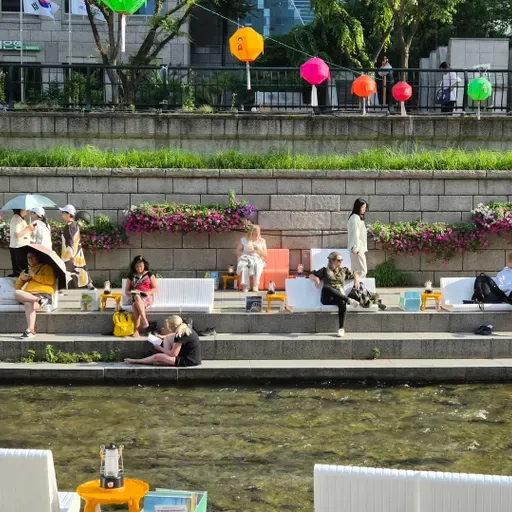
For short-term tourists and international residents looking for an outdoor experience, the Seoul Metropolitan Government's Seoul Outdoor Library project has become a major seasonal fixture.
This year, city organizers boosted the proportion of foreign-language books across the outdoor venues to 20 percent of the total display, doubling last year's 10 percent allocation. Notably, the selection extends well beyond English to include Ja...
As Korea grapples with changing demographics and a post-pandemic tourism boom, public libraries and municipal spaces are aggressively expanding their multilingual book collections.
Driven in part by the country's ongoing "text-hip" trend — where reading is embraced as a fashionable lifestyle — the broader policy shift aims to foster a more inclusive environment for international students, expatriates and tourists by ensuring access to publications in their native languages.
For Seven, a 21-year-old from the United States, who asked to be named only by her first name, libraries are a mandatory stop whenever she travels. Having previously worked at a library back home, she views these public spaces as a unique lens for experiencing local culture while also seeking a comforting sense of familiarity.
"I always try to look at the library when visiting a city in a new area," Seven said while walking around the newly opened Yeouido Brighten Library in Yeongdeungpo District, western Seoul, on Friday afternoon.
"I looked through the [English] books here, and there were far more than I expected."
Local authorities are steadily increasing foreign-language acquisitions in traditional brick-and-mortar facilities, while municipal flagship programs, such as the Seoul Outdoor Library initiatives, are intentionally placing multilingual texts into the hands of international visitors.
According to data from the National Library Statistics System, Korea's public libraries have aggressively scaled up their overseas collections over the past decade — from 3.3 million in 2015 to 6.9 million in 2025 — to meet shifting demands, with nationwide visitors per public library averaging 173,593 last year, a significant recovery from 115,016 in 2021.
English-friendly hub in Yeouido
Despite having opened its doors less than a month ago on April 28, the pristine, sunlit halls of the Yeouido Brighten Library were packed on Friday afternoon. The crowd spanned generations, from energetic kindergartners to financial professionals taking a break from the surrounding corporate buildings.
Located in an underground space covering approximately 3,305 square meters (35,583 square feet) in the heart of Seoul's financial hub, the library features a distinct layout. Rather than isolating foreign books to a distant corner, English titles are integrated directly alongside Korean volumes. There was also a dedicated zone for English fiction and nonfiction curated with literary quotes and photographs.
"When we first opened, we started with around 5,400 English books out of a total collection of some 27,000," a Yeongdeungpo District Office official told the Korea JoongAng Daily. "That number is continually growing as we purchase more volumes."
According to library data, roughly 3,000 of these English titles are targeted at adults, while the remainder are aimed at younger readers in a specialized children's zone called the English Kids' Cafe.
While books in languages other than English are not currently displayed on the shelves, the district office noted that visitors can request specific international titles via an online procurement system on its website.
Between its opening day and the third week of May, the library drew around 70,000 visitors. While primarily serving residents, it has become a popular midday destination for office workers and weekend crowds filtering in from nearby landmarks like The Hyundai Seoul and Yeouido Hangang Park.
An 'accidental encounter' for tourists
For short-term tourists and international residents looking for an outdoor experience, the Seoul Metropolitan Government's Seoul Outdoor Library project has become a major seasonal fixture.
This year, city organizers boosted the proportion of foreign-language books across the outdoor venues to 20 percent of the total display, doubling last year's 10 percent allocation. Notably, the selection extends well beyond English to include Ja...