04 September 2026
How Trump's order to scale back drills complicates Seoul's wartime command bid What exactly changed about this year's UFS exercise? What is Opcon, and how is the transfer actually decided? Does the government's "no impact" claim hold up? How has Washington reacted? Do Seoul and Washington agree on a timeline?
Korea JoongAng Daily - Daily News from Korea
About
South Korea and the United States cut short this year's Ulchi Freedom Shield (UFS) exercise on Aug. 21, six days ahead of schedule, after U.S. President Donald Trump ordered the Pentagon to substantially reduce the drills.
The second phase, built around a simulated counteroffensive against North Korea, was scrapped entirely.
South Korea's Ministry of National Defense says the cut has not affected the country's push to reclaim wartime operational control (Opcon) of its own military.
Defense Minister Ahn Gyu-back told the National Assembly on Aug. 20 that two evaluations tied to the transition — including one covering fire-support coordination — were already completed during the exercise's first phase.
The real test of that claim comes in October, when defense chiefs from both countries are expected to meet in Washington and decide whether to name a target year for the handover — a decision that will show whether Washington's read of this summer's verification actually matches Seoul's.
UFS, the allies' annual summertime command-post exercise, was originally scheduled to run 11 days, from Aug. 17 to 27.
The order came without prior coordination with Seoul. South Korea's defense and foreign ministries said during a parliamentary committee session that they learned of the decision only after it was posted.
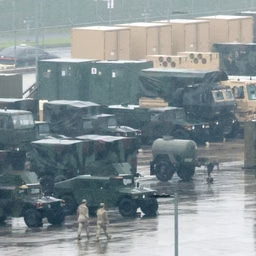
Field training exercises involving troops and equipment on the ground were reduced from 17 to 14, and the drill's second week — the counteroffensive phase — was canceled outright, leaving only the first week's defensive-phase drills.
It is highly unusual for a joint exercise already underway, and agreed to in advance by both militaries, to be cut short mid-exercise.
Opcon refers to the authority to command South Korean and U.S. forces in the event of a war on the peninsula.
South Korea transferred this authority to the U.S.-led United Nations Command at the outset of the 1950-53 Korean War. Peacetime operational control was returned to South Korea in 1994, but wartime control has remained with the commander of the Republic of Korea-U.S. Combined Forces Command — a post currently held by a U.S. four-star general who also serves as commander of U.S. Forces Korea (USFK).
Under the plan both governments have pursued since 2014, that role would eventually pass to a South Korean four-star general, with an American serving as deputy commander, under what is envisioned as a Future Combined Forces Command.
The two allies are following what they call a "conditions-based" transition plan, built around three requirements: South Korea's military capability to lead the combined defense, an alliance-wide capacity to counter North Korean nuclear and missile threats and a stable security environment on the peninsula and in the region.
Progress on the first condition is measured through a three-stage process for the future command: Initial Operational Capability, Full Operational Capability (FOC) and Full Mission Capability (FMC). South Korea has been working through the FOC stage this year.
At the 57th Security Consultative Meeting (SCM) in Seoul last November, the two countries' defense chiefs agreed to pursue FOC verification within 2026 — the target this year's UFS was meant to help meet.
The 58th SCM is expected to take place in Washington in October, where South Korea hopes the two countries' defense ministers will approve this year's FOC results and name a target year — referred to in Korean planning documents as the "X-year" — for the Opcon transfer.
Korea's Ministry of Defense said on Aug. 19 that the joint evaluation planned for this year's UFS proceeded as scheduled despite the shortened exercise.
Defense Minister Ahn reaffirmed that position the next day at the National Assembly's defense committee, saying the shortened schedule did not affect the transition-related verification.
Others have taken a broader view.
Robert Rapson, deputy director of the Forum on Asia-Pacific Security at the National Committee on American Foreign Pol...
The second phase, built around a simulated counteroffensive against North Korea, was scrapped entirely.
South Korea's Ministry of National Defense says the cut has not affected the country's push to reclaim wartime operational control (Opcon) of its own military.
Defense Minister Ahn Gyu-back told the National Assembly on Aug. 20 that two evaluations tied to the transition — including one covering fire-support coordination — were already completed during the exercise's first phase.
The real test of that claim comes in October, when defense chiefs from both countries are expected to meet in Washington and decide whether to name a target year for the handover — a decision that will show whether Washington's read of this summer's verification actually matches Seoul's.
UFS, the allies' annual summertime command-post exercise, was originally scheduled to run 11 days, from Aug. 17 to 27.
The order came without prior coordination with Seoul. South Korea's defense and foreign ministries said during a parliamentary committee session that they learned of the decision only after it was posted.
Field training exercises involving troops and equipment on the ground were reduced from 17 to 14, and the drill's second week — the counteroffensive phase — was canceled outright, leaving only the first week's defensive-phase drills.
It is highly unusual for a joint exercise already underway, and agreed to in advance by both militaries, to be cut short mid-exercise.
Opcon refers to the authority to command South Korean and U.S. forces in the event of a war on the peninsula.
South Korea transferred this authority to the U.S.-led United Nations Command at the outset of the 1950-53 Korean War. Peacetime operational control was returned to South Korea in 1994, but wartime control has remained with the commander of the Republic of Korea-U.S. Combined Forces Command — a post currently held by a U.S. four-star general who also serves as commander of U.S. Forces Korea (USFK).
Under the plan both governments have pursued since 2014, that role would eventually pass to a South Korean four-star general, with an American serving as deputy commander, under what is envisioned as a Future Combined Forces Command.
The two allies are following what they call a "conditions-based" transition plan, built around three requirements: South Korea's military capability to lead the combined defense, an alliance-wide capacity to counter North Korean nuclear and missile threats and a stable security environment on the peninsula and in the region.
Progress on the first condition is measured through a three-stage process for the future command: Initial Operational Capability, Full Operational Capability (FOC) and Full Mission Capability (FMC). South Korea has been working through the FOC stage this year.
At the 57th Security Consultative Meeting (SCM) in Seoul last November, the two countries' defense chiefs agreed to pursue FOC verification within 2026 — the target this year's UFS was meant to help meet.
The 58th SCM is expected to take place in Washington in October, where South Korea hopes the two countries' defense ministers will approve this year's FOC results and name a target year — referred to in Korean planning documents as the "X-year" — for the Opcon transfer.
Korea's Ministry of Defense said on Aug. 19 that the joint evaluation planned for this year's UFS proceeded as scheduled despite the shortened exercise.
Defense Minister Ahn reaffirmed that position the next day at the National Assembly's defense committee, saying the shortened schedule did not affect the transition-related verification.
Others have taken a broader view.
Robert Rapson, deputy director of the Forum on Asia-Pacific Security at the National Committee on American Foreign Pol...